Chapter 15
Introduction to the Gyroplane
Many gyroplanes do not incorporate a horizontal tail surface.
On some gyroplanes, especially those with an enclosed cockpit, the yaw stability is marginal due to the large fuselage side area located ahead of the center of gravity. The additional vertical tail surface necessary to compensate for this instability is difficult to achieve as the confines of the rotor tilt and high landing pitch attitude limits the available area. Some gyroplane designs incorporate multiple vertical stabilizers and rudders to add additional yaw stability.
Direct Control— The capacity for the pilot to maneuver the aircraft by tilting the rotor disc and, on some gyroplanes, affect changes in pitch to the rotor blades. These equate to cyclic and collective control, which were not available in earlier autogyros.
Unload— To reduce the component of weight supported by the rotor system.
Prerotate— Spinning a gyroplane rotor to sufficient r.p.m. prior to flight.
Landing Gear
The landing gear provides the mobility while on the ground and may be either conventional or tricycle.
Conventional gear consists of two main wheels, and one under the tail. The tricycle configuration also uses two mains, with the third wheel under the nose. Early autogyros, and several models of gyroplanes, use conventional gear, while most of the later gyroplanes incorporate tricycle landing gear. As with fixed wing aircraft, the gyroplane landing gear provides the ground mobility not found in most helicopters.
Wings
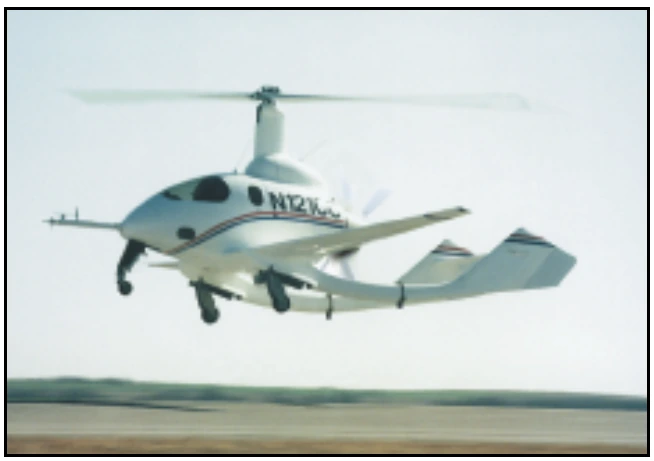
Wings may or may not comprise a component of the gyroplane. When used, they provide increased performance, increased storage capacity, and increased stability. Gyroplanes are under development with wings that are capable of almost completely unloading the rotor system and carrying the entire weight of the aircraft. This will allow rotary wing takeoff performance with fixed wing cruise speeds. [Figure 15-3]