
Chapter 20
Flight Operations
The diversity of gyroplane designs available today yields a wide variety of capability and performance.
For safe operation, you must be thoroughly familiar with the procedures and limitations for your particular aircraft along with other factors that may affect the safety of your flight.
Preflight
As pilot in command, you are the final authority in determining the airworthiness of your aircraft.
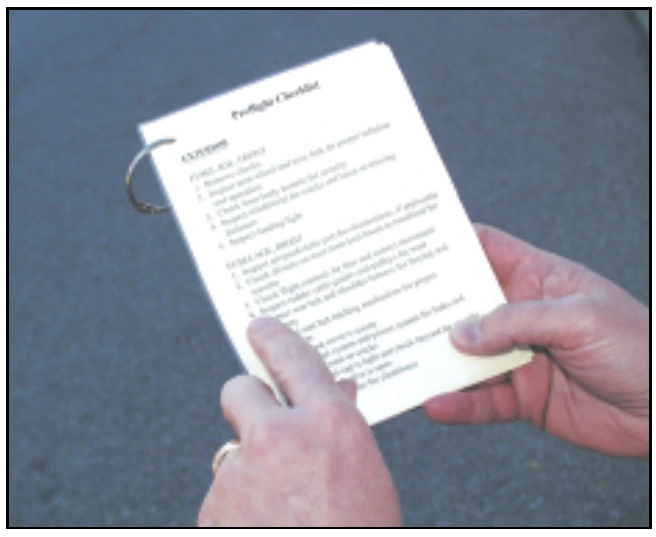
Adherence to a preflight checklist greatly enhances your ability to evaluate the fitness of your gyroplane by ensuring that a complete and methodical inspection of all components is performed. [Figure 20-1] For aircraft without a formal checklist, it is prudent to create one that is specific to the aircraft to be sure that important items are not overlooked. To determine the status of required inspections, a preflight review of the aircraft records is also necessary.
Cockpit Management
As in larger aircraft, cockpit management is an important skill necessary for the safe operation of a gyroplane. Intrinsic to these typically small aircraft is a limited amount of space that must be utilized to its potential. The placement and accessibility of charts, writing materials, and other necessary items must be carefully considered. Gyroplanes with open cockpits add the challenge of coping with wind, which further increases the need for creative and resourceful cockpit management for optimum efficiency.
Engine Starting
The dissimilarity between the various types of engines used for gyroplane propulsion necessitates the use of an engine start checklist. Again, when a checklist is not provided, it is advisable to create one for the safety of yourself and others, and to prevent inadvertent damage to the engine or propeller. Being inherently dangerous, the propeller demands special attention during engine starting procedures. Always ensure that the propeller area is clear prior to starting. In addition to providing an added degree of safety, being thoroughly familiar with engine starting procedures and characteristics can also be very helpful in starting an engine under various weather conditions.
Taxiing
The ability of the gyroplane to be taxied greatly enhances its utility. However, a gyroplane should not be taxied in close proximity to people or obstructions while the rotor is turning. In addition, taxi speed should be limited to no faster than a brisk walk in ideal conditions, and adjusted appropriately according to the circumstances.
Blade Flap
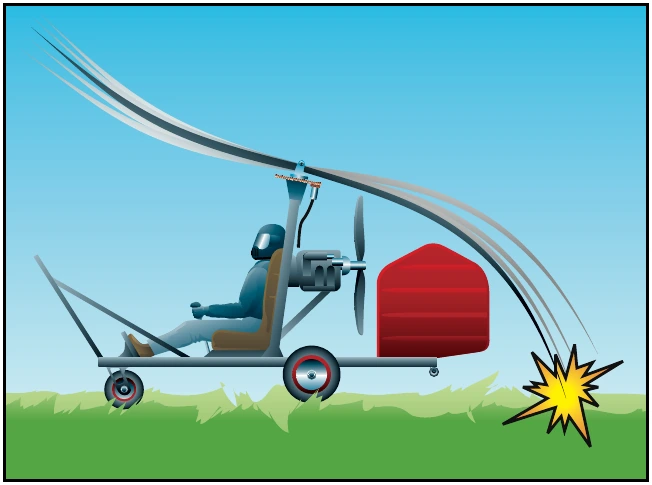
On a gyroplane with a semi-rigid, teeter-head rotor system, blade flap may develop if too much airflow passes through the rotor system while it is operating at low r.p.m. This is most often the result of taxiing too fast for a given rotor speed. Unequal lift acting on the advancing and retreating blades can cause the blades to teeter to the maximum allowed by the rotor head design. The blades then hit the teeter stops, creating a vibration that may be felt in the cyclic control. The frequency of the vibration corresponds to the speed of the rotor, with the blades hitting the stops twice during each revolution. If the flapping is not controlled, the situation can grow worse as the blades begin to flex and bend. Because the system is operating at low r.p.m., there is not enough centrifugal force acting on the blades to keep them rigid. The shock of hitting the teeter stops combined with uneven lift along the length of the blade causes an undulation to begin, which can increase in severity if allowed to progress. In extreme cases, a rotor blade may strike the ground or propeller. [Figure 20-2]
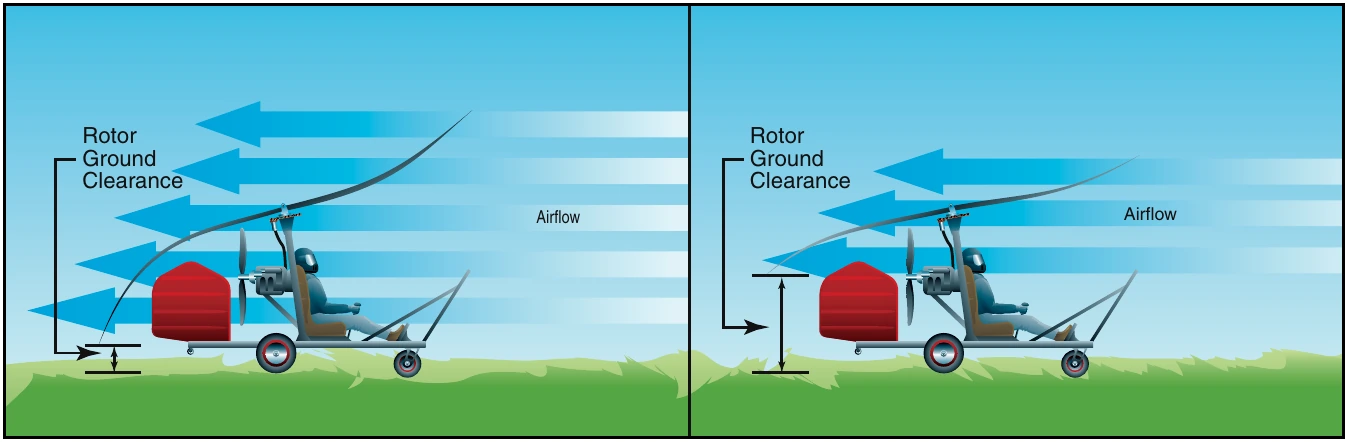
To avoid the onset of blade flap, always taxi the gyroplane at slow speeds when the rotor system is at low r.p.m. Consideration must also be given to wind speed and direction. If taxiing into a 10-knot headwind, for example, the airflow through the rotor will be 10 knots faster than the forward speed of the gyroplane, so the taxi speed should be adjusted accordingly. When prerotating the rotor by taxiing with the rotor disc tilted aft, allow the rotor to accelerate slowly and smoothly.
In the event blade flap is encountered, apply forward cyclic to reduce the rotor disc angle and slow the gyroplane by reducing throttle and applying the brakes, if needed. [Figure 20-3]
Before Takeoff
For the amateur-built gyroplane using single ignition and a fixed trim system, the before takeoff check is quite simple. The engine should be at normal operating temperature, and the area must be clear for prerotation.