
Chapter 20
Flight Operations
Jump Takeoff
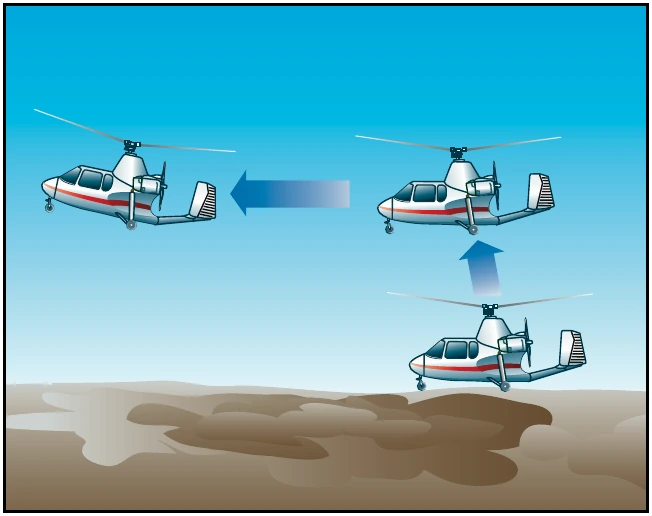
Gyroplanes with collective pitch change, and the ability to prerotate the rotor system to speeds approximately 50 percent higher than those required for normal flight, are capable of achieving extremely short takeoff rolls. Actual jump takeoffs can be performed under the proper conditions. A jump takeoff requires no ground roll, making it the most effective soft-field and crosswind takeoff procedure. [Figure 20-5] A jump takeoff is possible because the energy stored in the blades, as a result of the higher rotor r.p.m., is used to keep the gyroplane airborne as it accelerates through minimum level flight speed. Failure to have sufficient rotor r.p.m. for a jump takeoff results in the gyroplane settling back to the ground. Before attempting a jump takeoff, it is essential that you first determine if it is possible given the existing conditions by consulting the relevant performance chart. Should conditions of weight, altitude, temperature, or wind leave the successful outcome of the maneuver in doubt, it should not be attempted.
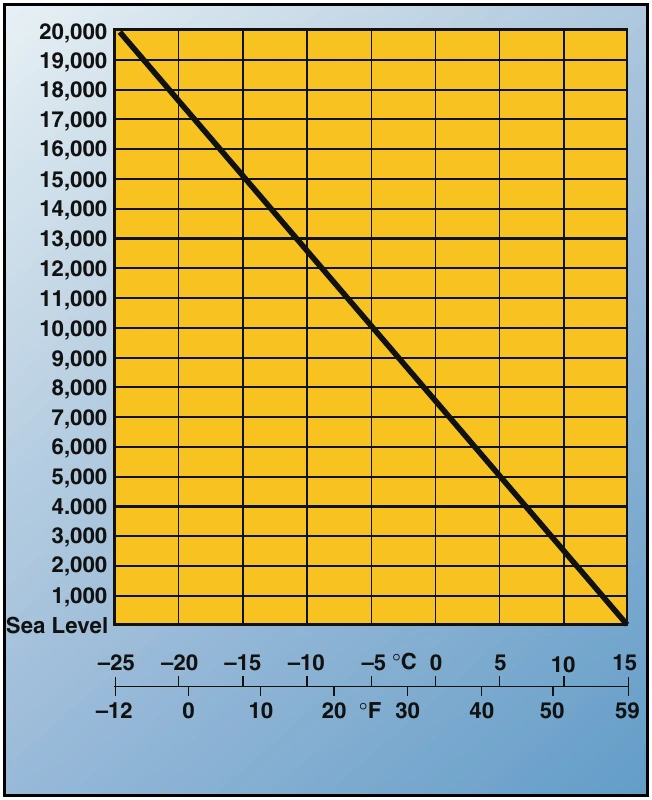
The prudent pilot may also use a “rule of thumb” for predicting performance before attempting a jump takeoff. As an example, suppose that a particular gyroplane is known to be able to make a jump takeoff and remain airborne to accelerate to V_X at a weight of 1,800 pounds and a density altitude of 2,000 feet. Since few takeoffs are made under these exact conditions, compensation must be made for variations in weight, wind, and density altitude. The “rule of thumb” being used for this particular aircraft stipulates that 1,000 feet of density altitude equates with 10 m.p.h. wind or 100 pounds of gross weight. To use this equation, you must first determine the density altitude. This is accomplished by setting your altimeter to the standard sea level pressure setting of 29.92 inches of mercury and reading the pressure altitude. Next, you must correct for nonstandard temperature. Standard temperature at sea level is 59°F (15°C) and decreases 3.5°F (2°C) for every additional one thousand feet of pressure altitude. [Figure 20-6] Once you have determined the standard temperature for your pressure altitude, compare it with the actual existing conditions. For every 10°F (5.5°C) the actual temperature is above standard, add 750 feet to the pressure altitude to estimate the density altitude. If the density altitude is above 2,000 feet, a jump takeoff in this aircraft should not be attempted unless wind and/or a weight reduction would compensate for the decrease in performance. Using the equation, if the density altitude is 3,000 feet (1,000 feet above a satisfactory jump density altitude), a reduction of 100 pounds in gross weight or a 10 m.p.h. of wind would still allow a satisfactory jump takeoff. Additionally, a reduction of 50 pounds in weight combined with a 5 m.p.h. wind would also allow a satisfactory jump. If it is determined that a jump takeoff should not be conducted because the weight cannot be reduced or an appropriate wind is not blowing, then consideration should be given to a rolling takeoff. A takeoff roll of 10 m.p.h. is equivalent to a wind speed of 10 m.p.h. or a reduction of 100 pounds in gross weight. It is important to note that a jump takeoff is predicated on having achieved a specific rotor r.p.m. If this r.p.m. has not been attained, performance is unpredictable, and the maneuver should not be attempted.
Density Altitude— Pressure altitude corrected for nonstandard temperature. This is a theoretical value that is used in determining aircraft performance.
Basic Flight Maneuvers
Conducting flight maneuvers in a gyroplane is different than in most other aircraft. Because of the wide variety in designs, many gyroplanes have only basic instruments available, and the pilot is often exposed to the airflow. In addition, the visual clues found on other aircraft, such as cowlings, wings, and windshields might not be part of your gyroplane’s design.
Therefore, much more reliance is placed on pilot interpretation of flight attitude and the “feel” of the gyroplane than in other types of aircraft. Acquiring the skills to precisely control a gyroplane can be a challenging and rewarding experience, but requires dedication and the direction of a competent instructor.
Straight-and-Level Flight
Straight-and-level flight is conducted by maintaining a constant altitude and a constant heading. In flight, a gyroplane essentially acts as a plumb suspended from the rotor. As such, torque forces from the engine cause the airframe to be deflected a few degrees out of the vertical plane. This very slight “out of vertical” condition should be ignored and the aircraft flown to maintain a constant heading.
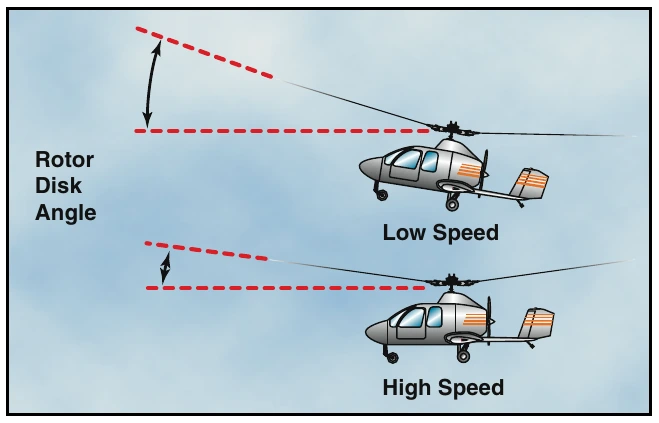
The throttle is used to control airspeed. In level flight, when the airspeed of a gyroplane increases, the rotor disc angle of attack must be decreased. This causes pitch control to become increasingly more sensitive.
[Figure 20-7] As this disc angle becomes very small, it is possible to overcontrol a gyroplane when encountering turbulence. For this reason, when extreme turbulence is encountered or expected, airspeed should be decreased. Even in normal conditions, a gyroplane requires constant attention to maintain straight-and-level flight. Although more stable than helicopters, gyroplanes are less stable than airplanes. When cyclic trim is available, it should be used to relieve any stick forces required during stabilized flight.
Climbs
A climb is achieved by adding power in excess of what is required for straight-and-level flight at a particular airspeed. The amount of excess power used is directly proportional to the climb rate. For maneuvers when maximum performance is desired, two important climb speeds are best angle-of-climb speed and best rate-of-climb speed.
Because a gyroplane cannot be stalled, it may be tempting to increase the climb rate by decreasing airspeed.
This practice, however, is self-defeating. Operating below the best angle-of-climb speed causes a diminishing rate of climb. In fact, if a gyroplane is slowed to the minimum level flight speed, it requires full power just to maintain altitude. Operating in this performance realm, sometimes referred to as the “backside of the power curve,” is desirable in some maneuvers, but can be hazardous when maximum climb performance is required. For further explanation of a gyroplane power curve, see Flight at Slow Airspeeds, which is discussed later in this chapter.
Descents
A descent is the result of using less power than that required for straight-and-level flight at a particular airspeed. Varying engine power during a descent allows you to choose a variety of descent profiles. In a power-off descent, the minimum descent rate is achieved by using the airspeed that would normally be used for level flight at minimum power, which is also very close to the speed used for the best angle of climb. When distance is a factor during a power-off descent, maximum gliding distance can be achieved by maintaining a speed very close to the best rate-of-climb airspeed. Because a gyroplane can be safely flown down to zero airspeed, a common error in this type of descent is attempting to extend the glide by raising the pitch attitude. The result is a higher rate of descent and less distance being covered. For this reason, proper glide speed should be adhered to closely. Should a strong headwind exist, while attempting to achieve the maximum distance during a glide, a rule of thumb to achieve the greatest distance is to increase the glide speed by approximately 25 percent of the headwind. The attitude of the gyroplane for best glide performance is learned with experience, and slight pitch adjustments are made for the proper airspeed. If a descent is needed to lose excess altitude, slowing the gyroplane to below the best glide speed increases the rate of descent. Typically, slowing to zero airspeed results in a descent rate twice that of maintaining the best glide speed.