Chapter 21
Gyroplane Emergencies
Buntover (Power Pushover)
As you learned in Chapter 16—Gyroplane Aerodynamics, the stability of a gyroplane is greatly influenced by rotor force. If rotor force is rapidly removed, some gyroplanes have a tendency to pitch forward abruptly. This is often referred to as a forward tumble, buntover, or power pushover. Removing the rotor force is often referred to as unloading the rotor, and can occur if pilot-induced oscillations become excessive, if extremely turbulent conditions are encountered, or the nose of the gyroplane is pushed forward rapidly after a steep climb.
A power pushover can occur on some gyroplanes that have the propeller thrust line above the center of gravity and do not have an adequate horizontal stabilizer. In this case, when the rotor is unloaded, the propeller thrust magnifies the pitching moment around the center of gravity. Unless a correction is made, this nose pitching action could become self-sustaining and irreversible. An adequate horizontal stabilizer slows the pitching rate and allows time for recovery.
Since there is some disagreement between manufacturers as to the proper recovery procedure for this situation, you must check with the manufacturer of your gyroplane. In most cases, you need to remove power and load the rotor blades. Some manufacturers, especially those with gyroplanes where the propeller thrust line is above the center of gravity, recommend that you need to immediately remove power in order to prevent a power pushover situation. Other manufacturers recommend that you first try to load the rotor blades. For the proper positioning of the cyclic when loading up the rotor blades, check with the manufacturer.
When compared to other aircraft, the gyroplane is just as safe and very reliable. The most important factor, as in all aircraft, is pilot proficiency. Proper training and flight experience helps prevent the risks associated with pilot-induced oscillation or buntover.
Ground Resonance
Ground resonance is a potentially damaging aerodynamic phenomenon associated with articulated rotor systems. It develops when the rotor blades move out of phase with each other and cause the rotor disc to become unbalanced. If not corrected, ground resonance can cause serious damage in a matter of seconds.
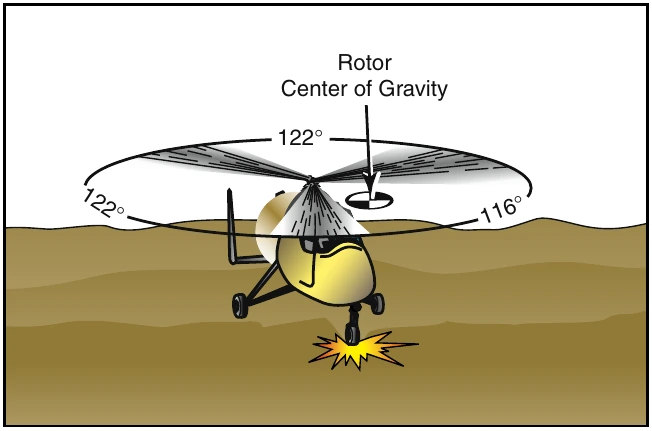
Ground resonance can only occur while the gyroplane is on the ground. If a shock is transmitted to the rotor system, such as with a hard landing on one gear or when operating on rough terrain, one or more of the blades could lag or lead and allow the rotor system’s center of gravity to be displaced from the center of rotation. Subsequent shocks to the other gear aggravate the imbalance causing the rotor center of gravity to rotate around the hub. This phenomenon is not unlike an out-of-balance washing machine. [Figure 21-2]
To reduce the chance of experiencing ground resonance, every preflight should include a check for proper strut inflation, tire pressure, and lag-lead damper operation. Improper strut or tire inflation can change the vibration frequency of the airframe, while improper damper settings change the vibration frequency of the rotor.
If you experience ground resonance, and the rotor r.p.m. is not yet sufficient for flight, apply the rotor brake to maximum and stop the rotor as soon as possible. If ground resonance occurs during takeoff, when rotor r.p.m. is sufficient for flight, lift off immediately.
Ground resonance cannot occur in flight, and the rotor blades will automatically realign themselves once the gyroplane is airborne. When prerotating the rotor system prior to takeoff, a slight vibration may be felt that is a very mild form of ground resonance. Should this oscillation amplify, discontinue the prerotation and apply maximum rotor brake.
Emergency Approach and Landing
The modern engines used for powering gyroplanes are generally very reliable, and an actual mechanical malfunction forcing a landing is not a common occurrence.
Failures are possible, which necessitates planning for and practicing emergency approaches and landings.
The best way to ensure that important items are not overlooked during an emergency procedure is to use a checklist, if one is available and time permits. Most gyroplanes do not have complex electrical, hydraulic, or pneumatic systems that require lengthy checklists.
In these aircraft, the checklist can be easily committed to memory so that immediate action can be taken if needed. In addition, you should always maintain an awareness of your surroundings and be constantly on the alert for suitable emergency landing sites.
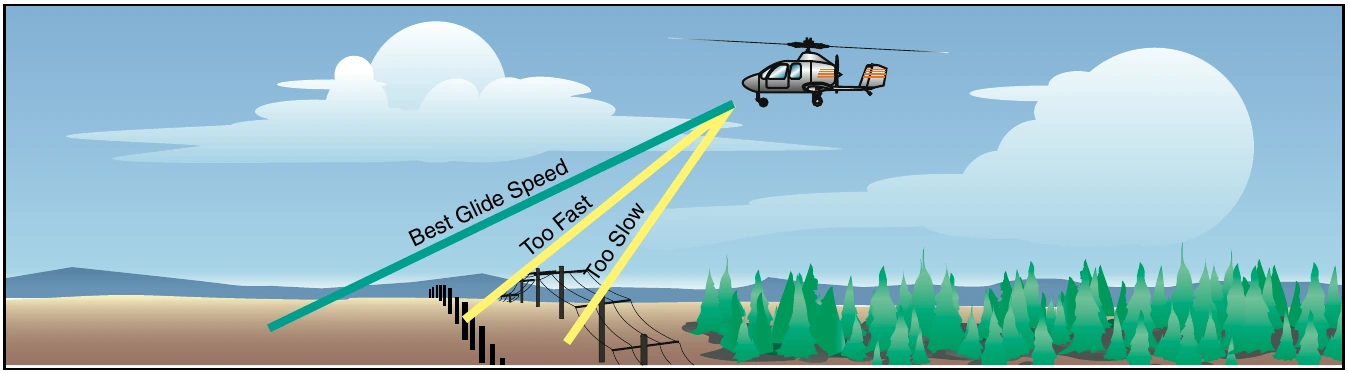
When an engine failure occurs at altitude, the first course of action is to adjust the gyroplane’s pitch attitude to achieve the best glide speed. This yields the most distance available for a given altitude, which in turn, allows for more possible landing sites. A common mistake when learning emergency procedures is attempting to stretch the glide by raising the nose, which instead results in a steep approach path at a slow airspeed and a high rate of descent. [Figure 21-3] Once you have attained best glide speed, scan the area within gliding distance for a suitable landing site. Remember to look behind the aircraft, as well as in front, making gentle turns, if necessary, to see around the airframe.
When selecting a landing site, you must consider the wind direction and speed, the size of the landing site, obstructions to the approach, and the condition of the surface. A site that allows a landing into the wind and has a firm, smooth surface with no obstructions is the most desirable. When considering landing on a road, be alert for powerlines, signs, and automobile traffic. In many cases, an ideal site will not be available, and it will be necessary for you to evaluate your options and choose the best alternative. For example, if a steady wind will allow a touchdown with no ground roll, it may be acceptable to land in a softer field or in a smaller area than would normally be considered. On landing, use short or soft field technique, as appropriate, for the site selected. A slightly higher-than-normal approach airspeed may be required to maintain adequate airflow over the rudder for proper yaw control.