
Chapter 4
Helicopter Flight Controls
There are four basic controls used during flight. They are the collective pitch control, the throttle, the cyclic pitch control, and the antitorque pedals.
Collective Pitch Control
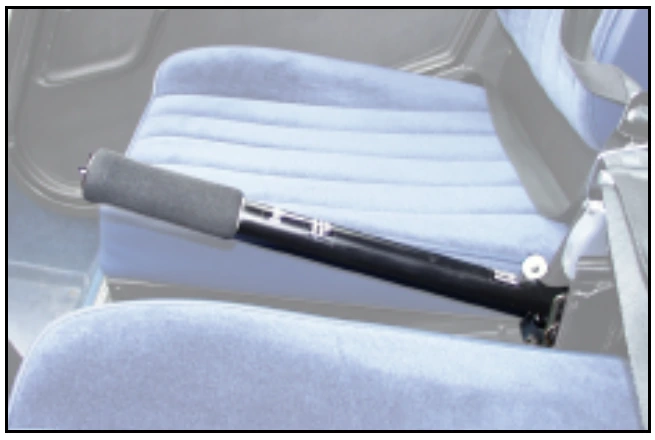
The collective pitch control, located on the left side of the pilot’s seat, changes the pitch angle of all main rotor blades simultaneously, or collectively, as the name implies. As the collective pitch control is raised, there is a simultaneous and equal increase in pitch angle of all main rotor blades; as it is lowered, there is a simultaneous and equal decrease in pitch angle. This is done through a series of mechanical linkages and the amount of movement in the collective lever determines the amount of blade pitch change. [Figure 4-1] An adjustable friction control helps prevent inadvertent collective pitch movement.
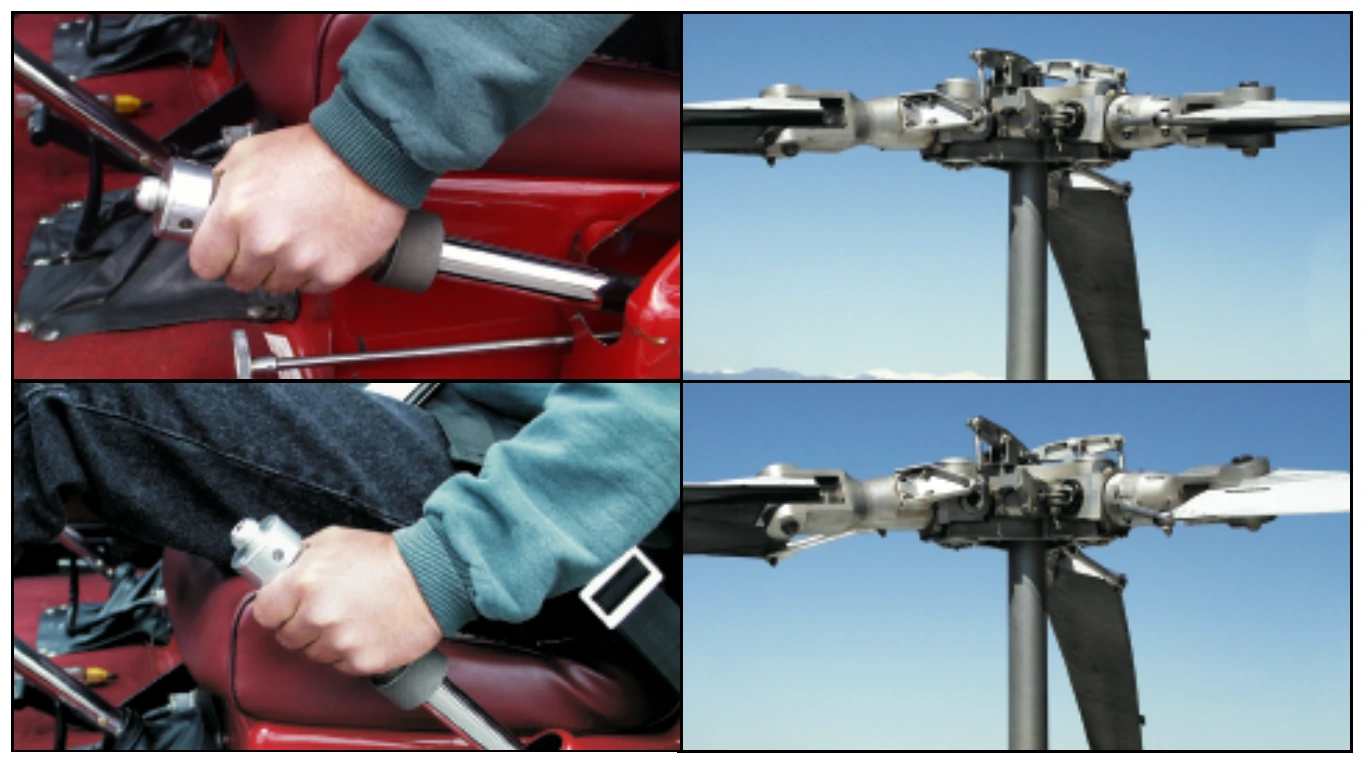
Changing the pitch angle on the blades changes the angle of attack on each blade. With a change in angle of attack comes a change in drag, which affects the speed or r.p.m. of the main rotor. As the pitch angle increases, angle of attack increases, drag increases, and rotor r.p.m. decreases. Decreasing pitch angle decreases both angle of attack and drag, while rotor r.p.m. increases. In order to maintain a constant rotor r.p.m., which is essential in helicopter operations, a proportionate change in power is required to compensate for the change in drag. This is accomplished with the throttle control or a correlator and/or governor, which automatically adjusts engine power.
Throttle Control
The function of the throttle is to regulate engine r.p.m.
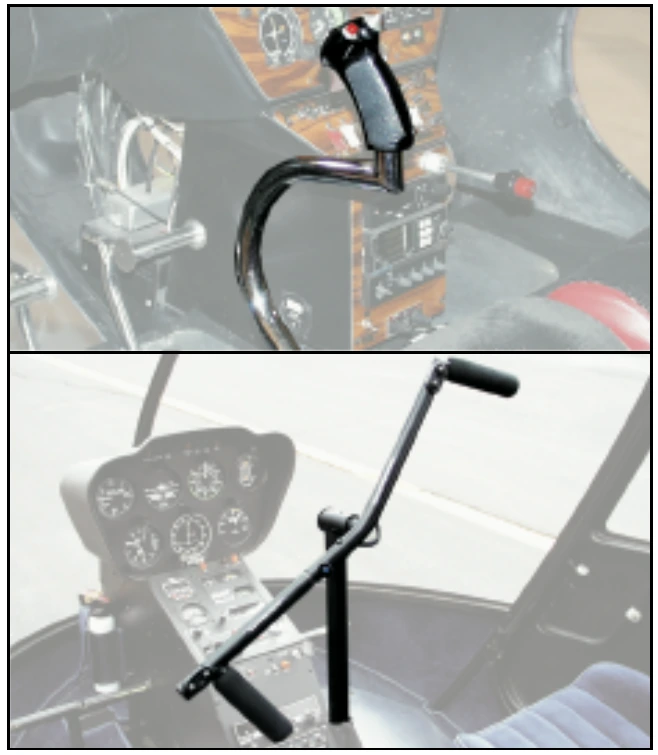
If the correlator or governor system does not maintain the desired r.p.m. when the collective is raised or lowered, or if those systems are not installed, the throttle has to be moved manually with the twist grip in order to maintain r.p.m. Twisting the throttle outboard increases r.p.m.; twisting it inboard decreases r.p.m. [Figure 4-2]
Collective Pitch / Throttle Coordination
When the collective pitch is raised, the load on the engine is increased in order to maintain desired r.p.m.
The load is measured by a manifold pressure gauge in piston helicopters or by a torque gauge in turbine helicopters.
In piston helicopters, the collective pitch is the primary control for manifold pressure, and the throttle is the primary control for r.p.m. However, the collective pitch control also influences r.p.m., and the throttle also influences manifold pressure; therefore, each is considered to be a secondary control of the other’s function.
Both the tachometer (r.p.m. indicator) and the manifold pressure gauge must be analyzed to determine which control to use. Figure 4-3 illustrates this relationship.

Correlator / Governor
A correlator is a mechanical connection between the collective lever and the engine throttle. When the collective lever is raised, power is automatically increased and when lowered, power is decreased. This system maintains r.p.m. close to the desired value, but still requires adjustment of the throttle for fine tuning.
A governor is a sensing device that senses rotor and engine r.p.m. and makes the necessary adjustments in order to keep rotor r.p.m. constant. In normal operations, once the rotor r.p.m. is set, the governor keeps the r.p.m. constant, and there is no need to make any throttle adjustments. Governors are common on all turbine helicopters and used on some piston powered helicopters.