
Chapter 3
Water Characteristics and Seaplane Base Operations
Water Effects on Operations
Compared to operations from typical hard-surface runways, taking off from and landing on water presents several added variables for the pilot to consider. Waves and swell not only create a rough or uneven surface, they also move, and their movement must be considered in addition to the wind direction. Likewise, currents create a situation in which the surface itself is actually moving. The pilot may decide to take off or land with or against the current, depending on the wind, the speed of the current, and the proximity of riverbanks or other obstructions.
While a landplane pilot can rely on windsocks and indicators adjacent to the runway, a seaplane pilot needs to be able to read wind direction and speed from the water itself. On the other hand, the landplane pilot may be restricted to operating in a certain direction because of the orientation of the runway, while the seaplane pilot can usually choose a takeoff or landing direction directly into the wind.
Even relatively small waves and swell can complicate seaplane operations. Takeoffs on rough water can subject the floats to hard pounding as they strike consecutive wave crests. Operating on the surface in rough conditions exposes the seaplane to forces that can potentially cause damage or, in some cases, overturn the seaplane. When a swell is not aligned with the wind, the pilot must weigh the dangers posed by the swell against limited crosswind capability, as well as pilot experience.
On the other hand, calm, glassy water presents a different set of challenges. Since the wind is calm, taxiing and docking are somewhat easier, but takeoffs and landings require special techniques. Takeoff distances may be longer because the wings get no extra lifting help from the wind. The floats seem to adhere more tenaciously to the glassy water surface. When landing, the flat, featureless surface makes it far more difficult to gauge altitude accurately, and reflections can create confusing optical illusions. The specific techniques for glassy water operations are covered in Chapter 4, Seaplane Operations–Preflight and Takeoffs, and Chapter 6, Seaplane Operations–Landing.
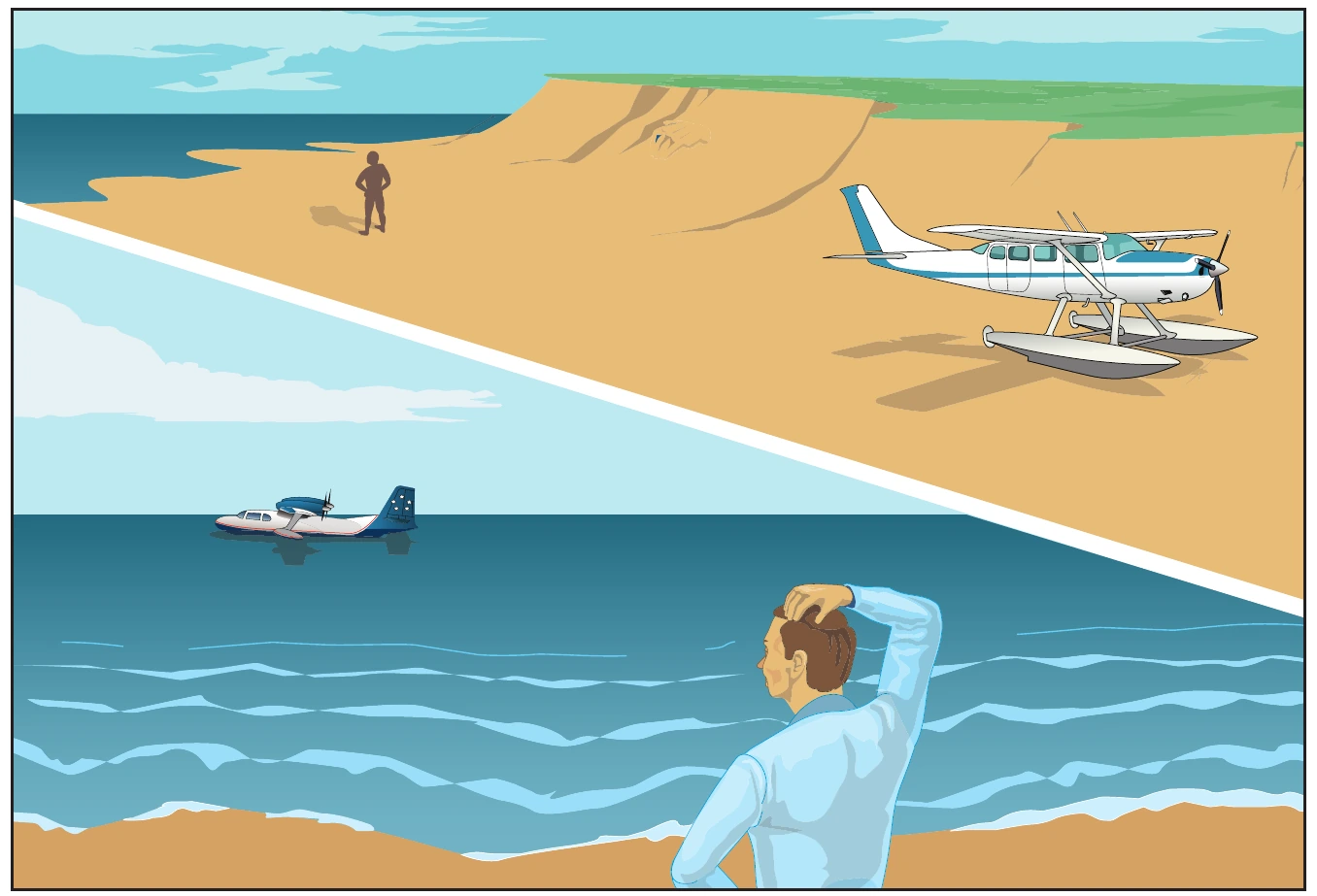
Tides are cause for concern when the airplane is beached or moored in shallow water. A rising tide can lift a beached seaplane and allow it to float out to sea if the airplane is not properly secured. Depending on the height of the tide and the topography of the beach, an outgoing tide could leave a beached seaplane stranded far from the water. [Figure 3-2] Many of the operational differences between landplanes and seaplanes relate to the fact that seaplanes have no brakes. From the time a seaplane casts off, it is usually in continuous motion due to the wind and current, so the pilot must take deliberate action to control this movement. Often these forces can be used to the pilot’s advantage to help move the seaplane as desired. Starting the engine, performing the engine runup, and completing most pre-takeoff checks are all accomplished while the seaplane is in motion. The seaplane continues moving after the engine is shut down, and this energy, along with the forces of wind and current, is typically used to coast the seaplane to the desired docking point.
As with land airplanes, the wind tends to make the airplane weathervane, or yaw, until the nose points into the wind. This tendency is usually negligible on landplanes with tricycle landing gear, more pronounced on those with conventional (tailwheel) gear, and very evident in seaplanes. The tendency to weathervane can usually be controlled by using the water rudders while taxiing, but the water rudders are typically retracted prior to takeoff. Weathervaning can create challenges in crosswind takeoffs and landings, as well as in docking or maneuvering in close quarters.
Seaplane Base Operations
In the United States, rules governing where seaplanes may take off and land are generally left to state and local governments.
Some states and cities are very liberal in the laws regarding the operation of seaplanes on their lakes and waterways, while other states and cities may impose stringent restrictions. The Seaplane Pilots Association publishes the useful Water Landing Directory with information on seaplane facilities, landing areas, waterway use regulations, and local restrictions throughout the United States. Before operating a seaplane on public waters, contact the Parks and Wildlife Department of the state, the State Aeronautics Department, or other authorities to determine the local requirements. In any case, seaplane pilots should always avoid creating a nuisance in any area, particularly in congested marine areas or near swimming or boating facilities.
Established seaplane bases are shown on aeronautical charts and are listed in the Airport/Facility Directory. The facilities at seaplane bases vary greatly, but most include a hard surface ramp for launching, servicing facilities, and an area for mooring or hangaring seaplanes. Many marinas designed for boats also provide seaplane facilities.
Seaplanes often operate in areas with extensive recreational or commercial water traffic. The movements of faster craft, such as speedboats and jet-skis are unpredictable. People towing skiers may be focusing their attention behind the boat and fail to notice a landing seaplane. Swimmers may be nearly invisible, often with just their heads showing among the waves. There is no equivalent of the airport traffic pattern to govern boat traffic, and although right-of-way rules exist on the water, many watercraft operators are unaware of the limits of seaplane maneuverability and may assume that seaplanes will always be able to maneuver to avoid them. Many times, the seaplane itself is an object of curiosity, drawing water traffic in the form of interested onlookers.
When seaplane operations are conducted in bush country, regular or emergency facilities are often limited or nonexistent. The terrain and waterways are frequently hazardous, and any servicing becomes the individual pilot’s responsibility. Prior to operating in an unfamiliar area away from established seaplane facilities, obtain the advice of FAA Accident Prevention Counselors or experienced seaplane pilots who are familiar with the area.