
Chapter 4
Seaplane Operations - Preflight and Takeoffs
The weathervaning tendency is more evident in seaplanes, and the taxiing seaplane pilot must be constantly aware of the wind’s effect on the ability to maneuver. In stronger winds, weathervaning forces may make it difficult to turn downwind. Often a short burst of power provides sufficient air over the rudder to overcome weathervaning. Since the elevator is held all the way up, the airflow also forces the tail down, making the water rudders more effective. Short bursts of power are preferable to a longer, continuous power application. With continuous power, the seaplane accelerates, increasing the turn radius. The churning of the water in the wake of the floats also makes the water rudders less effective. At the same time, low cooling airflow may cause the engine to heat up.
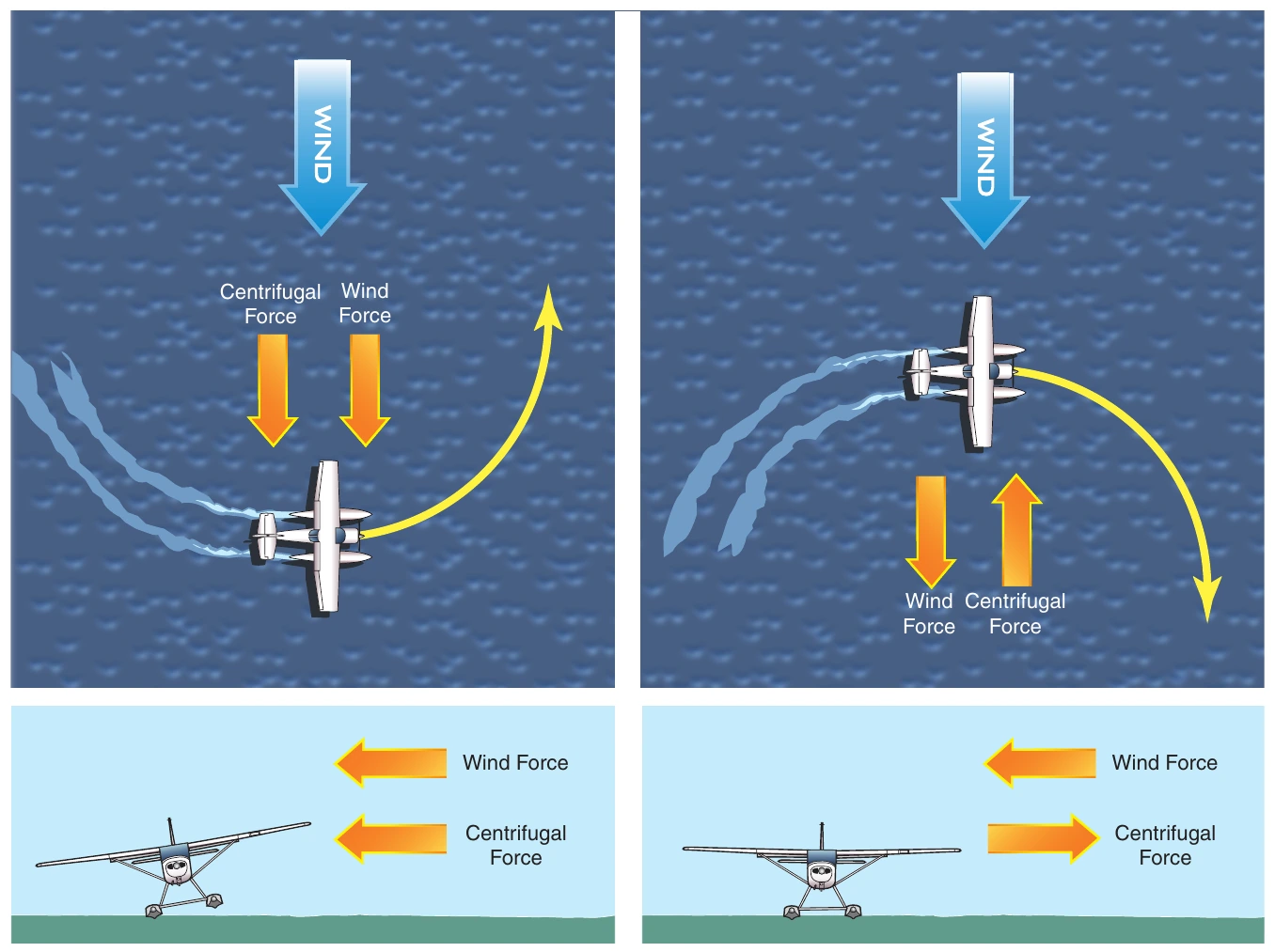
During a high speed taxiing turn, centrifugal force tends to tip the seaplane toward the outside of the turn. When turning from an upwind heading to a downwind heading, the wind force acts in opposition to centrifugal force, helping stabilize the seaplane. On the other hand, when turning from downwind to upwind, the wind force against the fuselage and the underside of the wing increases the tendency for the seaplane to lean to the outside of the turn, forcing the downwind float deeper into the water. In a tight turn or in strong winds, the combination of these two forces may be sufficient to tip the seaplane to the extent that the downwind float submerges or the outside wing drags in the water, and may even flip the seaplane onto its back. The further the seaplane tips, the greater the effect of the crosswind, as the wing presents more vertical area to the wind force. [Figure 4-8]
When making a turn into the wind from a crosswind condition, often all that is necessary to complete the turn is to neutralize the air rudder and allow the seaplane to weathervane into the wind. If taxiing directly downwind, use the air rudder momentarily to get the turn started, then let the wind complete the turn. Sometimes opposite rudder may be needed to control the rate of turn.
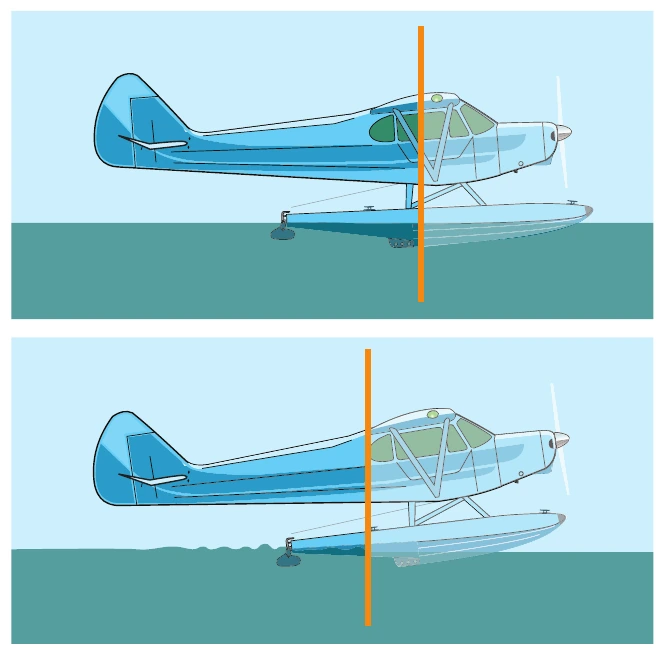
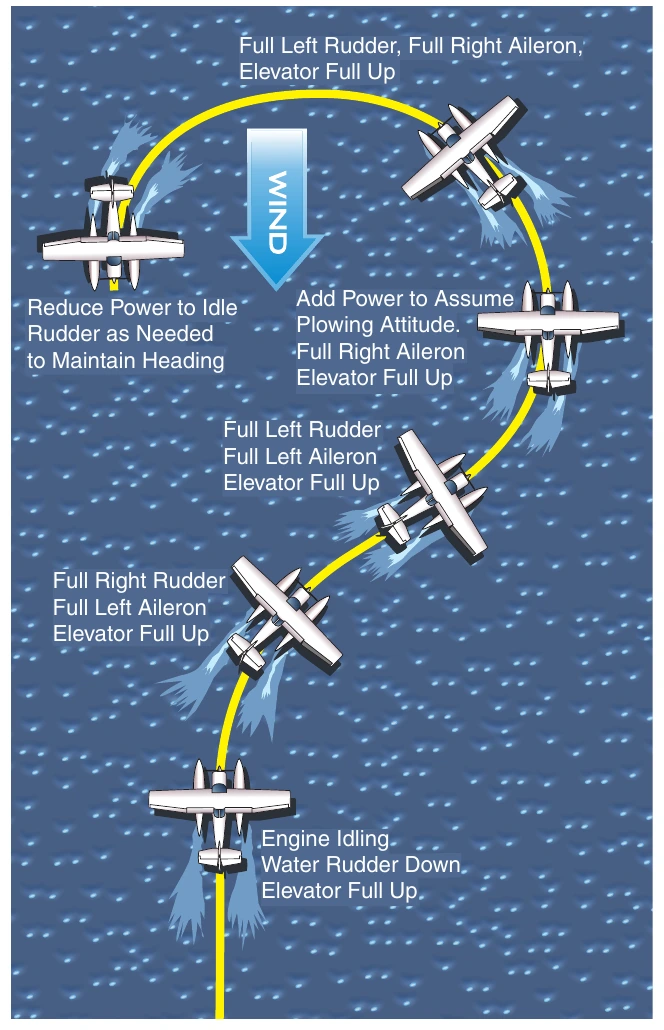
Stronger winds may make turns from upwind to downwind more difficult. The plow turn is one technique for turning downwind when other methods are inadequate, but this maneuver is only effective in certain seaplanes. It takes advantage of the same factor that reduces a floatplane’s yaw stability in flight: the large vertical area of the floats forward of the center of gravity. In the plowing attitude, the front portion of each float comes out of the water, presenting a large vertical surface for the wind to act upon. This tends to neutralize the weathervaning force, allowing the turn to proceed. At the same time, the center of buoyancy shifts back. Since this is the axis around which the seaplane pivots while on the water, more of the fuselage is now forward of the axis and less is behind, further decreasing the weathervaning tendency. In some seaplanes, this change is so pronounced in the plowing attitude that they experience reverse weathervaning, and tend to turn downwind rather than into the wind. Experienced seaplane pilots can sometimes use the throttle as a turning device in high wind conditions by increasing power to cause a nose-up position when turning downwind, and decreasing power to allow the seaplane to weathervane into the wind. [Figure 4-9]
To execute a plow turn, begin with a turn to the right, then use the weathervaning force combined with full left rudder to turn back to the left. As the seaplane passes its original upwind heading, add enough power to place it into the plow position, continuing the turn with the rudder. As the seaplane comes to the downwind heading, reduce power and return to an idle taxi. From above, the path of the turn looks like a question mark. [Figure 4-10]
Plow turns are useful only in very limited situations because they expose the pilot to a number of potential dangers. They should not be attempted in rough water or gusty conditions. Floatplanes are least stable when in the plowing attitude, and are very susceptible to capsizing. In spite of the nose-high attitude, the high power setting often results in spray damage to the propeller. In most windy situations, it is much safer to sail the seaplane backward (as explained in the next section) rather than attempt a plow turn.
When the seaplane is on the step, turns involve careful balancing of several competing forces. As the rate of turn increases, the floats are being forced to move somewhat sideways through the water, and they resist this sideways motion with drag, much like an airplane fuselage in a skidding turn. More power is required to overcome this drag and maintain planing speed. This skidding force also tends to roll the seaplane toward the outside of the turn, driving the outside float deeper into the water and adding more drag on that side. To prevent this, use aileron into the turn to keep the outside wing from dropping. Once full aileron into the step turn is applied, any further roll to the outside can only be stopped by reducing the rate of turn, so pay careful attention to the angle of the wings and the feel of the water drag on the floats to catch any indication that the outside float is starting to submerge. When stopping a step turn, always return to a straight path before reducing power.
At step taxi speeds, the centrifugal force in a turn is far greater than at idle taxi speed, so the forces involved in turning from downwind to upwind are proportionately more dangerous, especially in strong winds. Chances are, by the time a pilot discovers that the outside float is going under, the accident is almost inevitable. However, immediate full rudder out of the turn and power reduction may save the situation by reversing the centrifugal force and allowing the buried float to come up.
Sailing
Landplane pilots are accustomed to taxiing by pointing the nose of the airplane in the desired direction and rolling forward. In seaplane operations, there are often occasions when it is easier and safer to move the seaplane backward or to one side because wind, water conditions, or limited space make it impractical to attempt a turn. If there is a significant wind, a seaplane can be guided into a space that might seem extremely cramped to an inexperienced pilot. Sailing is a method of guiding the seaplane on the water using the wind as the main motive force. It is a useful technique for maneuvering in situations where conventional taxiing is undesirable or impossible. Since the seaplane automatically aligns itself so the nose points into the wind, sailing in a seaplane usually means moving backward.
In light wind conditions with the engine idling or off, a seaplane naturally weathervanes into the wind. If the pilot uses the air rudder to swing the tail a few degrees, the seaplane sails backward in the direction the tail is pointed. This is due to the keel effect of the floats, which tends to push the seaplane in the direction the sterns of the floats are pointing. In this situation, lift the water rudders, since their action is counter to what is desired. When sailing like this, the sterns of the floats have become the front, as far as the water is concerned, but the rear portions of the floats are smaller and therefore not as buoyant. If the wind is strong and speed starts to build up, the sterns of the floats could start to submerge and dig into the water. Combined with the lifting force of the wind over the wings, the seaplane could conceivably flip over backward, so use full forward elevator to keep the sterns of the floats up and the seaplane’s nose down. Adding power can also help keep the floats from submerging.
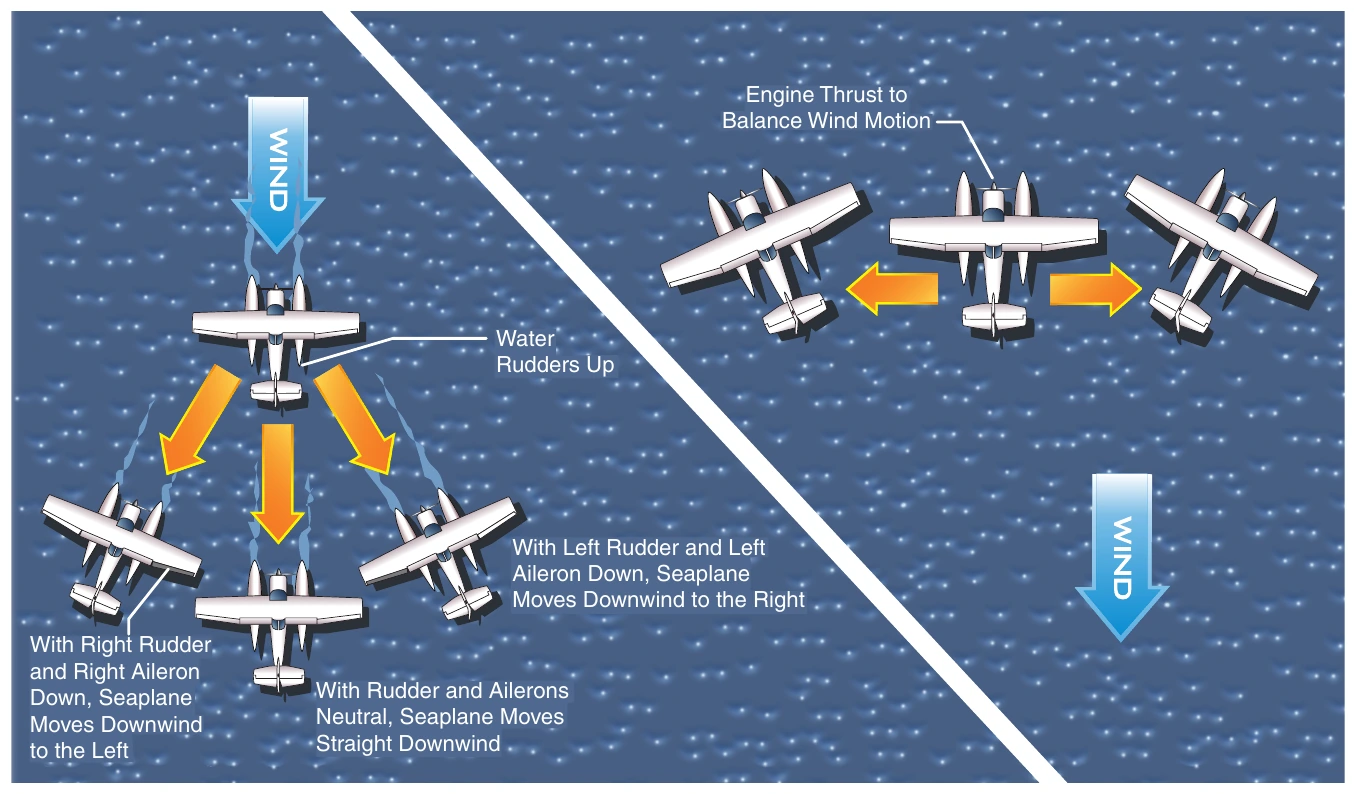
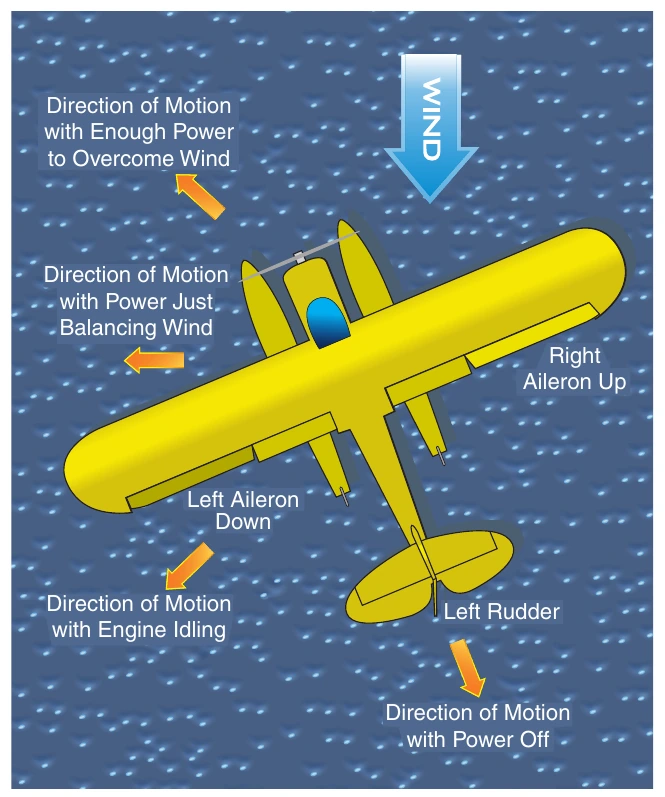
If enough engine power is used to exactly cancel the backward motion caused by the wind, the seaplane is not moving relative to the water, so keel effect disappears. However, turning the fuselage a few degrees left or right provides a surface for the wind to push against, so the wind will drive the seaplane sideways in the direction the nose is pointed. Combining these techniques, a skilled pilot can sail a seaplane around obstacles and into confined docking spaces. [Figure 4-11]
Figure 4-12 shows how to position the controls for the desired direction of motion in light or strong winds. With the engine off, lowering the wing flaps and opening the cabin doors increases the air resistance and thus adds to the effect of the wind. This increases sailing speed but may reduce the effect of the air rudder. If sailing with the engine off results in too much motion downwind, but an idling engine produces too much thrust, adding carburetor heat or turning off one magneto can reduce the engine power slightly. Avoid using carburetor heat or running on one magneto for extended periods. Instead, start the engine briefly to slow down.
Where currents are a factor, such as in strong tidal flows or a fast flowing river, sailing techniques must incorporate the movement of the water along with the wind. The current may be a help or a hindrance, or change from a help to a hindrance when the pilot attempts to change direction. The keel effect only works when the floats are moving through the water. If the current is moving the seaplane, there may be little or no motion relative to the water, even though the seaplane is moving relative to the shore. Using wind, current, and thrust to track the desired course requires careful planning and a thorough understanding of the various forces at work.
With the engine shut down, most flying boats sail backward and toward whichever side the nose is pointed, regardless of wind velocity, because the hull does not provide as much keel effect as floats in proportion to the side area of the seaplane above the waterline. To sail directly backward in a flying boat, release the controls and let the wind steer. Sailing is an essential part of seaplane operation. Since each type of seaplane has its own peculiarities, practice sailing until thoroughly familiar with that particular type. Practice in large bodies of water such as lakes or bays, but sufficiently close to a prominent object in order to evaluate performance.