
Chapter 4
Seaplane Operations - Preflight and Takeoffs
During a takeoff in stiff crosswinds, weathervaning forces can cause an uncontrolled turn to begin. As the turn develops, the addition of centrifugal force acting outward from the turn aggravates the problem. The keels of the floats resist the sideways force, and the upwind wing tends to lift. If strong enough, the combination of the wind and centrifugal force may tip the seaplane to the point where the downwind float submerges and subsequently the wingtip may strike the water. This is known as a waterloop, and the dynamics are similar to a groundloop on land. Although some damage occurs when the wingtip hits the ground during a groundloop, the consequences of plunging a wingtip underwater in a seaplane can be disastrous. In a fully developed waterloop, the seaplane may be severely damaged or may capsize. Despite these dire possibilities, crosswind takeoffs can be accomplished safely by exercising good judgment and proper piloting technique.
Since there are no clear reference lines for directional guidance, such as those on airport runways, it can be difficult to quickly detect side drift on water. Waves may make it appear that the water is moving sideways, but remember that although the wind moves the waves, the water remains nearly stationary. The waves are simply an up-and-down motion of the water surface— the water itself is not moving sideways. To maintain a straight path through the water, pick a spot on the shore as an aim point for the takeoff run. On the other hand, some crosswind techniques involve describing a curved path through the water. Experience will help determine which technique is most appropriate for a given situation.
Controlled Weathervaning
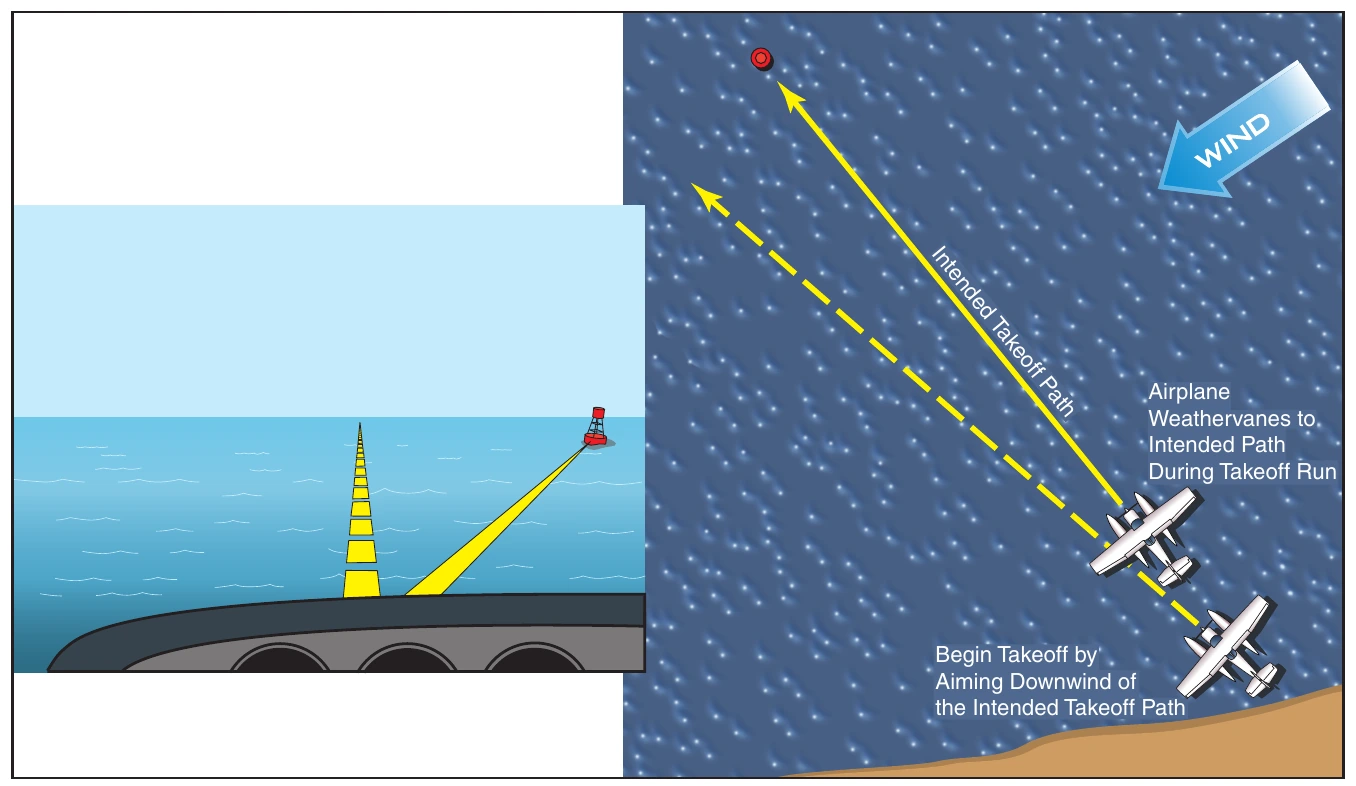
In light winds, it is easy to counteract the weathervaning tendency during the early part of the takeoff run by creating an allowance for it from the beginning. Prior to adding takeoff power, use the water rudders to set up a heading somewhat downwind of the aim point. The angle will depend on the speed of the wind—the higher the wind, the greater the lead angle. Create just enough of a lead angle so that when the water rudders are raised and power is applied, the seaplane weathervanes to the desired heading during the time it gains enough speed to make the air rudder and ailerons effective. As the seaplane transitions to the plowing attitude, the weathervaning tendency decreases as the fronts of the floats come out of the water, adding vertical surface area at the front of the seaplane. Use full aileron into the wind as the takeoff run begins, and maintain enough aileron to keep the upwind wing from lifting as airspeed builds. [Figure 4-15 on previous page]
Using Water Rudders
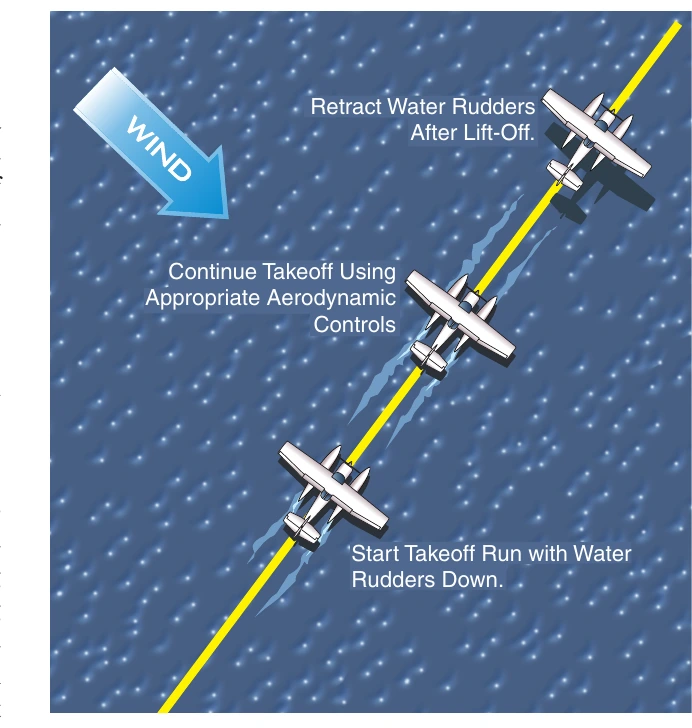
Another technique for maintaining a straight takeoff path involves leaving the water rudders down to assist with steering. Using the water rudders provides added directional control until the aerodynamic controls become effective.
To use this technique, align the seaplane with the aim point on the shore, hold full aileron into the wind, and apply takeoff power. As the seaplane accelerates, use enough aileron pressure to keep the upwind wing down. The downwind float should lift free of the water first. After lift-off, make a coordinated turn to establish the proper crab angle for the climb, and retract the water rudders.
This takeoff technique subjects the water rudders to high dynamic water pressures and could cause damage. Be sure to comply with the advice of the float manufacturer. [Figure 4-16]
Downwind Arc
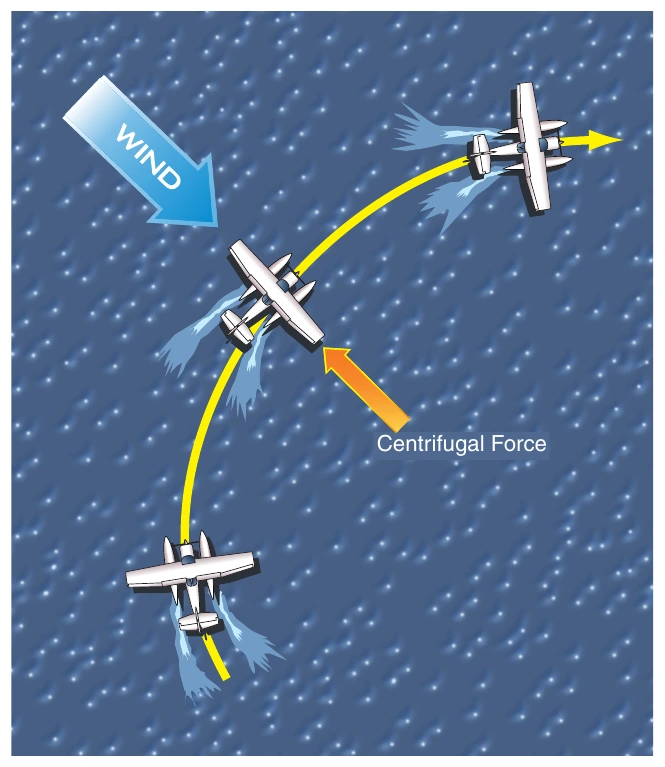
The other crosswind takeoff technique results in a curved path across the water, starting somewhat into the wind and turning gradually downwind during the takeoff run. This reduces the actual crosswind component at the beginning of the takeoff, when the seaplane is most susceptible to weathervaning. As the aerodynamic controls become more effective, the pilot balances the side loads imposed by the wind with the skidding force of an intentional turn, as always, holding the upwind wing down with the ailerons. [Figure 4-17]
The pilot plans a curved path and follows this arc to produce sufficient centrifugal force so that the seaplane tends to lean outward against the wind force. During the run, the pilot can adjust the rate of turn by varying rudder pressure, thereby increasing or decreasing the centrifugal force to compensate for a changing wind force. In practice, it is quite simple to plan sufficient curvature of the takeoff path to cancel out strong crosswinds, even on very narrow rivers. Note that the tightest part of the downwind arc is when the seaplane is traveling at slower speeds.
The last portion of a crosswind takeoff is somewhat similar to a landplane. Use ailerons to lift the downwind wing, providing a sideways component of lift to counter the effect of the crosswind. This means that the downwind float lifts off first. Be careful not to drop the upwind wing so far that it touches the water. When using a straight takeoff path, keep the nose on the aim point with opposite rudder and maintain the proper step attitude until the other float lifts off. Unlike a landplane, there is usually no advantage in holding the seaplane on the water past normal lift-off speed, and doing so may expose the floats to unnecessary pounding as they splash through the waves. Once airborne, make a coordinated turn to the crab angle that results in a straight track toward the aim point, and pitch to obtain the desired climb airspeed.
Again, experience plays an important part in successful operation during crosswinds. It is essential that all seaplane pilots have thorough knowledge and skill in these maneuvers.
Downwind Takeoffs
Downwind takeoffs in a seaplane present a somewhat different set of concerns. If the winds are light, the water is smooth, and there is plenty of room, a downwind takeoff may be more convenient than a long downwind taxi to a position that would allow a takeoff into the wind. In any airplane, the wing needs to attain a specific airspeed in order to fly, and that indicated airspeed is the same regardless of wind direction.
However, when taking off downwind, obtaining the airspeed means accelerating to a proportionately higher groundspeed. Naturally, the takeoff run is longer because the wings must first be accelerated to the speed of the wind, then accelerated to the correct airspeed to generate the lift required for takeoff. So far, this is identical to what occurs with a landplane during a downwind takeoff. But in addition, a downwind takeoff run in a seaplane is further lengthened by the factor of float drag. The speed of the floats in the water corresponds to the higher groundspeed required in a landplane, but the drag of the floats increases as the square of their speed. This increase in drag is much greater than the increase in rolling resistance of tires and wheel bearings in a landplane. A tailwind may lengthen the seaplane’s takeoff distance much more dramatically than the same tailwind in a landplane.
Nevertheless, there are situations in which a downwind takeoff may be more favorable than taking off into the wind. If there is a long lake with mountains at the upwind end and a clear departure path at the other, a downwind takeoff might be warranted. Likewise, noise considerations and thoughtfulness might prompt a downwind takeoff away from a populated shore area if plenty of water area is available. In areas where the current favors a downwind takeoff, the advantage gained from the movement of the water can more than compensate for the wind penalty. Keep in mind that overcoming the current creates far more drag than accelerating a few extra knots downwind with the current. In all cases, safety requires a thorough knowledge of the takeoff performance of the seaplane.