
Chapter 3
Weighing the Aircraft and Determining the Empty Weight Center of Gravity
Scale Preparation
Mechanical and electronic scales shall be inspected prior to use and set to zero. This is done by adding and removing a weight, then rechecking for zero. This process should be repeated until a steady zero setting is obtained. The scales should be located in the same environment in which they are to be used and allowed to come up to temperature at least 2 hours prior to use. Scales should not be used in temperature extremes below 40 °F or above 100 °F unless the scale is specifically designed for use in those temperatures. Electronic scales are very sensitive and, if subjected to freezing temperatures, the liquid displays may be damaged beyond use.
Weigh Clean Aircraft Inside Hangar
The aircraft should be weighed inside a hangar where wind cannot blow over the surface and cause fluctuating or false scale readings. The aircraft should be clean inside and out, with special attention paid to the bilge area to ensure that no water or debris is trapped there. The outside of the aircraft should be as free as possible of all mud and dirt.
Equipment List
All of the required equipment must be properly installed, and there should be no equipment installed that is not included in the equipment list. If such equipment is installed, the weight and balance record must be corrected to indicate it.
Ballast
All required permanent ballasts must be properly secured in place. All temporary ballasts must be removed.
Standard Weights
Standard weights are established weights for numerous items involved in weight and balance computations. These weights should not be used if actual weights are available. Some of the standard weights are listed in Figure 3-4.
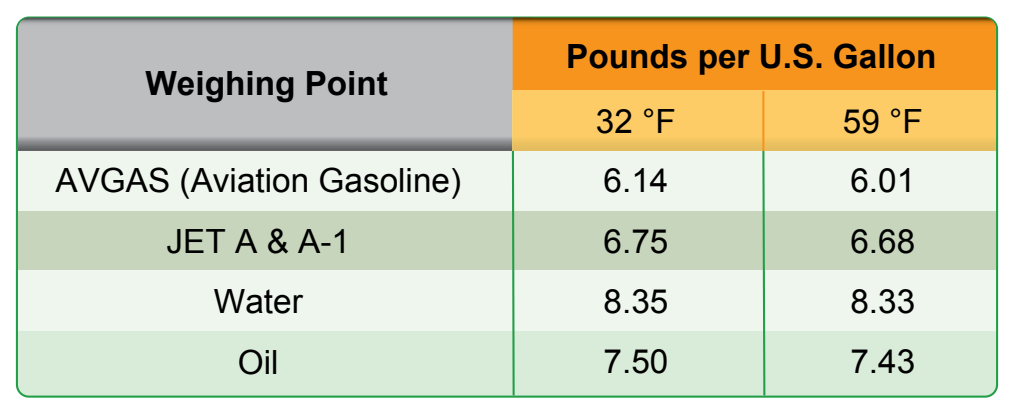
Note the difference in weight as temperatures change. Although this change is a very small amount per gallon, it could end up in a significant total weight gain when dealing with large quantities of fluids, such as those found in commercial aircraft.
Draining the Fuel
Drain fuel from the tanks in the manner specified by the aircraft manufacturer. If there are no specific instructions, drain the fuel until the fuel quantity gauges read empty when the aircraft is in level-flight attitude. Any fuel remaining in the system is considered residual or unusable fuel and is part of the aircraft empty weight.
The amount of residual fuel and its arm are normally found in Note 1 in the section of the Type Certificate Data Sheets (TCDS), “Data pertaining to all Models.” For additional fuel capacity information, see Chapter 2, Weight and Balance Theory.
If it is not feasible to drain the fuel, the tanks can be topped off to be sure of the quantity they contain and the aircraft weighed with full fuel. After weighing is complete, the weight of the fuel and its moment are subtracted from those of the aircraft as weighed. To correct the empty weight for the residual fuel, add its weight and moment.
When computing the weight of the fuel (e.g., a tank full of jet fuel), measure its specific gravity (sg) with a hydrometer and multiply it by 8.345 (the nominal weight of 1 gallon of pure water whose sg is 1.0). If the ambient temperature is high and the jet fuel in the tank is hot enough for its specific gravity to reach 0.81 rather than its nominal sg of 0.82, the fuel actually weighs 6.76 pounds per gallon rather than its normal weight of 6.84 pounds per gallon.
Oil
The empty weight for aircraft certificated under the Civilian Air Regulations (CAR) part 3 does not include the engine lubricating oil. The oil must either be drained before the aircraft is weighed, or its weight must be subtracted from the scale readings to determine the empty weight. To weigh an aircraft that does not include the engine lubricating oil as part of the empty weight, place it in level flight attitude, then open the drain valves and allow the oil to drain out. Any remaining is undrainable oil and is part of the empty weight. Aircraft certificated under Title 14 of the Code of Federal Regulations (14 CFR) parts 23 and 25 include full oil as part of the empty weight. If it is impractical to drain the oil, the reservoir can be filled to the specified level and the weight of the oil computed at 7.5 pounds per gallon. Then, its weight and moment are subtracted from the weight and moment of the aircraft as weighed. The amount and arm of the undrainable oil are found in Note 1 of the TCDS, and this must be added to the empty weight.