
Chapter 7
Center of Gravity Change After a Repair or Alteration
Empty Weight CG (EWCG) Range
The fuel tanks, seats, and baggage compartments of some aircraft are so located that changes in the fuel or occupant load have a very limited effect on the balance of the aircraft. Aircraft of such a configuration show an empty weight CG (EWCG) range in the Type Certificate Data Sheet (TCDS). If the EWCG is located within this range, it is impossible to legally load the aircraft so that its loaded CG falls outside its allowable range.
If the TCDS lists an EWCG range, and after the alteration is completed the EWCG falls within this range, then there is no need to compute a fore and aft check for adverse loading. But if the TCDS lists the EWCG range as “None” (and most of them do), a check must be made to determine whether or not it is possible by any combination of legal loading to cause the aircraft CG to move outside of either its forward or aft limits.
Adverse-Load CG Checks
Many modern aircraft have multiple rows of seats and often more than one baggage compartment. After any repair or alteration that changes the weight and balance, the Airframe and Powerplant (A&P) FAA-certificated mechanic or repairman must ensure that no legal condition of loading can move the CG outside of its allowable limits. To determine this, adverse-loaded CG checks must be performed and the results noted in the weight and balance revision sheet. [Figure 7-3]
Forward Adverse-Load CG Check
To conduct a forward CG check, make a chart that includes the airplane and any occupants and items of the load located in front of the forward CG limit. Include only those items behind the forward limit that are essential to flight: the pilot, and the minimum fuel.
In this example, the pilot, whose nominal weight is 170 pounds, is behind the forward CG limit. The fuel is also behind the forward limit, so the minimum fuel is used. For weight and balance purposes, the minimum fuel is no more than the quantity needed for one-half hour of operation at rated maximum continuous power. This is considered to be 1/12 gallon for each maximum except takeoff (METO) horsepower. Because aviation gasoline weighs 6 pounds per gallon, determine the number of pounds of the minimum fuel by dividing the METO horsepower by two. In this example, minimum fuel is 115 pounds. The front and rear seats and the baggage are all behind the forward CG limit, so no passengers or baggage are considered.
Make a chart like the one in Figure 7-9 to determine the CG with the aircraft loaded for its most forward CG. With the load consisting of only a pilot and the minimum fuel, the CG is +36.6, which is behind the most forward allowable limit for this weight of +33.0.

Aft Adverse-Load CG Check
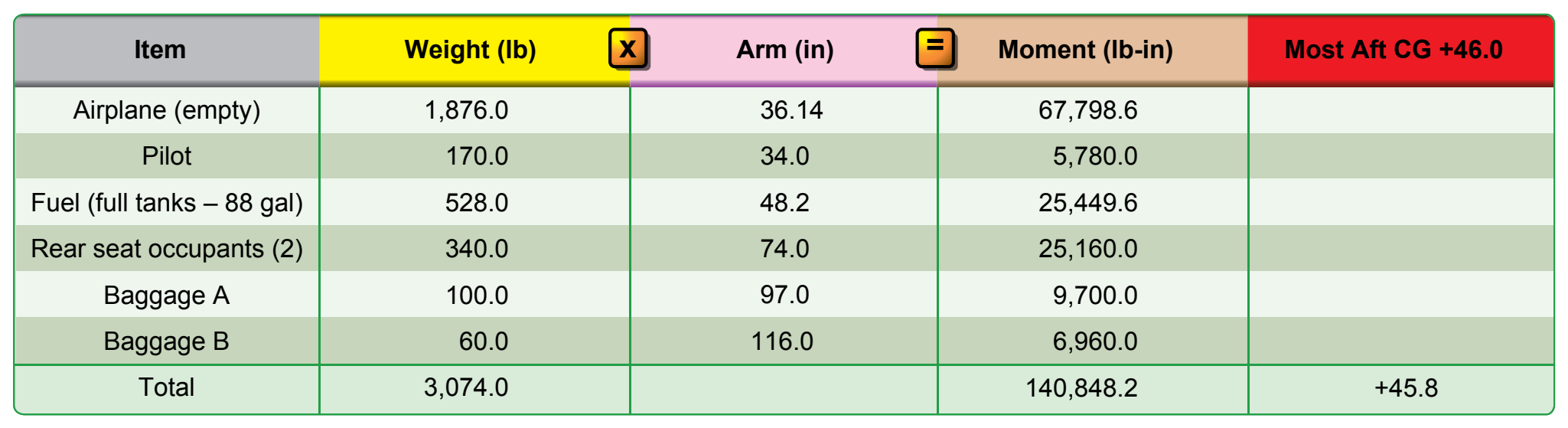
To conduct an aft or rearward CG check, make a chart that includes the empty weight and EWCG of the aircraft after the alteration and all occupants and items of the load behind the aft CG limit of 46.0. The pilot is in front of this limit but is essential for flight and must be included. In this example, only the pilot occupies the front seats. Since the CG of the fuel is behind the aft limit, full fuel is used, as well as the nominal weight (170 lb) for both rear seat passengers and the maximum allowable baggage.
Under these loading conditions, the CG is located at +45.8, which is ahead of the aft limit of +46.0. [Figure 7-10] With only the pilot in front of the aft CG limit and maximum of all items behind the aft limit, the CG is at +45.8 inches, which is ahead of the aft limit of +46.0 inches.
Ballast
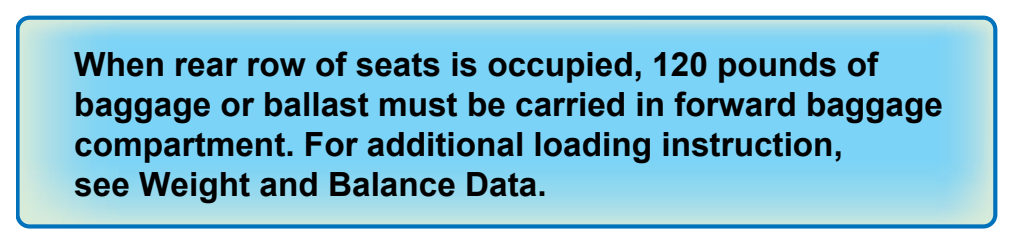
It is possible to load most modern airplanes so the CG shifts outside of the allowable limit. Placards and loading instructions in the weight and balance data inform the pilot of the restrictions that prevent such a shift from occurring. A typical placard in the baggage compartment of an airplane is shown in Figure 7-11. When the CG of an aircraft falls outside of the limits, it can usually be brought back in by using ballast.
Temporary Ballast
Temporary ballast, in the form of lead bars or heavy canvas bags of sand or lead shot, is often carried in the baggage compartments to adjust the balance for certain flight conditions. The bags are marked “Ballast XX Pounds— Removal Requires Weight and Balance Check.” Temporary ballast must be secured so it cannot shift its location in flight and the structural limits of the baggage compartment must not be exceeded. All temporary ballast must be removed before the aircraft is weighed.