User-friendly explanations of instrument approach charts, planviews, profiles, minimums, airport diagrams, departures, arrivals, and visual procedures.
BRIEFING STRIP INFORMATION
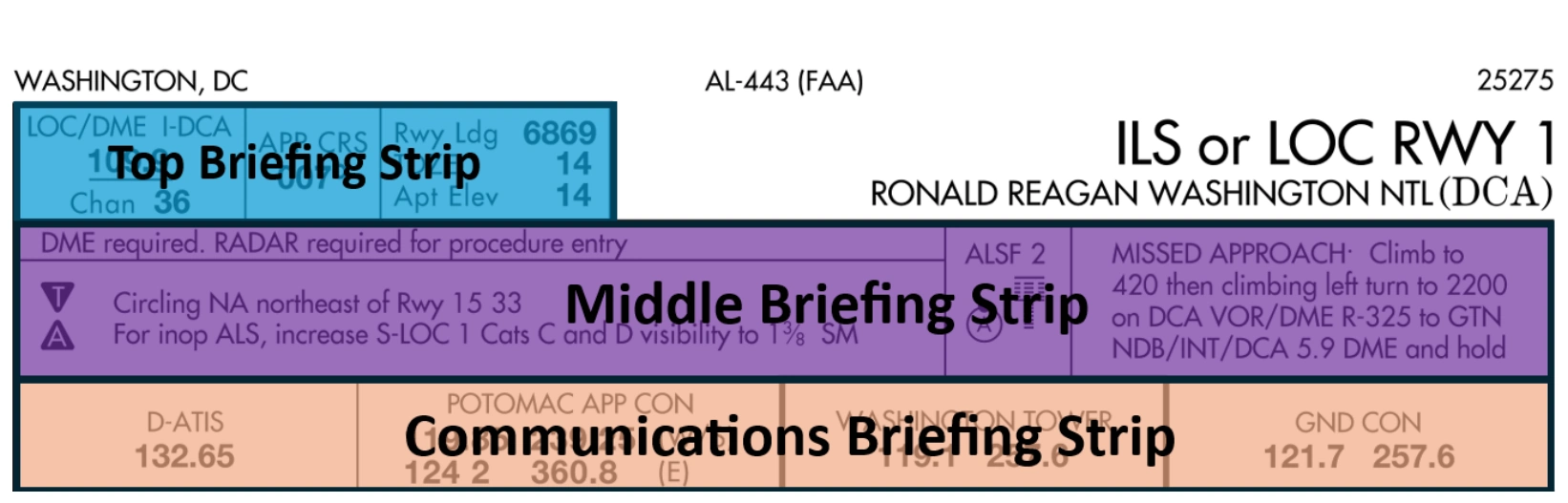
At the top of every TPP is the Briefing Strip that consists of three stacked strips of information immediately above the planview. Information varies depending upon the type of procedure.
Briefing-strip overview — top, middle, communications strips — source page 101.
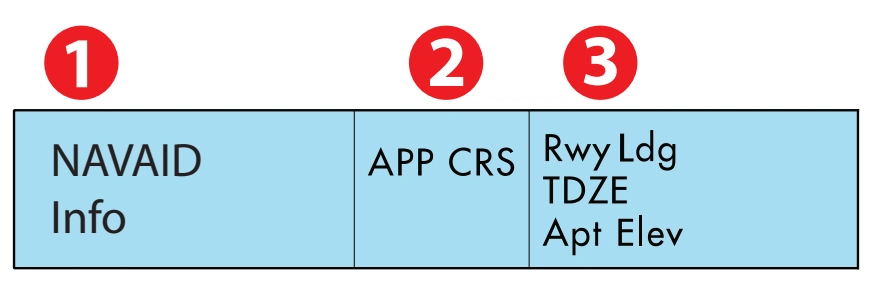
The top briefing strip contains procedural information in three separate boxes, in the following sequence from left to right:
Top briefing-strip 3-box layout — NAVAID info / APP CRS / runway data — source page 101.
Box 1: Primary Procedure Navigation Information: The primary navigation type (VOR, LOC, NDB, RNAV, etc.) with its identifier and frequency/channel. If applicable, WAAS, the WAAS Channel Number, and the WAAS Reference Path indicator are shown stacked top to bottom. If the primary navigation type is GBAS, then the following information is shown, stacked top to bottom: GBAS, CH NNNN, RPI XXXX. If there is not a primary Navigation Box required, the first box is removed.
Box 2: Final Approach Course Information. The inbound Approach Course (APP CRS) is shown.
Box 3: Runway Landing Information: Stacked top to bottom, the runway landing distance (Rwy Ldg), the Touchdown Zone Elevation (TDZE), and the Airport Elevation (Apt Elev) are shown. Runway landing distance is determined by comparing the total runway length with the displaced threshold accounted for against the published Declared Distance Landing Distance Available (LDA). The shortest of these lengths, either the published Declared Distance LDA or the total runway length (minus displaced threshold) on the approach end of the runway, will be charted.
Top Briefing Strip Examples:
Ground based NAVAID:
Ground-based NAVAID top briefing strip — ILS or LOC RWY 7, Denver — source page 101.
RNAV-WAAS:
Denver RNAV (GPS) Y RWY 16R WAAS top briefing strip — CH 82628 / W16B, APP CRS 173°, DEN — source page 101.
BRIEFING STRIP INFORMATION At the top of every TPP is the Briefing Strip that consists of three stacked strips of information immediately above the planview. Information varies depending upon the type of procedure. Top Briefing Strip The top briefing strip contains procedural information in three separate boxes, in the following sequence from left to right: 1 2 3 NAVAID Info • Box 1: Primary Procedure Navigation Information: The primary navigation type (VOR, LOC, NDB, RNAV, etc.) with its identifier and frequency/channel. If applicable, WAAS, the WAAS Channel Number, and the WAAS Reference Path indicator are shown stacked top to bottom. If the primary navigation type is GBAS, then the following information is shown, stacked top to bottom: GBAS, CH NNNN, RPI XXXX. If there is not a primary Navigation Box required, the first box is removed. • Box 2: Final Approach Course Information. The inbound Approach Course (APP CRS) is shown. • Box 3: Runway Landing Information: Stacked top to bottom, the runway landing distance (Rwy Ldg), the Touchdown Zone Elevation (TDZE), and the Airport Elevation (Apt Elev) are shown. Runway landing distance is determined by comparing the total runway length with the displaced threshold accounted for against the published Declared Distance Landing Distance Available (LDA). The shortest of these lengths, either the published Declared Distance LDA or the total runway length (minus displaced threshold) on the approach end of the runway, will be charted. Top Briefing Strip Examples: Ground based NAVAID: RNAV-WAAS:
Source page 102
GBAS:
GBAS top briefing strip — GLS RWY 4L, Newark — source page 102.
No Primary NAVAID box:
No-primary-NAVAID-box top strip — RNAV (RNP) Z RWY 17L, Denver — source page 102.
Circling Approach:
Circling-approach top strip — VOR/DME-A, Roanoke — source page 102.
Sidestep Procedure:
Cookie Preferences
We use cookies to operate this website, improve performance, understand site traffic, and personalize your experience. Essential cookies are always active because they are required for the website to function.
Required for basic site functionality and security.
Help us understand how visitors use the website so we can improve it.
May be used for advertising, remarketing, or social media features.
You can update your choices anytime using Cookie Settings. View Privacy Policy