Chapter 11
Night Operations
Introduction
The mechanical operation of an airplane at night is no different than operating the same airplane during the day. The airplane does not know if it is being operated in the dark or in bright sunlight. It performs and responds to control inputs by the pilot. The pilot, however, is affected by various aspects of night operations and should take them into consideration during night flight operations. Some are actual physical limitations affecting all pilots. Others, such as equipment requirements, procedures, and emergency situations, should also be considered.
According to 14 CFR part 1, section 1.1, Definitions and Abbreviations, “night” means the time between the end of evening civil twilight and the beginning of morning civil twilight, as published in the Air Almanac, converted to local time. To explain further, the National Weather Service defines evening civil twilight as the time that begins in the morning, or ends in the evening, when the geometric center of the sun is 6 degrees below the horizon. Therefore, morning civil twilight begins when the geometric center of the sun is 6 degrees below the horizon, and ends at sunrise. Evening civil twilight begins at sunset and ends when the geometric center of the sun is 6 degrees below the horizon. The FAA has an online tool to calculate sunrise, sunset, and civil twilight for any given location.
For 14 CFR part 61, section 61.57(b)(1) night operations that meet recent flight experience requirements, the term “night” refers to the time period beginning 1 hour after sunset and ending 1 hour before sunrise. The same regulation requires that during those hours, no person may act as pilot-in-command (PIC) of an aircraft carrying passengers unless within the preceding 90 days and during those specified hours, that person has made 3 takeoffs and landings to a full stop. 14 CFR part 61, sections 61.57(b)(1)(i) and (ii) require the pilot to have made the required takeoffs and landings acting as the sole manipulator of the controls, and to have performed the takeoffs and landings in an aircraft of the same category, class, and type (if a type rating is required). Other conditions apply if using a full flight simulator to meet the requirement as described in 14 CFR part 61 (section 61.57(b)(2)) or if seeking to use another alternative provided in the regulation.
Night flying operations should not be encouraged or attempted except by certificated pilots with knowledge of and experience in the topics discussed in this chapter.
Night Vision
Due to the physiology of the eye [Figure 11-1], humans experience diminished vision in low-light conditions. Because vision involves the eyes and brain working together, understanding eye function leads to pilot behaviors that can improve night vision significantly.
Anatomy of the Eye
- Light from an object enters the eye through the cornea and then continues through the pupil.
- The opening (dilation) and closing (constriction) of the pupil is controlled by the iris, which is the colored part of the eye. The function of the pupil is similar to that of the diaphragm of a photographic camera: to control the amount of light.
- The lens is located behind the pupil and its function is to focus light on the surface of the retina.
- The retina is the inner layer of the eyeball that contains photosensitive cells called rods and cones. The function of the retina is similar to that of the film in a photographic camera: to record an image.
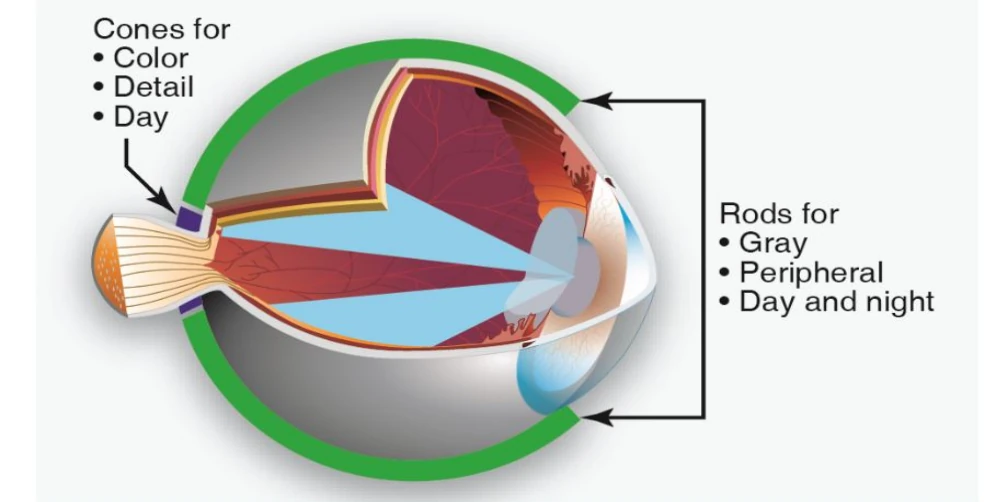
- The cones are located in higher concentrations than rods in the central area of the retina known as the macula, which measures about 4.5 mm in diameter. The exact center of the macula has a very small depression called the fovea, which contains cones only. The cones are used for day or high-intensity light vision. They are involved with central vision to detect detail, perceive color, and identify far-away objects.
- The rods are located mainly in the periphery of the retina—an area that is about 10,000 times more sensitive to light than the fovea. Rods are used for low light intensity or night vision and are involved with peripheral vision to detect position references, including objects (fixed and moving) in shades of gray, but cannot be used to detect detail or to perceive color.
- Although there is not a clear-cut division of function, the rods make night vision possible. The rods and cones function in daylight and in moonlight, but in the absence of normal light, the process of night vision is placed almost entirely on the rods.
- Light energy (an image) enters the eyes and is transformed by the cones and rods into electrical signals that are carried by the optic nerve to the posterior area of the brain (occipital lobes). This part of the brain interprets the electrical signals and creates a mental image of the actual object that was seen by the person.
Types of Vision
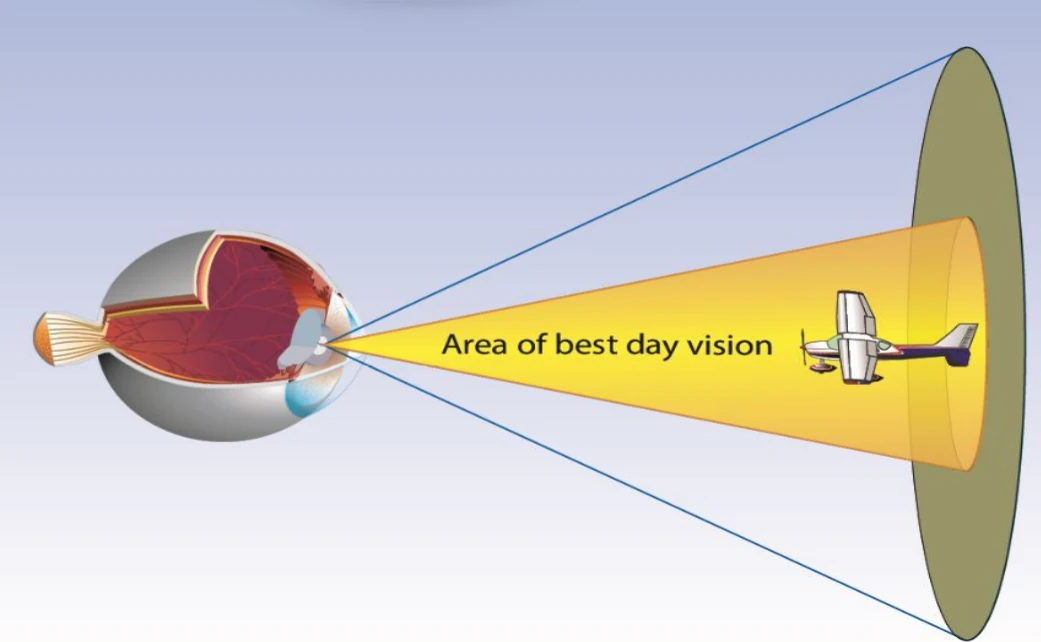
Photopic Vision. During daytime or high-intensity artificial illumination conditions, the eyes rely on central vision (foveal cones) to perceive and interpret sharp images and color of objects. [Figure 11-2]
Mesopic Vision. Occurs at dawn, dusk, or under full moonlight levels and is characterized by decreasing visual acuity and color vision. Under these conditions, a combination of central (foveal cones) and peripheral (rods)vision is required to maintain appropriate visual performance.
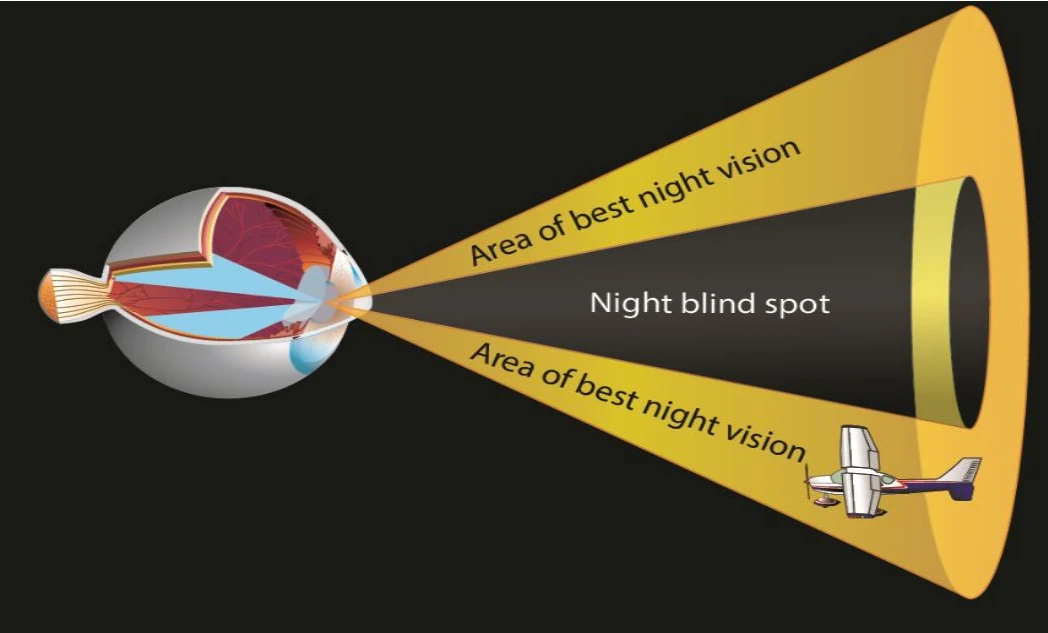
Scotopic Vision. During nighttime, partial moonlight, or low intensity artificial illumination conditions, central vision (foveal cones) becomes ineffective to maintain visual acuity and color perception. Under these conditions, if looking directly at an object for more than a few seconds, the image of the object fades away completely (night blind spot). Peripheral vision (off center scanning) provides the only means of seeing very dim objects in the dark.
Night Blind Spot
The “Night Blind Spot” appears under conditions of low ambient illumination due to the absence of rods in the fovea. [Figure 11-3] This absence of rods affects the central 5 to 10 degrees of the visual field. If an object is viewed directly at night, it may go undetected or it may fade away after initial detection. The night blind spot can hide larger objects as the distance between the pilot and an object increases.