
Chapter 11
Night Operations
At least one reliable flashlight is recommended as standard equipment on all night flights. A reliable incandescent or light-emitting diode (LED) dimmable flashlight able to produce white/red light is preferable. The flashlight should be large enough to be easily located in the event it is needed. It is also recommended to have a spare set of batteries for the flashlight readily available. The white light is used while performing the preflight visual inspection of the airplane, the red light is used when performing flight deck operations, and the dim white light may be used for chart reading. Many charts can be displayed on a EFB, which does not require a flashlight. However, its brightness should be set so as not to seriously impair night vision.
Since the red light is non-glaring, it will not impair night vision. Some pilots prefer two flashlights, one with a white light for preflight and the other a penlight type with a red light. The latter can be suspended by a string from around the neck to ensure the light is always readily available. As mentioned earlier, red light distorts color perception of pigments other than red on charts.
Aeronautical charts are essential for night cross-country flight and, if the intended course is near the edge of the chart, the adjacent chart should also be available. The lights of cities and towns can be seen at surprising distances at night, and if this adjacent chart is not available to identify those landmarks, confusion could result. Regardless of the equipment used, organization of the flight deck eases the burden and enhances safety. Organize equipment and charts and place them within easy reach prior to taxiing.
Airplane Equipment and Lighting
14 CFR part 91, section 91.205(c) specifies the basic minimum airplane equipment that is required for VFR flight at night. This equipment includes basic instruments, lights, electrical energy source, and spare fuses if applicable.
The standard instruments required by 14 CFR part 91, section 91.205(d) for IFR flight are valuable assets for aircraft control at night. 14 CFR part 91, section 91.205(c)(3) specifies that during VFR flight at night, operating aircraft are required to have an approved anti-collision light system, which can include a flashing or rotating beacon and position lights. However, 14 CFR part 91, section 91.209(b) gives the pilot-in-command leeway to turn off the anti-collision lights in the interest of safety. Airplane position lights are arranged similar to those of boats and ships. A red light is positioned on the left wingtip, a green light on the right wingtip, and a white light on the tail. [Figure 11-4]
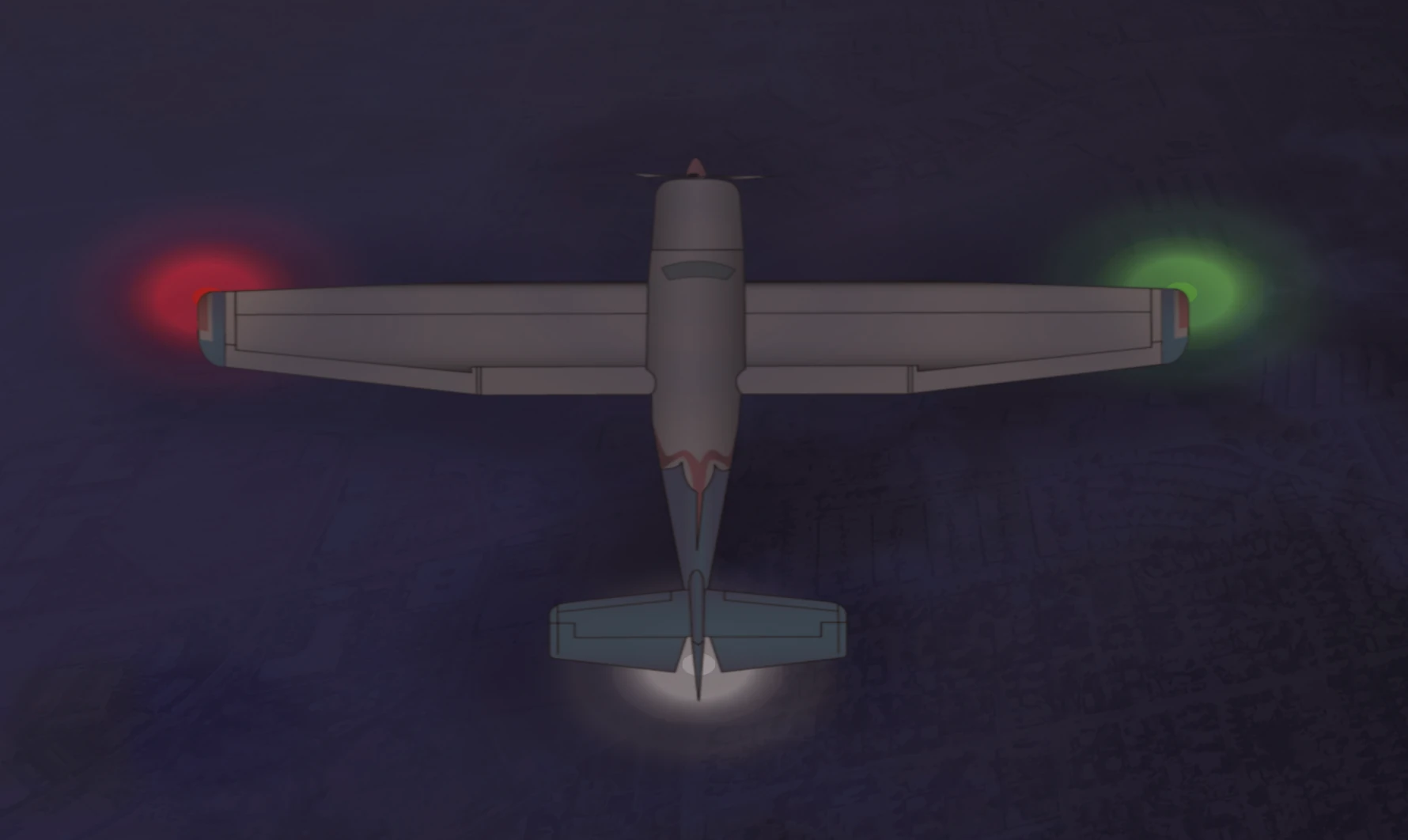
This arrangement provides a means to determine the general direction of movement of other airplanes in flight. If both a red and green light of another aircraft are observed, and the red light is on the left and the green to the right, the airplane is flying the same direction. Care must be taken to maintain clearance. If red were on the right and green to the left, the airplane could be on a collision course.
Landing lights are not only useful for taxi, takeoffs, and landings, but also provide a means by which airplanes can be seen at night by other pilots. Pilots are encouraged to turn on their landing lights when operating within 10 miles of an airport and below 10,000 feet. Operation with landing lights on applies to both day and night or in conditions of reduced visibility. This should also be done in areas where flocks of birds may be expected.
Although turning on aircraft lights supports the “see and be seen” concept, pilots should continue to keep a sharp lookout for other aircraft. Aircraft lights may blend in with the stars or the lights of the cities at night and go unnoticed unless a conscious effort is made to distinguish them from other lights.
Airport and Navigation Lighting Aids
The lighting systems used for airports, runways, obstructions, and other visual aids at night are other important aspects of night flying. Lighted airports located away from congested areas are identified readily at night by the lights outlining the runways. Airports located near or within large cities are often difficult to identify as the airport lights tend to blend with the city lights. It is important to not only know the exact location of an airport relative to the city, but also to be able to identify these airports by the characteristics of their lighting patterns.
Aeronautical lights are designed and installed in a variety of colors and configurations, each having its own purpose. Although some lights are used only during low ceiling and visibility conditions, this discussion includes only the lights that are fundamental to visual flight rules (VFR) night operation.
It is recommended that prior to a night flight, and particularly a cross-country night flight, that a check of the availability and status of lighting systems at the destination airport is made. This information can be found on aeronautical charts and in the Chart Supplements. The status of each facility can be determined by reviewing pertinent Notices to Airmen (NOTAMs).
Most airports have rotating beacons. The beacon rotates at a constant speed, thus producing a series of light flashes at regular intervals. These flashes may consist of a white flash and one or two different colors that are used to identify various types of landing areas. For example:
- Lighted civilian land airports—alternating white and green lights
- Lighted civilian water airports—alternating white and yellow lights
- Lighted military airports—alternating white and green lights, but are differentiated from civil airports by dual peaked (two quick) white flashes, then green
Beacons producing red flashes indicate obstructions or areas considered hazardous to aerial navigation. Steady-burning red lights are used to mark obstructions on or near airports and sometimes to supplement flashing lights on en route obstructions. High-intensity, flashing white lights are used to mark some supporting structures of overhead transmission lines that stretch across rivers, chasms, and gorges. These high-intensity lights are also used to identify tall structures, such as chimneys and towers.
As a result of technological advancements, runway lighting systems have become quite sophisticated to accommodate takeoffs and landings in various weather conditions. However, if flying is limited to VFR only, it is important to be familiar with the basic lighting of runways and taxiways.
The basic runway lighting system consists of two straight parallel lines of runway edge lights defining the lateral limits of the runway. These lights are aviation white, although aviation yellow may be substituted for a distance of 2,000 feet from the far end of the runway to indicate a caution zone. At some airports, the intensity of the runway edge lights can be activated and adjusted by radio control. The control system consists of a 3-step control responsive to 7, 5, and/or 3 microphone clicks. This 3-step control turns on lighting facilities capable of either 3-step, 2-step, or 1-step operation. The 3-step and 2-step lighting facilities can be altered in intensity, while the 1-step cannot. All lighting is illuminated for a period of 15 minutes from the most recent time of activation and may not be extinguished prior to end of the 15-minute period. Suggested use is to always initially key the mike 7 times; this assures that all controlled lights are turned on to the maximum available intensity. If desired, adjustment can then be made, where the capability is provided, to a lower intensity by keying 5 and/or 3 times. Due to the close proximity of airports using the same frequency, radio-controlled lighting receivers may be set at a low sensitivity requiring the aircraft to be relatively close to activate the system. Consequently, even when lights are on, the pilot should always key the mike as directed when overflying an airport of intended landing or just prior to entering the final segment of an approach. This assures the aircraft is close enough to activate the system and a full 15-minute lighting duration is available.
The length limits of the runway are defined by straight lines of lights across the runway ends. At some airports, the runway threshold lights are aviation green, and the runway end lights are aviation red. At many airports, the taxiways are also lighted. A taxiway edge lighting system consists of blue lights that outline the usable limits of taxi paths.