
Chapter 11
Night Operations
Generally, at night, it is difficult to see clouds and restrictions to visibility, particularly on dark nights or under an overcast. When flying under VFR, pilots should exercise caution to avoid flying into clouds. Usually, the first indication of flying into restricted visibility conditions is the gradual disappearance of lights on the ground. If the lights begin to appear surrounded by a halo or glow, further flight in the same direction calls for caution. Such a halo or glow around lights on the ground is indicative of ground fog. If a descent occurs through clouds, smoke, or haze in order to land, the horizontal visibility is considerably less when looking through the restriction than it is when looking straight down through it from above. Pilots should avoid a VFR night flight if expecting conditions below VFR minimums. If encountering IMC, risk increases dramatically unless both the pilot and aircraft are equipped for flight under IFR, and the pilot has prepared and filed an IFR flight plan that can be activated, if needed.
Crossing large bodies of water at night in single-engine airplanes could be potentially hazardous, because in the event of an engine failure, the pilot may be forced to land (ditch) the airplane in the water. Another hazard faced by pilots of all aircraft, due to limited or no lighting, is that the horizon blends with the water. During poor visibility conditions over water, the horizon becomes obscure and may result in a loss of orientation. Even on clear nights, the stars may be reflected on the water surface, which could appear as a continuous array of lights, thus making the horizon difficult to identify.
Lighted runways, buildings, or other objects may cause illusions when seen from different altitudes. At an altitude of 2,000 feet, a group of lights on an object may be seen individually, while at 5,000 feet or higher, the same lights could appear to be one solid light mass. These illusions may become quite acute with altitude changes and, if not overcome, could present problems when making approaches to lighted runways.
Approaches and Landings
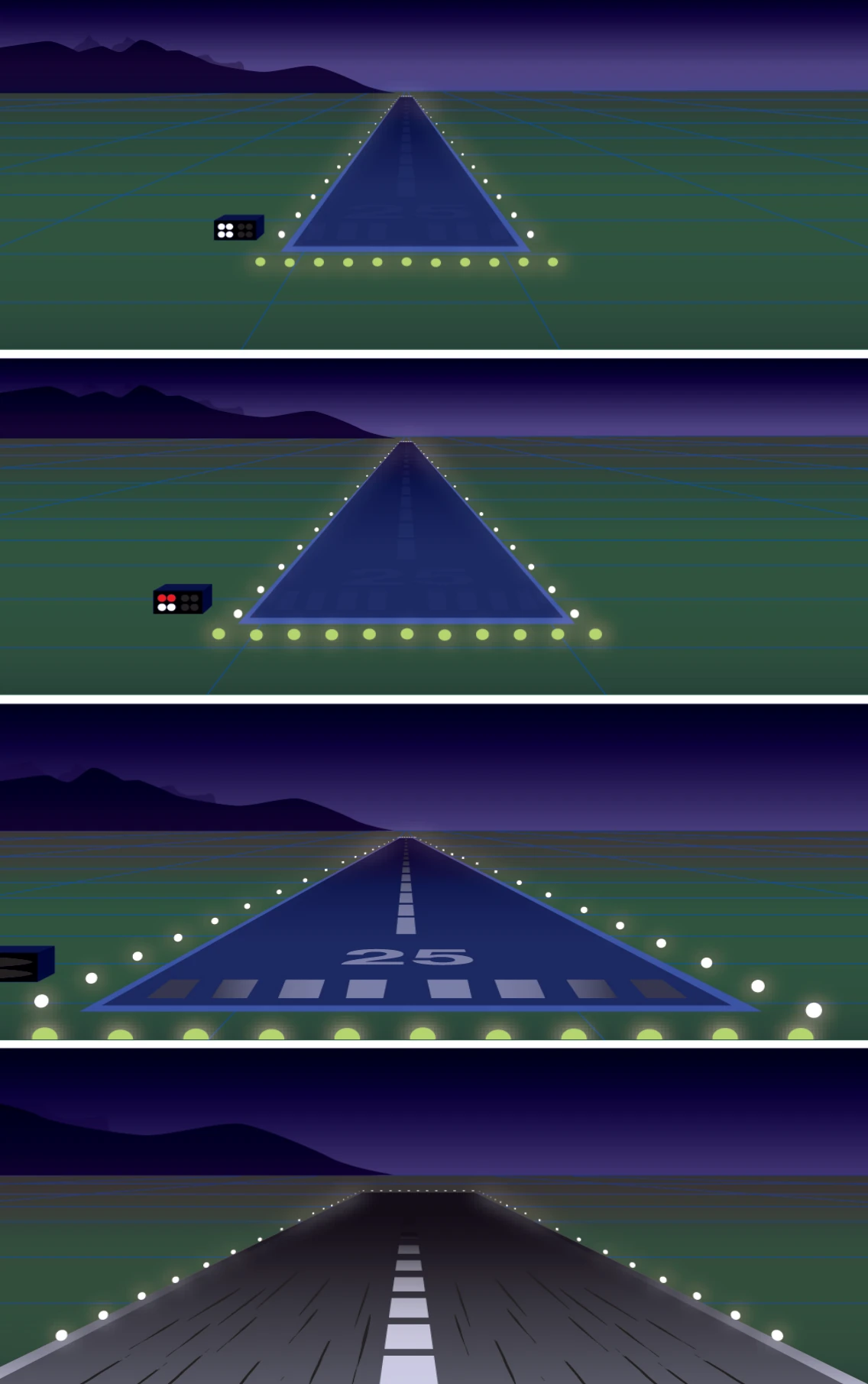
When approaching the airport to enter the traffic pattern and land, it is important that the runway lights and other airport lighting be identified as early as possible. If the airport layout is unfamiliar, sighting of the runway may be difficult until very close-in due to the maze of lights observed in the area. [Figure 11-6] A pilot should normally fly toward the rotating beacon until the lights outlining the runway are distinguishable. To fly a traffic pattern of proper size and direction, the runway threshold and runway-edge lights need to be positively identified. Once the airport lights are seen, these lights should be kept in sight throughout the approach.

Distance may be deceptive at night due to limited lighting conditions. A lack of intervening references on the ground and the inability to compare the size and location of different ground objects cause this. This also applies to the estimation of altitude and speed. Consequently, more dependence should be placed on flight instruments, particularly the altimeter and the airspeed indicator. Monitoring the altimeter prevents flying too low for the distance from the airport. When entering the traffic pattern, the pilot should allow adequate time to complete the before-landing checklist. If the heading indicator contains a heading bug, setting it to the runway heading is an excellent reference for the pattern legs.
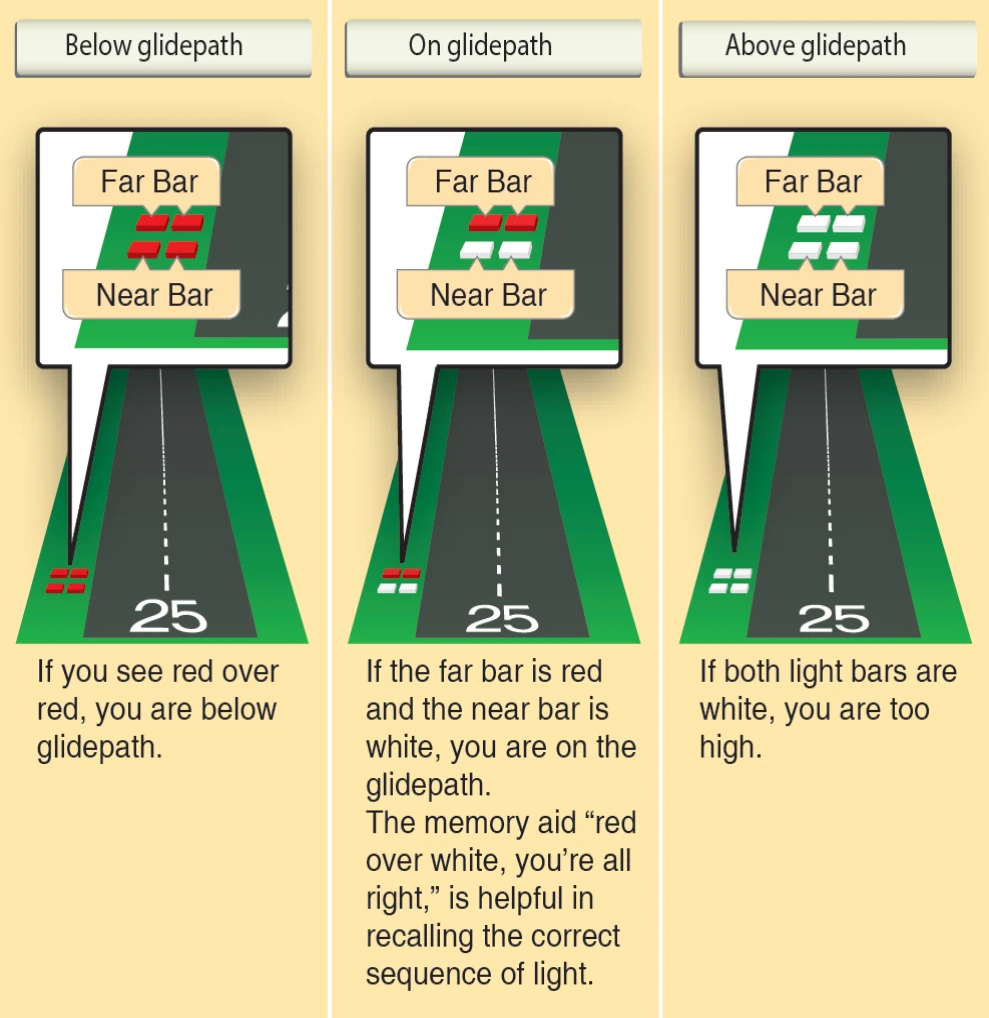
The pilot maintains the recommended airspeeds and executes the approach and landing in the same manner as during the day. A low, shallow approach is definitely inappropriate during a night operation. The altimeter and VSI should be constantly cross-checked against the airplane’s position along the base leg and final approach. A visual approach slope indicator (VASI) is an indispensable aid in establishing and maintaining a proper glide path. [Figure 11-7]
After turning onto the final approach and aligning the airplane midway between the two rows of runway-edge lights, the pilot should note and correct for any wind drift. Throughout the final approach, proper use of pitch and power helps to maintain a stabilized approach. Flaps are used as in a normal approach. Usually, halfway through the final approach, the landing light is turned on. The landing light is sometimes ineffective since the light beam will usually not reach the ground from higher altitudes. The light may even be reflected back into the pilot’s eyes by any existing haze, smoke, or fog. Safety considerations regarding local traffic and collision avoidance may overshadow these disadvantages.
The round out and touchdown is made in the same manner as in day landings. At night, the judgment of height, speed, and sink rate is impaired by the scarcity of observable objects in the landing area. An inexperienced pilot may have a tendency to round out too high. Continuing a constant approach descent until the landing lights reflect on the runway and tire marks on the runway can be seen clearly helps identify the point to begin the round out. At this point, the round out is started smoothly and the throttle gradually reduced to idle as the airplane is touching down. [Figure 11-8] During landings without the use of landing lights, the round out may be started when the runway lights at the far end of the runway first appear to be rising higher than the nose of the airplane. This demands a smooth and very timely round out and requires that the pilot feel for the runway surface using power and pitch changes, as necessary, for the airplane to settle slowly to the runway. Blackout landings should always be included in night pilot training as an emergency procedure.
How to Prevent Landing Errors Due to Optical Illusions
To prevent these illusions and their potentially hazardous consequences, pilots can:
- Anticipate the possibility of visual illusions during approaches to unfamiliar airports, particularly at night or in adverse weather conditions.
- Consult airport diagrams and the Chart Supplements for information on runway slope, terrain, and lighting.
- Make frequent reference to the altimeter, especially during all approaches, day and night.
- If possible, conduct aerial visual inspection of unfamiliar airports before landing.
- Use Visual Approach Slope Indicator (VASI) or Precision Approach Path Indicator (PAPI) systems for a visual reference or an electronic glideslope, whenever they are available.
- Utilize the visual descent point (VDP) found on many nonprecision instrument approach procedure charts.
- Recognize that the chances of being involved in an approach accident increase when some emergency or other activity distracts from usual procedures.
- Maintain optimum proficiency in landing procedures.
Night Emergencies
Perhaps the greatest concern about flying a single-engine airplane at night is the possibility of a complete engine failure and the subsequent emergency landing. This is a legitimate concern, even though continuing flight into adverse weather and poor pilot judgment account for most serious accidents.
If the engine fails at night, there are several important procedures and considerations to keep in mind. They are as follows:
- Maintain positive control of the airplane and establish the best glide configuration and airspeed. Turn the airplane towards an airport or away from congested areas.
- Check to determine the cause of the engine malfunction, such as the position of fuel selectors, magneto switch, or primer. If possible, the cause of the malfunction should be corrected immediately and the engine restarted.
- Announce the emergency situation to air traffic control (ATC) or Universal Communications (UNICOM). If already in radio contact with a facility, do not change frequencies unless instructed to change.
- If the condition of the nearby terrain is known and is suitable for a forced landing, turn towards an unlighted portion of the area and plan an emergency forced landing to an unlighted portion.
- Consider an emergency landing area close to public access if possible. This may facilitate rescue or help, if needed.
- Maintain orientation with the wind to avoid a downwind landing.
- Complete the before-landing checklist, and check the landing lights for operation at altitude and turn ON in sufficient time to illuminate the terrain or obstacles along the flightpath. The landing should be completed in the normal landing attitude at the slowest possible airspeed. If the landing lights are unusable and outside visual references are not available, the airplane should be held in level-landing attitude until the ground is contacted.
- After landing, turn off all switches and evacuate the airplane as quickly as possible.