
Chapter 12
Transition to Complex Airplanes
- Length of the runway
- Climb gradient
- Obstacle clearance requirements
- The characteristics of the terrain beyond the departure end of the runway
- The climb characteristics of the particular airplane
For example, in some situations it may be preferable, in the event of an engine failure, to make an off airport forced landing with the gear extended in order to take advantage of the energy absorbing qualities of the terrain (see Chapter 18, “Emergency Procedures”). In which case, a delay in retracting the landing gear after takeoff from a short runway may be warranted. In other situations, obstacles in the climb path may warrant a timely gear retraction after takeoff. Also, in some airplanes the initial climb pitch attitude is such that any view of the runway remaining is blocked, making an assessment of the feasibility of touching down on the remaining runway difficult.
Avoid premature landing gear retraction and do not retract the landing gear until a positive rate of climb is indicated on the flight instruments. If the airplane has not attained a positive rate of climb, there is always the chance it may settle back onto the runway with the gear retracted. This is especially so in cases of premature lift-off. Remember that leaning forward to reach the landing gear selector may result in inadvertent forward pressure on the yoke, which causes the airplane to descend.
As the landing gear retracts, airspeed increases and the airplane’s pitch attitude may change. The gear may take several seconds to retract. Gear retraction and locking (and gear extension and locking) is accompanied by sound and feel that are unique to the specific make and model airplane. Become familiar with the sound and feel of normal gear retraction so that any abnormal gear operation can be readily recognized. Abnormal landing gear retraction is most often a clear sign that the gear extension cycle will also be abnormal.
Approach and Landing
The operating loads placed on the landing gear at higher airspeeds may cause structural damage due to the forces of the airstream. Limiting speeds, therefore, are established for gear operation to protect the gear components from becoming overstressed during flight. These speeds may not be found on the airspeed indicator. They are published in the AFM/POH for the particular airplane and are usually listed on placards in the flight deck. [Figure 12-15] The maximum landing extended speed (VLE ) is the maximum speed at which the airplane can be flown with the landing gear extended. The maximum landing gear operating speed (VLO ) is the maximum speed at which the landing gear may be operated through its cycle.

The landing gear is extended by placing the gear selector switch in the GEAR DOWN position. As the landing gear extends, the airspeed decreases and the pitch attitude may change. During the several seconds it takes for the gear to extend, be attentive to any abnormal sounds or feel. Confirm that the landing gear has extended and locked by the normal sound and feel of the system operation, as well as by the gear position indicators in the flight deck. Unless the landing gear has been previously extended to aid in a descent to traffic pattern altitude, the landing gear should be extended by the time the airplane reaches a point on the downwind leg that is opposite the point of intended landing. Establish a standard procedure consisting of a specific position on the downwind leg at which to lower the landing gear. Strict adherence to this procedure aids in avoiding unintentional gear up landings.
Operation of an airplane equipped with a retractable landing gear requires the deliberate, careful, and continued use of an appropriate checklist. When on the downwind leg, make it a habit to complete the before-landing checklist for that airplane. This accomplishes two purposes—it ensures that action has been taken to lower the gear and establishes awareness so that the gear down indicators can be rechecked prior to landing.
Unless good operating practices dictate otherwise, the landing roll should be completed and the airplane should be clear of the runway before any levers or switches are operated. This technique greatly reduces the chance of inadvertently retracting the landing gear while on the ground. Wait until after rollout and clearing the runway to focus attention on the after-landing checklist. This practice allows for positive identification of the proper controls.
When transitioning to retractable gear airplanes, it is important to consider some frequent pilot errors. These include pilots that have:
- Neglected to extend landing gear
- Inadvertently retracted landing gear
- Activated gear but failed to check gear position
- Misused emergency gear system
- Retracted gear prematurely on takeoff
- Extended gear too late
These mistakes are not only committed by pilots who have just transitioned to complex aircraft, but also by pilots who have developed a sense of complacency over time. In order to minimize the chances of a landing gear-related mishap:
- Use an appropriate checklist. (A condensed checklist mounted in view is a reminder for its use and easy reference can be especially helpful.)
- Be familiar with, and periodically review, the landing gear emergency extension procedures for the particular airplane.
- Be familiar with the landing gear warning horn and warning light systems for the particular airplane. Use the horn system to cross-check the warning light system when an unsafe condition is noted.
- Review the procedure for replacing light bulbs in the landing gear warning light displays for the particular airplane, if applicable, so that you can properly replace a bulb to determine if the bulb(s) in the display is good. If bulbs are replaceable, check to see if spare bulbs are available in the airplane spare bulb supply as part of the preflight inspection.
- Be familiar with and aware of the sounds and feel of a properly operating landing gear system.
Transition Training
Transition to a complex airplane or a high-performance airplane should be accomplished through a structured course of training administered by a competent and qualified flight instructor. The training should be accomplished in accordance with a ground and flight training syllabus. [Figure 12-16]
This sample syllabus for transition training is an example. The arrangement of the subject matter may be changed and the emphasis shifted to fit the qualifications of the transitioning pilot, the airplane involved, and the circumstances of the training situation. The goal is to ensure proficiency standards are achieved. These standards are contained in the Airman Certification Standards for the certificate that the transitioning pilot holds or is working toward.
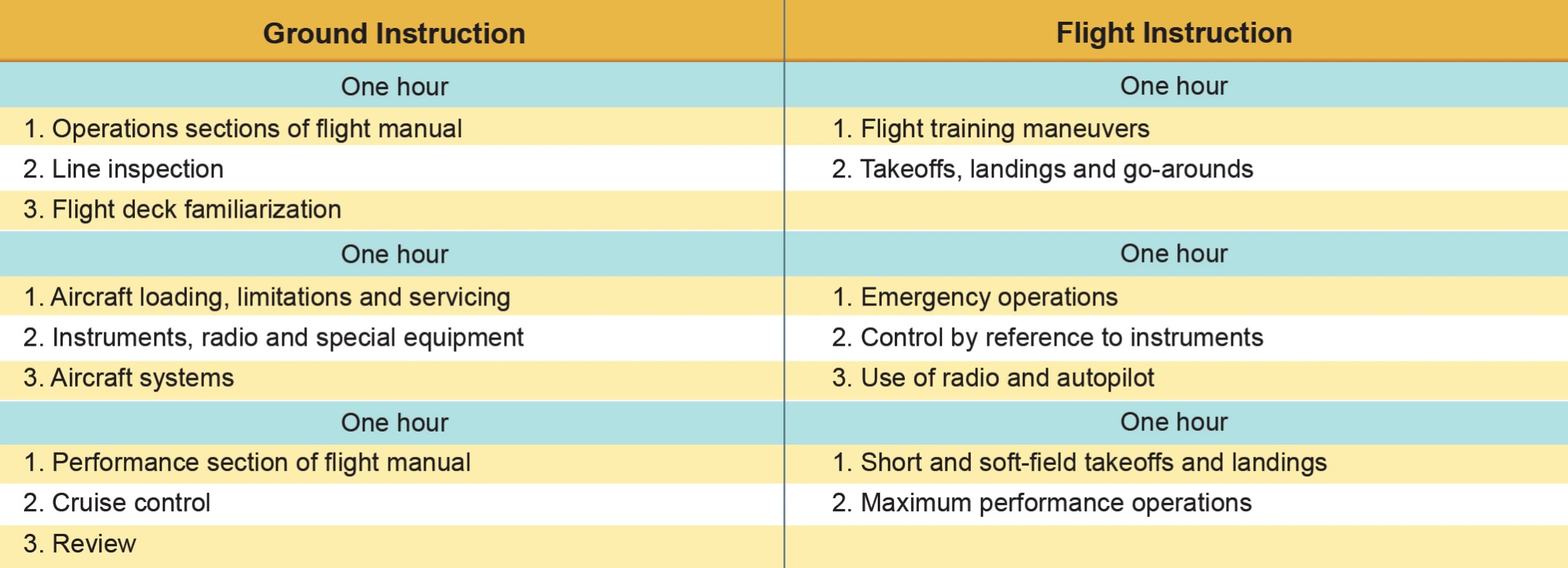
The training times indicated in the syllabus are for illustration purposes. Actual times should be based on the capabilities of the pilot. The time periods may be minimal for pilots with higher qualifications or increased for pilots who do not meet certification requirements or have had little recent flight experience.