
Chapter 13
Transition to Multiengine Airplanes
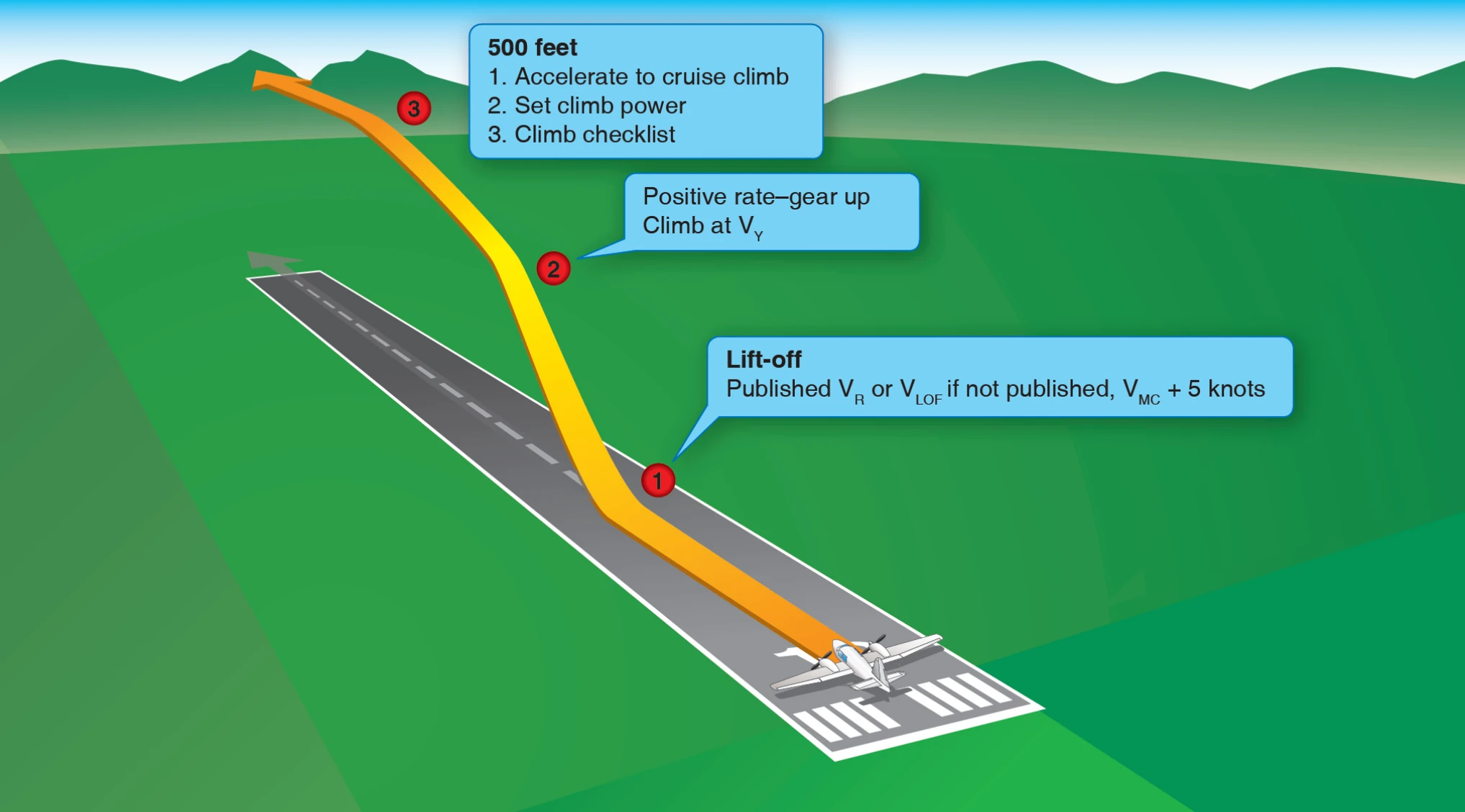
Once a safe, single-engine maneuvering altitude has been reached, typically a minimum of 400—500 feet AGL, the transition to an en route climb speed should be made. This speed is higher than VY and is usually maintained to cruising altitude. En route climb speed gives better visibility, increased engine cooling, and a higher groundspeed. Takeoff power can be reduced, if desired, as the transition to en route climb speed is made.
Some airplanes have a climb power setting published in the AFM/POH as a recommendation (or sometimes as a limitation), which should then be set for en route climb. If there is no climb power setting published, it is customary, but not a requirement, to reduce manifold pressure and rpm somewhat for en route climb. The propellers are usually synchronized after the first power reduction and the yaw damper, if installed, engaged. The AFM/POH may also recommend leaning the mixtures during climb. The climb checklist should be accomplished as traffic and work load allow. [Figure 13-7]
Short-Field Takeoff and Climb
The short-field takeoff and climb differs from the normal takeoff and climb in the airspeeds and initial climb profile. Some AFM/POHs give separate short-field takeoff procedures and performance charts that recommend specific flap settings and airspeeds. Other AFM/POHs do not provide separate short-field procedures. In the absence of such specific procedures, the airplane should be operated only as recommended in the AFM/POH. No operations should be conducted contrary to the recommendations in the AFM/POH.
On short-field takeoffs in general, just after rotation and lift-off, the airplane should be allowed to accelerate to VX, making the initial climb over obstacles at VX and transitioning to VY as obstacles are cleared. [Figure 13-8]
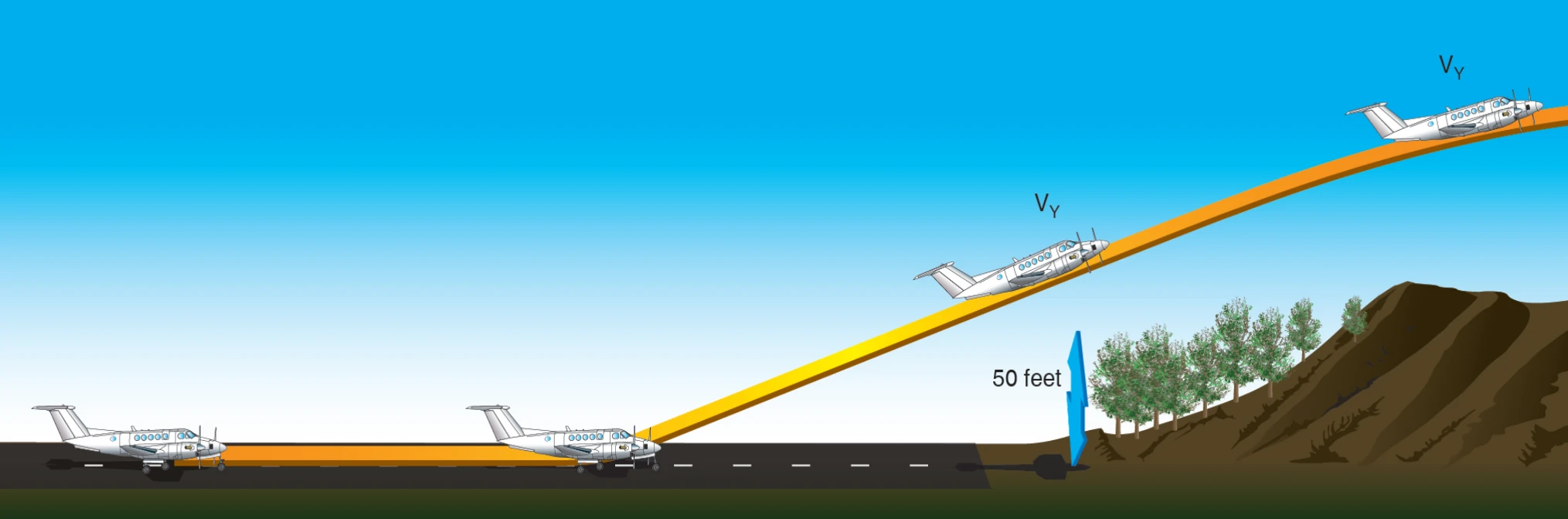
When partial flaps are recommended for short-field takeoffs, many light-twins have a strong tendency to become airborne prior to VMC plus 5 knots. Attempting to prevent premature lift-off with forward elevator pressure results in wheel barrowing. To prevent this, allow the airplane to become airborne, but only a few inches above the runway. The pilot should be prepared to promptly abort the takeoff and land in the event of engine failure on takeoff with landing gear and flaps extended at airspeeds below VX.
Engine failure on takeoff, particularly with obstructions, is compounded by the low airspeeds and steep climb attitudes utilized in short-field takeoffs. VX and VXSE are often perilously close to VMC, leaving scant margin for error in the event of engine failure as VXSE is assumed. If flaps were used for takeoff, the engine failure situation becomes even more critical due to the additional drag incurred. If VX is less than 5 knots higher than VMC, give strong consideration to reducing useful load or using another runway in order to increase the takeoff margins so that a short-field technique is not required.
Rejected Takeoff
A takeoff can be rejected for the same reasons a takeoff in a single-engine airplane would be rejected. Once the decision to reject a takeoff is made, the pilot should promptly close both throttles and maintain directional control with the rudder, nose-wheel steering, and brakes. Aggressive use of rudder, nose-wheel steering, and brakes may be required to keep the airplane on the runway, particularly if an engine failure is not immediately recognized and accompanied by prompt closure of both throttles. However, the primary objective is not necessarily to stop the airplane in the shortest distance, but to maintain control of the airplane as it decelerates. In some situations, it may be preferable to continue into the overrun area under control, rather than risk directional control loss, landing gear collapse, or tire/brake failure in an attempt to stop the airplane in the shortest possible distance.
Level Off and Cruise
Upon leveling off at cruising altitude, the pilot should allow the airplane to accelerate at climb power until cruising airspeed is achieved, and then cruise power and rpm should be set. To extract the maximum cruise performance from any airplane, the power setting tables provided by the manufacturer should be closely followed. If the cylinder head and oil temperatures are within their normal ranges, the cowl flaps may be closed. When the engine temperatures have stabilized, the mixtures may be leaned per AFM/POH recommendations. The remainder of the cruise checklist should be completed by this point.
Fuel management in multiengine airplanes is often more complex than in single-engine airplanes. Depending upon system design, the pilot may need to select between main tanks and auxiliary tanks or even employ fuel transfer from one tank to another. In complex fuel systems, limitations are often found restricting the use of some tanks to level flight only or requiring a reserve of fuel in the main tanks for descent and landing. Electric fuel pump operation can also vary widely among different models, particularly during tank switching or fuel transfer. Some fuel pumps are to be on for takeoff and landing; others are to be off. There is simply no substitute for thorough systems and AFM/POH knowledge when operating complex aircraft.
Slow Flight
There is nothing unusual about maneuvering during slow flight in a multiengine airplane. Slow flight may be conducted in straight-and-level flight, turns, climbs, or descents. It can also be conducted in the clean configuration, landing configuration, or at any other combination of landing gear and flaps. Slow flight in a multiengine airplane should be conducted so the maneuver can be completed no lower than 3,000 feet AGL or higher if recommended by the manufacturer. In all cases, practicing slow flight should be conducted at an adequate height above the ground for recovery should the airplane inadvertently stall.
Pilots should closely monitor cylinder head and oil temperatures during slow flight. Some high performance multiengine airplanes tend to heat up fairly quickly under some conditions of slow flight, particularly in the landing configuration. Simulated engine failures should not be conducted during slow flight. The airplane will be well below VSSE and very close to VMC. Stability, stall warning, or stall avoidance devices should not be disabled while maneuvering during slow flight.
Spin Awareness and Stalls
No multiengine airplane is approved for spins, and their spin recovery characteristics are generally very poor. It is therefore prudent to practice spin avoidance and maintain a high awareness of situations that can result in an inadvertent spin.