
Chapter 13
Transition to Multiengine Airplanes
The entry method for the maneuver is no different than for a single-engine airplane. Once at an appropriate speed, begin increasing the back pressure on the elevator while maintaining a coordinated 45° turn. A good speed reduction rate is approximately 3 to 5 knots per second. Once a stall warning occurs, recover promptly by reducing the AOA until the stall warning stops. Then, roll the wings level with coordinated rudder and add power as necessary to return to the desired flightpath.
Normal Approach and Landing
Given the higher cruising speed (and frequently altitude) of multiengine airplanes over most single-engine airplanes, the descent needs to be planned in advance. A hurried, last minute descent with power at or near idle is inefficient and can cause excessive engine cooling. It may also lead to passenger discomfort, particularly if the airplane is unpressurized. As a rule of thumb, if terrain and passenger conditions permit, a maximum of a 500 fpm rate of descent should be planned. Pressurized airplanes can plan for higher descent rates, if desired.
In a descent, some airplanes require a minimum EGT or may have a minimum power setting or cylinder head temperature to maintain. In any case, combinations of very low manifold pressure and high rpm settings are strongly discouraged by engine manufacturers. If higher descent rates are necessary, the pilot should consider extending partial flaps or lowering the landing gear before retarding the power excessively. The descent checklist should be initiated upon leaving cruising altitude and completed before arrival in the terminal area. Upon arrival in the terminal area, pilots are encouraged to turn on their landing and recognition lights when operating below 10,000 feet, day or night, and especially when operating within 10 miles of any airport or in conditions of reduced visibility.
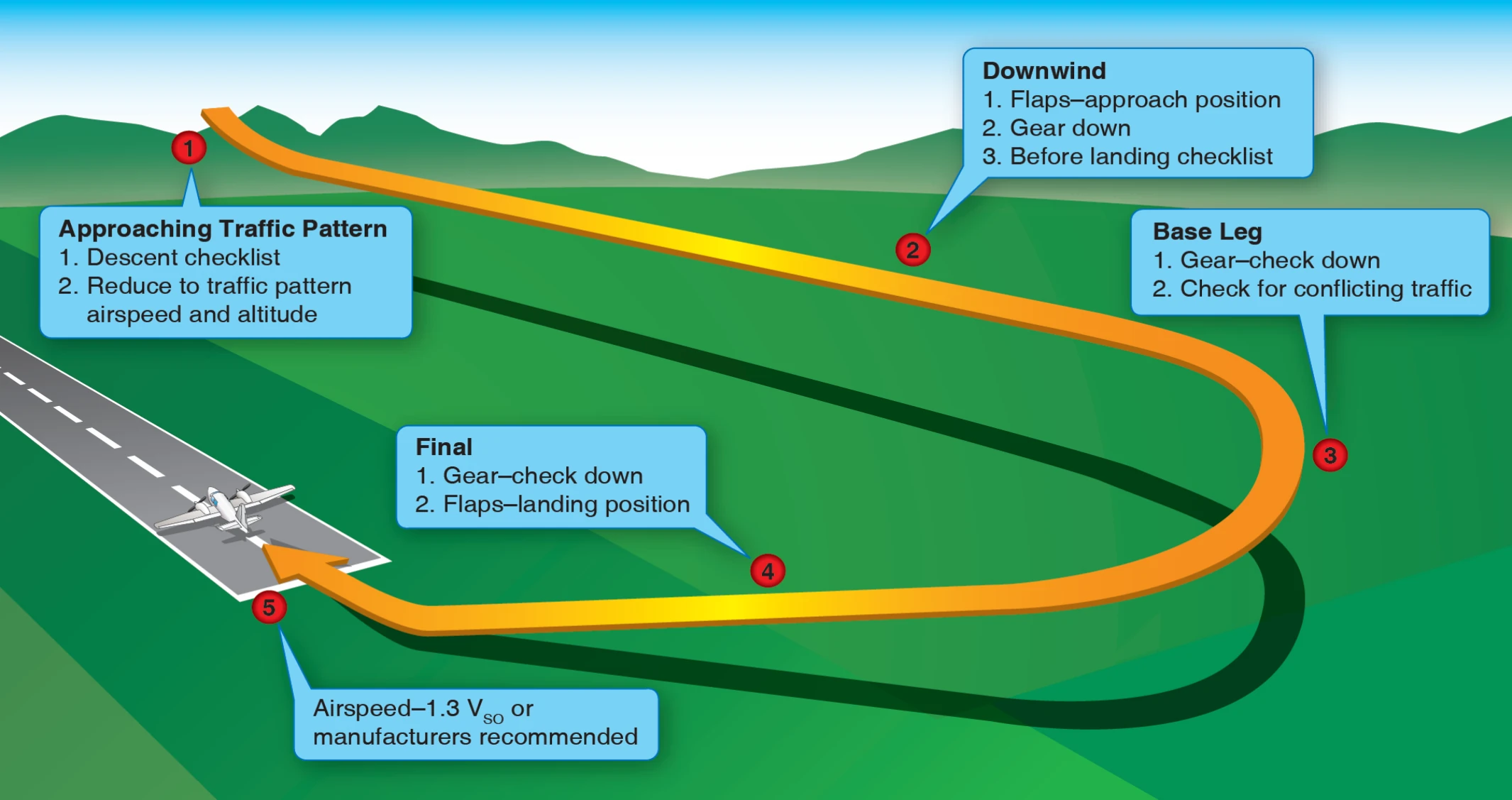
The traffic pattern and approach are typically flown at somewhat higher indicated airspeeds in a multiengine airplane contrasted to most single-engine airplanes. The pilot may allow for this through an early start on the before-landing checklist. This provides time for proper planning, spacing, and thinking well ahead of the airplane. Many multiengine airplanes have partial flap extension speeds above VFE, and partial flaps can be deployed prior to traffic pattern entry. Normally, the landing gear should be selected and confirmed down when abeam the intended point of landing as the downwind leg is flown. [Figure 13-10]
The FAA recommends a stabilized approach concept. To the greatest extent practical, on final approach and within 500 feet AGL, the airplane should be on speed, in trim, configured for landing, tracking the extended centerline of the runway, and established in a constant angle of descent toward an aim point in the touchdown zone. Absent unusual flight conditions, only minor corrections are required to maintain this approach to the round out and touchdown.
The final approach should be made with power and at a speed recommended by the manufacturer; if a recommended speed is not furnished, the speed should be no slower than the single-engine best rate-of-climb speed (VYSE ) until short final with the landing assured, but in no case less than critical engine-out minimum control speed (VMC ). Some multiengine pilots prefer to delay full flap extension to short final with the landing assured. This is an acceptable technique with appropriate experience and familiarity with the airplane.
In the round out for landing, residual power is gradually reduced to idle. With the higher wing loading of multiengine airplanes and with the drag from two windmilling propellers, there is minimal float. Full stall landings are generally undesirable in twins. The airplane should be held off as with a high performance single-engine model, allowing touchdown of the main wheels prior to a full stall.
Under favorable wind and runway conditions, the nose-wheel can be held off for best aerodynamic braking. Even as the nose-wheel is gently lowered to the runway centerline, continued elevator back pressure greatly assists the wheel brakes in stopping the airplane.
If runway length is critical, or with a strong crosswind, or if the surface is contaminated with water, ice, or snow, it is undesirable to rely solely on aerodynamic braking after touchdown. The full weight of the airplane should be placed on the wheels as soon as practicable. The wheel brakes are more effective than aerodynamic braking alone in decelerating the airplane.
Once on the ground, elevator back pressure should be used to place additional weight on the main wheels. When necessary, wing flap retraction also adds additional weight to the wheels and improves braking effectivity. Flap retraction during the landing rollout is discouraged, however, unless there is a clear, operational need. It should not be accomplished as routine with each landing.
Some multiengine airplanes, particularly those of the cabin class variety, can be flown through the round out and touchdown with a small amount of power. This is an acceptable technique to prevent high sink rates and to cushion the touchdown. The pilot should keep in mind, however, that the primary purpose in landing is to get the airplane down and stopped. This technique should only be attempted when there is a generous margin of runway length. As propeller blast flows directly over the wings, lift as well as thrust is produced. The pilot should taxi clear of the runway as soon as speed and safety permit, and then accomplish the after-landing checklist. Ordinarily, no attempt should be made to retract the wing flaps or perform other checklist duties until the airplane has been brought to a halt when clear of the active runway. Exceptions to this would be the rare operational needs discussed above, to relieve the weight from the wings and place it on the wheels. In these cases, AFM/POH guidance should be followed. The pilot should not indiscriminately reach out for any switch or control on landing rollout. An inadvertent landing gear retraction while meaning to retract the wing flaps may result.
Crosswind Approach and Landing
The multiengine airplane is often easier to land in a crosswind than a single-engine airplane due to its higher approach and landing speed. In any event, the principles are no different between singles and twins. Prior to touchdown, the longitudinal axis should be aligned with the runway centerline to avoid landing gear side loads.
The two primary methods, crab and wing-low, are typically used in conjunction with each other. As soon as the airplane rolls out onto final approach, the crab angle to track the extended runway centerline is established. This is coordinated flight with adjustments to heading to compensate for wind drift either left or right. Prior to touchdown, the transition to a sideslip is made with the upwind wing lowered and opposite rudder applied to prevent a turn. The airplane touches down on the landing gear of the upwind wing first, followed by that of the downwind wing, and then the nose gear. Follow-through with the flight controls involves an increasing application of aileron into the wind until full control deflection is reached.
The point at which the transition from the crab to the sideslip is made is dependent upon pilot familiarity with the airplane and experience. With high skill and experience levels, the transition can be made during the round out just before touchdown. With lesser skill and experience levels, the transition is made at increasing distances from the runway. Some multiengine airplanes (as some single-engine airplanes) have AFM/POH limitations against slips in excess of a certain time period; 30 seconds, for example. This itso prevent engine power loss from fuel starvation as the fuel in the tank of the lowered wing flows toward the wingtip, away from the fuel pickup point. This time limit should be observed if the wing-low method is utilized.
Some multiengine pilots prefer to use differential power to assist in crosswind landings. The asymmetrical thrust produces a yawing moment little different from that produced by the rudder. When the upwind wing is lowered, power on the upwind engine is increased to prevent the airplane from turning. This alternate technique is completely acceptable, but most pilots feel they can react to changing wind conditions quicker with rudder and aileron than throttle movement. This is especially true with turbocharged engines where the throttle response may lag momentarily. The differential power technique should be practiced with an instructor before being attempted alone.
Short-Field Approach and Landing
The primary elements of a short-field approach and landing do not differ significantly from a normal approach and landing. Many manufacturers do not publish short-field landing techniques or performance charts in the AFM/POH. In the absence of specific short-field approach and landing procedures, the airplane should be operated as recommended in the AFM/POH. No operations should be conducted contrary to the AFM/POH recommendations.