
Chapter 14
Transition to Tailwheel Airplanes
With the exception of flap settings and initial climb speed as recommended by the manufacturer, there is little difference between the techniques described above for normal takeoffs. After liftoff, the pitch attitude should be adjusted as required for obstacle clearance. However, note that manufacturers of some airplanes, especially of higher power, recommend a short-field technique with liftoff in a three-point attitude. Pilots should always review and follow the airplane manufacturer's recommended procedures.
Soft-Field Takeoff
Wing flaps may be lowered prior to starting the takeoff (if recommended by the manufacturer) to provide additional lift and transfer the airplane’s weight from the wheels to the wings as early as possible. The airplane should be taxied onto the takeoff surface without stopping on a soft surface since mud or snow might bog the airplane down. The airplane should be kept in continuous motion with sufficient power while lining up for the takeoff roll. Due to the high power settings, it is usually best to have the elevator full up while taxiing onto the runway in soft conditions. There is not only the danger of the airplane bogging down, but also a danger of it tipping up onto its nose.
As the airplane is aligned with the proposed takeoff path, takeoff power is applied smoothly and as rapidly as the powerplant will accept without faltering. The tail should be kept very low to maintain the inherent positive AOA and to avoid any tendency of the airplane to nose over as a result of soft spots, tall grass, or deep snow.
When the airplane is held at a nose-high attitude throughout the takeoff run, the wings progressively relieve the wheels of more and more of the airplane’s weight, thereby minimizing the drag caused by surface irregularities or adhesion. Once airborne, the airplane should be allowed to accelerate to climb speed in ground effect.
Landing
The difference between nose-wheel and tailwheel airplanes becomes apparent when discussing the touchdown and the period of deceleration to taxi speed. In the nose-wheel design, touchdown is followed quite naturally by a reduction in pitch attitude to bring the nose-wheel tire into contact with the runway. This pitch change reduces AOA, removes almost all wing lift, and rapidly transfers aircraft weight to the tires.
In tailwheel designs, this reduction of AOA and weight transfer are not practical and, as noted in the section on takeoffs, it is rare to encounter tailwheel planes designed so that the wings are beyond critical AOA in the three-point attitude. In consequence, the airplane continues to “fly” in the three-point attitude after touchdown, requiring careful attention to heading, roll, and pitch for an extended period.
Touchdown
Tailwheel airplanes are less forgiving of crosswind landing errors than nose-wheel models. It is important that touchdown occurs with the airplane’s longitudinal axis parallel to the direction the airplane is moving along the runway. [Figure 14-2] Failure to accomplish this imposes side loads on the landing gear which leads to directional instability. To avoid side stresses and directional problems, the pilot should not allow the airplane to touch down while in a crab or while drifting.
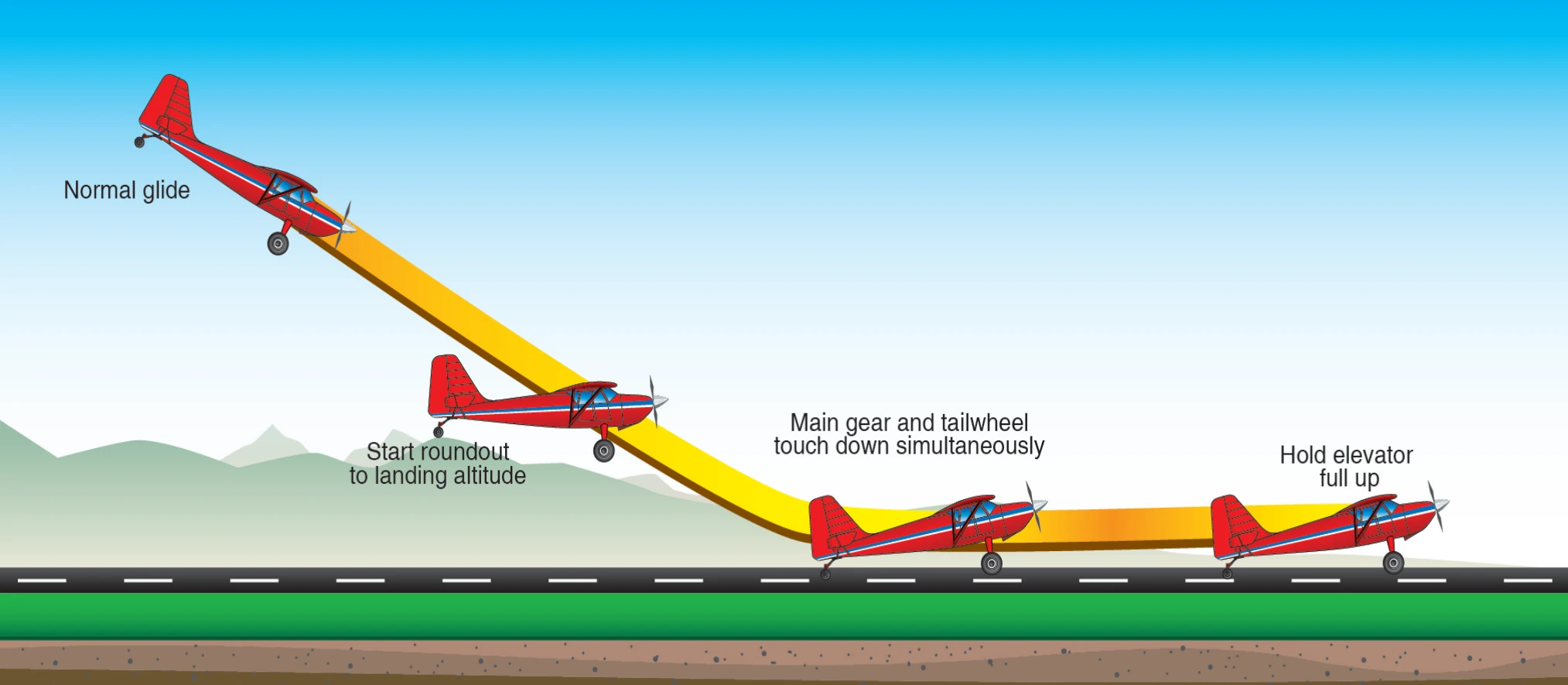
There are two significantly different techniques used to manage tailwheel aircraft touchdowns: three-point and wheel landings. In the first, the airplane is held off the surface of the runway until the attitude needed to remain aloft matches the geometry of the landing gear. When touchdown occurs at this point, the main gear and the tailwheel make contact at the same time. In the second technique (wheel landings), the airplane is allowed to touch down earlier in the process in a lower pitch attitude, so that the main gear touch while the tail remains off the runway.
Three-Point Landing
As with all landings, success begins with an orderly arrival: airspeed, alignment, and configuration well in hand crossing the threshold. Round out (level-off) should be made with the main wheels about one foot off the surface. From that point forward, the technique is essentially the same that is used in nose-wheels: a gentle increase in AOA to maintain flight while slowing. In a tailwheel aircraft, however, the goal is to attain a much steeper fuselage angle than that commonly used in nose-wheel models; one that touches the tailwheels at the same time as the main wheels.
With the tailwheel on the surface, a further increase in pitch attitude is impossible, so the plane remains on the runway, albeit tenuously. With deceleration, weight shifts increasingly from wings to wheels, with the final result that the plane once again becomes a ground vehicle after shedding most of its speed.
There are two potential errors in attempting a three-point landing. In the first, the main wheels are allowed to make runway contact a little early with the tail still in the air. With the CG aft of themain wheells, the tail naturally drops when thmain wheelels touch, AOA increases, and the plane may become airborne again. This “skip” is easily managed by re-flaring and again trying to hold the plane off until reaching the three-point attitude. A large “skip” or bounce may result in being high above the runway with insufficient energy. In these circumstances, the pilot should execute a go-around.
In the second error, the plane is held off the ground a bit too long so that the in-flight pitch attitude is steeper than the three-point attitude. When touchdown is made in this attitude, the tail makes contact first. Provided this happens from no more than a foot off the surface, the result is undramatic: the tail touches, the plane pitches forward slightly onto the main wheels, and rollout proceeds normally.
In every case, once the tailwheel makes contact, the elevator control should be eased fully back to press the tailwheel on the runway. Without this elevator input, the AOA of the horizontal stabilizer develops enough lift to lighten pressure on the tailwheel and render it useless as a directional control with possibly unwelcomed consequences. This after-landing elevator input is quite foreign to nose-wheel pilots and needs to be stressed during transition training.
Note: Before the tailwheel is on the ground, application of full back elevator during the flare lowers the tail, increases the AOA, and quite naturally puts the plane in climbing flight.