
Chapter 14
Transition to Tailwheel Airplanes
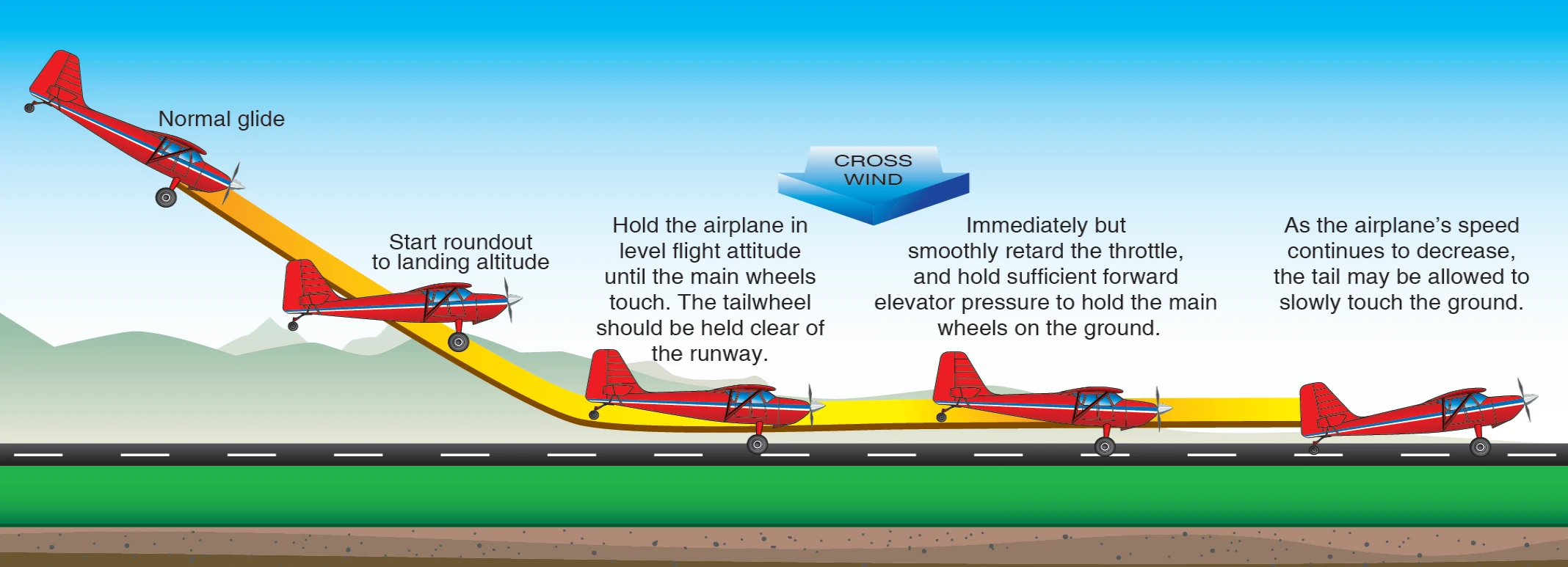
In some wind conditions, the need to retain control authority may make it desirable to make contact with the runway at a higher airspeed than that associated with the three-point attitude. This necessitates landing in a flatter pitch attitude on the main wheels only, with the tailwheel still off the surface. [Figure 14-3] As noted, if the tail is off the ground, it tends to drop and put the plane airborne, so a soft touchdown and a slight relaxation of back elevator just after the wheels touch are key ingredients to a successful wheel landing.
Once the main wheels are on the surface, the tail should be permitted to drop on its own accord until it too makes ground contact. At this point, the elevator should be brought to the full aft position and deceleration should be allowed to proceed as in a three-point landing.
If the touchdown is made at too high a rate of descent, the tail is forced down by its own weight, resulting in a sudden increase in lift. If the pilot now pushes forward in an attempt to again make contact with the surface, a potentially dangerous pilot-induced oscillation may develop. It is far better to respond to a bounced wheel landing attempt by initiating a go-around or converting to a three-point landing if conditions permit.
Note: The only difference between three-point and wheel landings is the timing of the touchdown (early and later). There is no difference between the approach angles and airspeeds in the two techniques.
Crosswinds
As noted, it is highly desirable to eliminate crab and drift at touchdown. By far the best approach to crosswind management is a side-slip or wing-low touchdown. Landing in this attitude, only one main wheel makes initial contact, either in concert with the tailwheel in three-point landings or by itself in wheel landings. Many tailwheel pilots prefer completing a wheel landing in a crosswind, as the initial touchdown speed is higher than for a three-point landing, making the flight controls more effective. In addition, in some aircraft, the rudder effectiveness can be reduced by the blocking effect of the fuselage and flaps with the tail low and on the ground.
After-Landing Roll
The landing process should never be considered complete until the airplane decelerates to the normal taxi speed during the landing roll or has been brought to a complete stop when clear of the landing area. The pilot should be alert for directional control difficulties immediately upon and after touchdown, and the elevator control should be held back as far as possible and as firmly as possible until the airplane stops. This provides more positive control with tailwheel steering, tends to shorten the after-landing roll, and prevents bouncing and skipping.
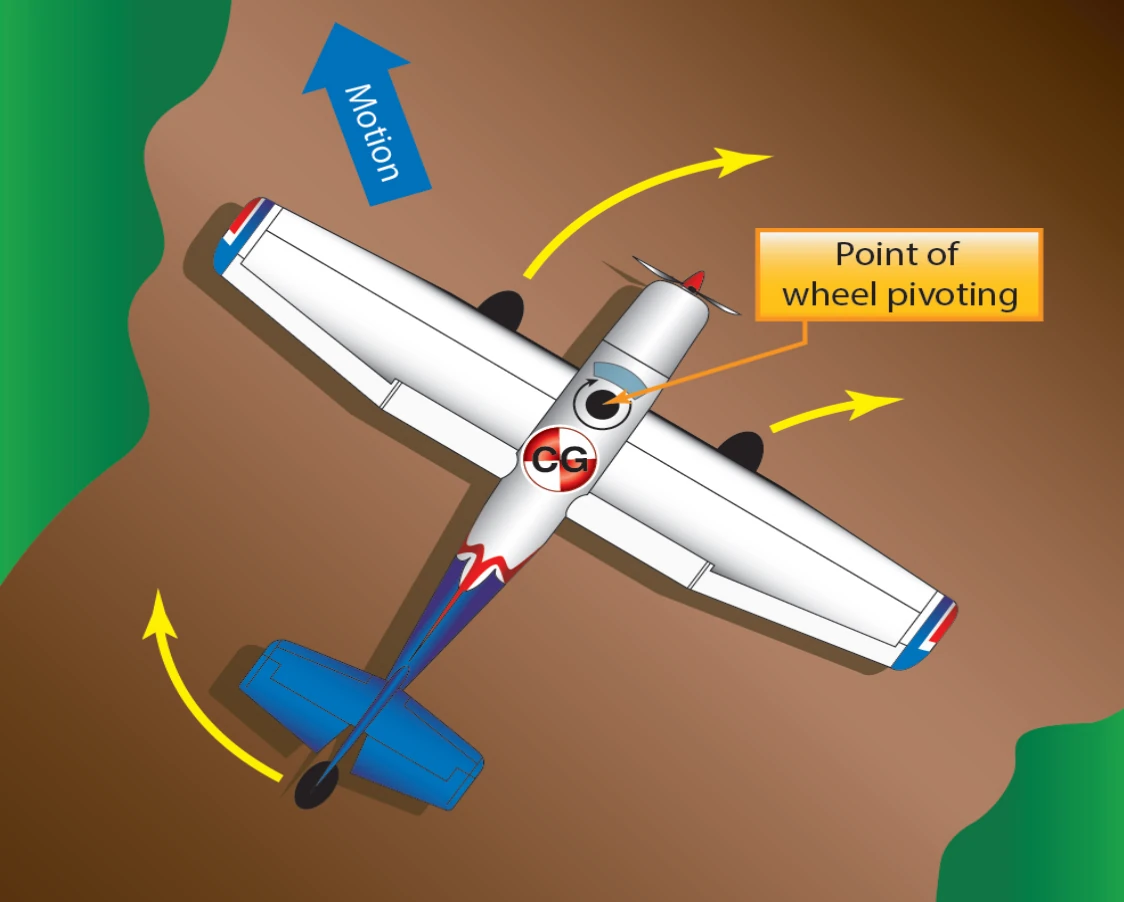
Any difference between the direction the airplane is traveling and the direction it is headed (drift or crab) produces a moment about the pivot point of the wheels, and the airplane tends to swerve. Loss of directional control may lead to an aggravated, uncontrolled, tight turn on the ground, or a ground loop. The combination of inertia acting on the CG and ground friction of the main wheels during the ground loop may cause the airplane to tip enough for the outside wingtip to contact the ground and may even impose a sideward force that could collapse one landing gear leg. [Figure 14-4] In general, this combination of events is eliminated by landing straight and avoiding turns at higher than normal running speed.
To use the brakes, the pilot should slide the toes or feet up from the rudder pedals to the brake pedals (or apply heel pressure in airplanes equipped with heel brakes). If rudder pressure is being held at the time braking action is needed, that pressure should not be released as the feet or toes are being slid up to the brake pedals because control may be lost before brakes can be applied. During the ground roll, the airplane’s direction of movement may be changed by carefully applying pressure on one brake or uneven pressures on each brake in the desired direction. Caution should be exercised when applying brakes to avoid overcontrolling.
If a wing starts to rise, aileron control should be applied toward that wing to lower it. The amount required depends on speed because as the forward speed of the airplane decreases, the ailerons become less effective.
If available runway permits, the speed of the airplane should be allowed to dissipate in a normal manner by the friction and drag of the wheels on the ground. Brakes may be used if needed to help slow the airplane. After the airplane has been slowed sufficiently and has been turned onto a taxiway or clear of the landing area, it should be brought to a complete stop. Only after this is done should the pilot retract the flaps and perform other checklist items.
Crosswind After-Landing Roll
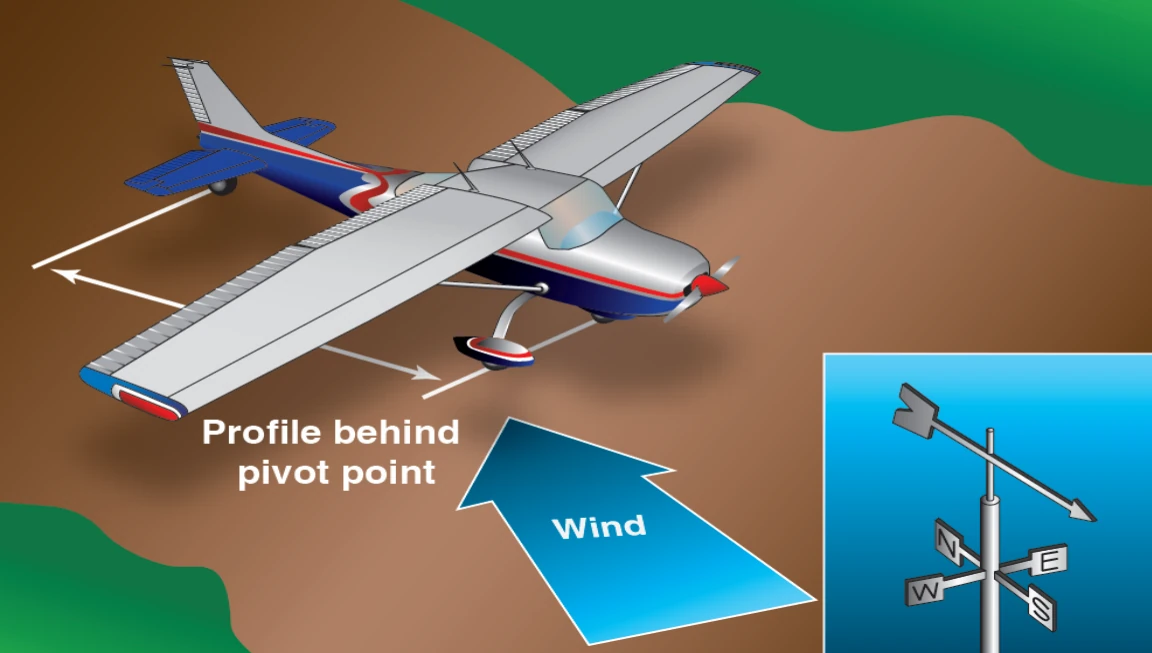
Particularly during the after-landing roll, special attention should be given to maintaining directional control by the use of rudder and tailwheel steering while keeping the upwind wing from rising by the use of aileron. Characteristically, an airplane has a greater profile or side area behind the main landing gear than forward of it. With the main wheels acting as a pivot point and the greater surface area exposed to the crosswind behind that pivot point, the airplane tends to turn or weathervane into the wind. [Figure 14-5] This weathervaning tendency is more prevalent in the tailwheel-type because the airplane’s surface area behind the main landing gear is greater than in nose-wheel-type airplanes.
Pilots should be familiar with the crosswind component of each airplane they fly and avoid operations in wind conditions that exceed the capability of the airplane, as well as their own limitations. While the airplane is decelerating during the after-landing roll, more aileron should be applied to keep the upwind wing from rising. Since the airplane is slowing down, there is less airflow around the ailerons and they become less effective. At the same time, the relative wind is becoming more of a crosswind and exerting a greater lifting force on the upwind wing. Consequently, when the airplane is coming to a stop, the aileron control should be held fully toward the wind.
Short-Field Landing
Upon touchdown, the airplane should be firmly held in a three-point attitude. This provides aerodynamic braking by the wings. Immediately upon touchdown and closing the throttle, the brakes should be applied evenly and firmly to minimize the after-landing roll. The airplane should be stopped within the shortest possible distance consistent with safety.