
Chapter 15
Transition to Turbopropeller-Powered Airplanes
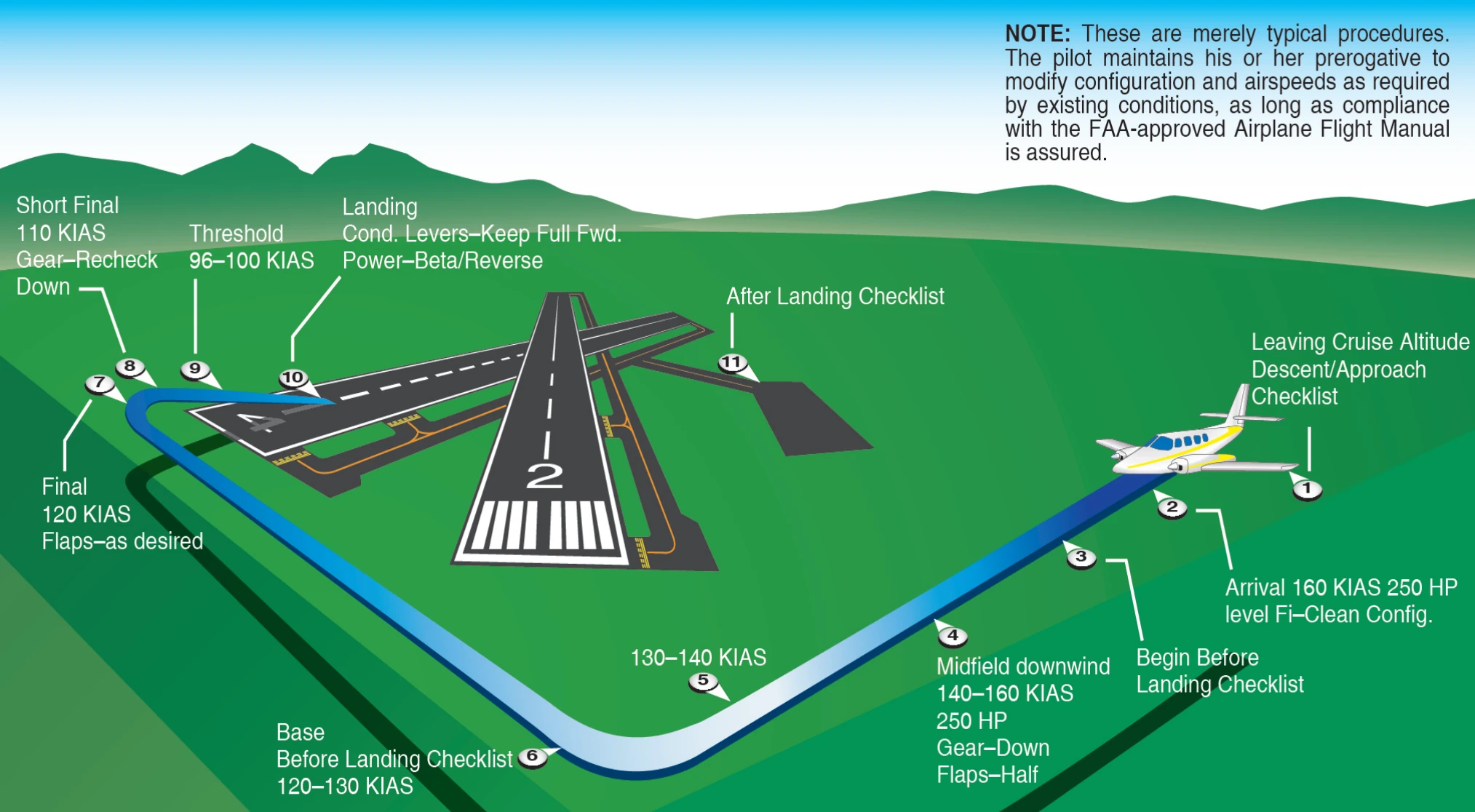
A stabilized approach is an essential part of the approach and landing process. In a stabilized approach, the airplane, depending on design and type, is placed in a stabilized descent on a glidepath ranging from 2.5 to 3.5°. The speed is stabilized at some reference from the AFM/POH—usually 1.25 to 1.30 times the stall speed in approach configuration. The descent rate is stabilized from 500 fpm to 700 fpm until the landing flare.
Landing some turboprop airplanes (as well as some piston twins) can result in a hard, premature touchdown if the engines are idled too soon. This is because large propellers spinning rapidly in low pitch create considerable drag. In such airplanes, it may be preferable to maintain power throughout the landing flare and touchdown. Once firmly on the ground, propeller beta range operation dramatically reduces the need for braking in comparison to piston airplanes of similar weight.
Training Considerations
The medium and high altitudes at which turboprop airplanes are flown provide an entirely different environment in terms of regulatory requirements, airspace structure, physiological requirements, and even meteorology. The pilot transitioning to turboprop airplanes, particularly those who are not familiar with operations in the high/medium altitude environment, should approach turboprop transition training with this in mind. Thorough ground training should cover all aspects of high/medium altitude flight, including the flight environment, weather, flight planning and navigation, physiological aspects of high-altitude flight, oxygen and pressurization system operation, and high-altitude emergencies.
Flight training should prepare the pilot to demonstrate a comprehensive knowledge of airplane performance, systems, emergency procedures, and operating limitations, along with a high degree of proficiency in performing all flight maneuvers and in-flight emergency procedures. The training outline below covers information used by pilots to operate safely at high altitudes.
Ground Training
1. High-Altitude Flight Environment
- Airspace and Reduced Vertical Separation Minimum (RVSM) Operations
- Title 14 Code of Federal Regulations (14 CFR) part 91, section 91.211, Requirements for Use of Supplemental Oxygen
2. Weather
- Atmosphere
- Winds and clear air turbulence
- Icing
3. Flight Planning and Navigation
- Flight planning
- Weather charts
- Navigation
- Navigation aids (NAVAIDs)
- High Altitude Redesign (HAR)
- RNAV/Required Navigation Performance (RNP) and Receiver Autonomous Integrity Monitoring (RAIM) prediction
4. Physiological Training
- Respiration
- Hypoxia
- Effects of prolonged oxygen use
- Decompression sickness
- Vision
- Altitude chamber (optional)
5. High-Altitude Systems and Components
- Oxygen and oxygen equipment
- Pressurization systems
- High-altitude components
6. Aerodynamics and Performance Factors
- Acceleration and deceleration
- Gravity (G)-forces
- Mach Tuck and Mach Critical (turbojet airplanes)
- Swept-wing concept
7. Emergencies