
Chapter 16
Transition to Jet-Powered Airplanes
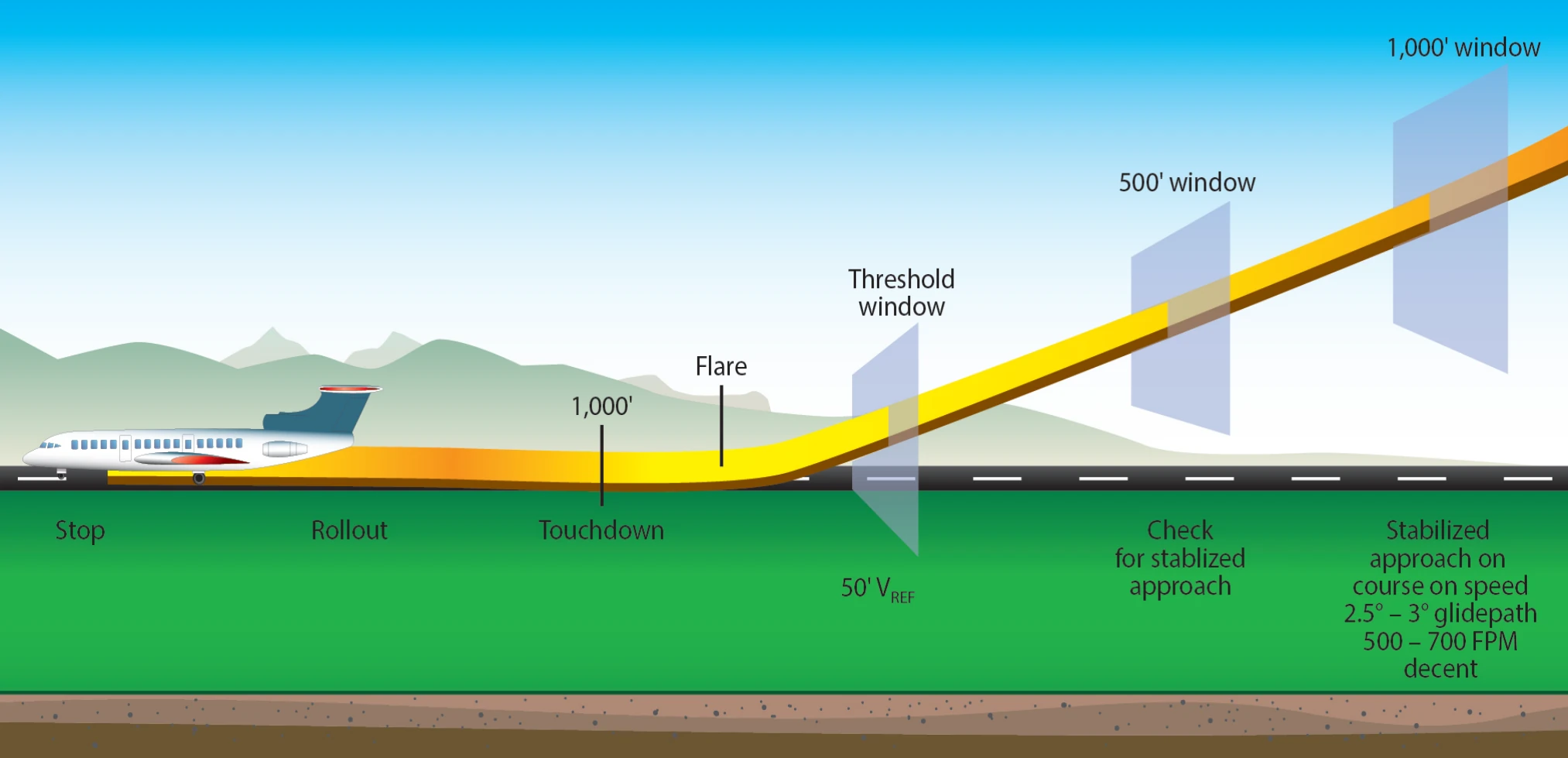
Approach Speed
Any speed deviation on final approach should be detected immediately and corrected. With experience, the pilot is able to detect the onset of an increasing or decreasing airspeed trend, which normally can be corrected with a small adjustment. It is imperative the pilot does not allow the airspeed to decrease below VREF or a high sink rate can develop. If an increasing sink rate is detected, it should be countered by increasing the AOA and simultaneously increasing thrust to counter the extra drag. The degree of correction depends on how much the sink rate needs to be reduced. For small amounts, smooth and gentle, almost anticipatory corrections are sufficient. For large sink rates, drastic corrective measures would be required that, even if successful, would destabilize the approach.
A common error in the performance of approaches in jet airplanes is excess approach speed. Excess approach speed carried through the threshold window and onto the runway increases the minimum stopping distance required by 20–30 feet per knot for a dry runway and 40–50 feet for a wet runway. Worse yet, the excess speed increases the chances of an extended flare, which increases the distance to touchdown by approximately 250 feet for each excess knot in speed.
Proper speed control on final approach is of primary importance. The pilot should anticipate the need for speed adjustment so that only small adjustments are required, and the airplane arrives at the approach threshold window exactly on speed.
Glidepath Control
The optimum glidepath angle is about 3°. On visual approaches, pilots may have a tendency to make flat approaches. A flat approach, however, increases landing distance and should be avoided. For example, an approach angle of 2° instead of a recommended 3° adds 500 feet to landing distance.
A more common error is excessive height over the threshold. This could be the result of an unstable approach or a stable but high approach. It also may occur during a nonprecision instrument approach where the missed approach point is close to or at the runway threshold. Regardless of the cause, excessive height over the threshold most likely results in a touchdown beyond the normal aiming point. An extra 50 feet of height over the threshold adds approximately 1,000 feet to the landing distance. The airplane should arrive at the approach threshold window exactly on altitude (50 feet above the runway).
The Flare
The flare reduces the approach rate of descent to a more acceptable rate for touchdown. Unlike light airplanes, a jet airplane should be flown onto the runway rather than “held off” the surface as speed dissipates. A jet airplane is aerodynamically clean even in the landing configuration, and its engines still produce residual thrust at idle rpm. Holding it off during the flare in an attempt to make a smooth landing greatly increases landing distance. A firm landing is normal and desirable. A firm landing does not mean a hard landing, but rather a deliberate or positive landing.
For most airports, the airplane passes over the end of the runway with the landing gear 30–45 feet above the surface, depending on the landing flap setting and the location of the touchdown zone. It takes 5–7 seconds from the time the airplane passes the end of the runway until touchdown. The flare is initiated by increasing the pitch attitude just enough to reduce the sink rate to 100–200 fpm when the landing gear is approximately 15 feet above the runway surface. In most jet airplanes, this requires a pitch attitude increase of only 1° to 3°. The thrust is smoothly reduced to idle as the flare progresses.
The normal speed bleed off during the time between passing the end of the runway and touchdown is just a few knots. Most of the decrease occurs during the flare when thrust is reduced. If the flare is extended (held off) while an additional speed is bled off, hundreds or even thousands of feet of runway may be used up. [Figure 16-19] The extended flare also results in additional pitch attitude, which may lead to a tail strike. It is, therefore, essential to fly the airplane onto the runway at the target touchdown point, even if the speed is excessive. A deliberate touchdown should be planned and practiced on every flight. A positive touchdown helps prevent an extended flare.
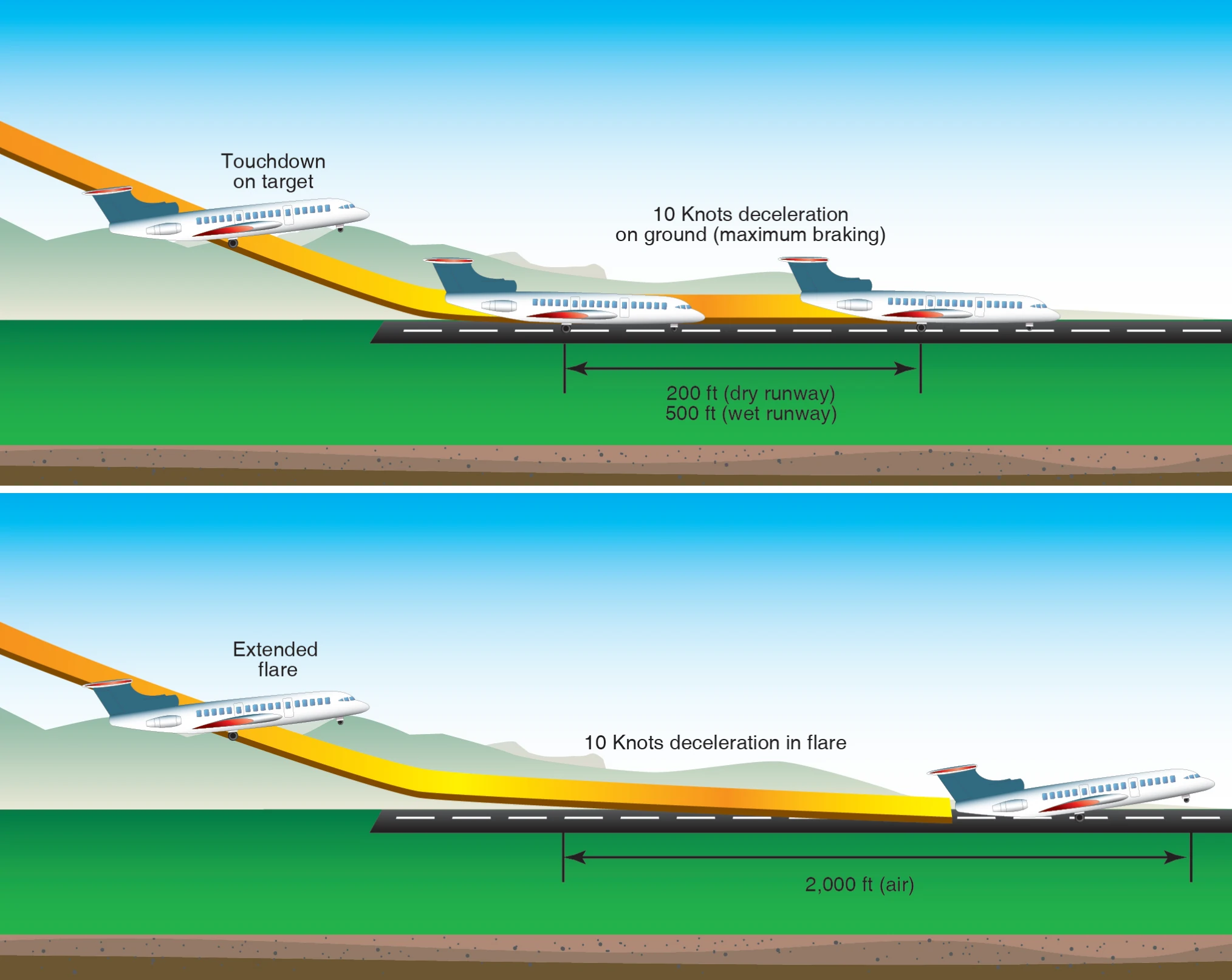
Pilots should learn the flare characteristics of each model of airplane they fly. The visual reference cues observed from each airplane are different because window geometry and visibility are different. The geometric relationship between the pilot’s eye and the landing gear is different for each make and model. It is essential that the flare maneuver be initiated at the proper height—not too high and not too low.
Beginning the flare too high or reducing the thrust too early may result in the airplane floating beyond the target touchdown point or may include a rapid pitch up as the pilot attempts to prevent a high sink rate touchdown. This can lead to a tail strike. The flare that is initiated too late may result in a hard touchdown.
Proper thrust management through the flare is also important. In many jet airplanes, the engines produce a noticeable effect on pitch trim when the thrust setting is changed. A rapid change in the thrust setting requires a quick elevator response. If the thrust levers are moved to idle too quickly during the flare, the pilot may need to make rapid changes in pitch control. If the thrust levers are moved more slowly, the elevator input can be more easily coordinated.
Touchdown and Rollout
A proper approach and flare positions the airplane to touch down in the touchdown target zone, which is usually about 1,000 feet beyond the runway threshold. Once the main wheels have contacted the runway, the pilot should maintain directional control and initiate the stopping process on the runway that remains in front of the airplane. The runway distance available to stop is longest if the touchdown was on target. The energy to be dissipated is least if there is no excess speed.
At the point of touchdown, the airplane represents a very large mass that is moving at a relatively high speed. The large total energy gets dissipated by the brakes, the aerodynamic drag, and the thrust reversers (if available). The nose-wheel should be lowered onto the ground immediately after touchdown because a jet airplane decelerates poorly when held in a nose-high attitude, and placing the nose-wheel tire(s) on the ground assists in maintaining directional control. Lowering the nose gear decreases the wing AOA, decreasing the lift, placing more load onto the tires, thereby increasing tire-to-ground friction. Landing distance charts for jet airplanes assume that the nose-wheel is lowered onto the runway within 4 seconds of touchdown.
There are only three forces available for stopping the airplane: wheel braking, reverse thrust, and aerodynamic braking. Of the three, the brakes are most effective and therefore the most important stopping force for most landings. When the runway is very slippery, reverse thrust and drag may be the dominant forces. Both reverse thrust and aerodynamic drag are most effective at high speeds. Neither is affected by runway surface conditions. Brakes, on the other hand, are most effective at low speed. The landing rollout distance depends on the touchdown speed, what forces are applied, and when they are applied. The pilot controls the what and when factors, but the maximum braking force may be limited by tire-to-ground friction.