
Chapter 16
Transition to Jet-Powered Airplanes
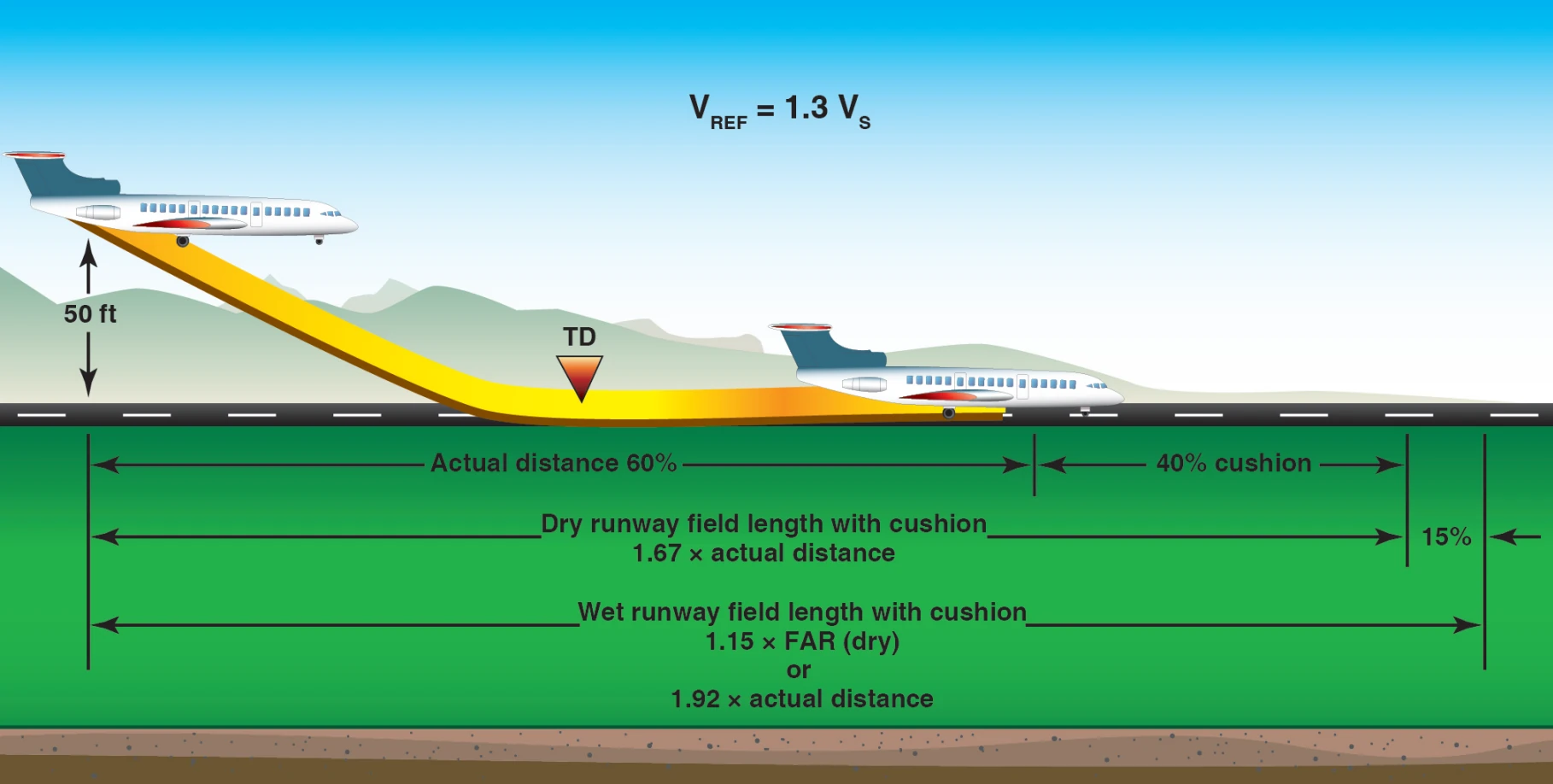
Simply put, the pilot divides the length of an intended runway by 1.67 or 1.92, as appropriate, to determine the minimum distance that should be available for landing. With this safety margin, it works out that the minimum dry runway field length should be at least 1.4 times the calculated air and ground distance needed, and the wet runway landing field length should be at least 1.61 times the calculated air and ground distance needed. Careful flight planning allows a pilot to determine how much load in terms of fuel, passengers, or cargo can be carried to a particular runway while still maintaining the desired safety margin. Depending on the destination, the load might need to be limited in order to protect the safety margin when landing. This is often complex, since fuel load has its own safety implications.
Certified landing field length requirements are computed for the stop made with speed brakes deployed and maximum wheel braking. Reverse thrust is not used in establishing the certified landing distances. However, reversers should definitely be used, if available.
Landing Speeds
As in the takeoff planning, there are certain speeds that should be taken into consideration when landing a jet airplane. The speeds are as follows:
- VSO —stall speed in the landing configuration.
- VREF —1.3 times the stall speed in the landing configuration.
- Approach climb—the speed that guarantees adequate performance in a go-around situation with an inoperative engine.
- Landing climb—the speed that guarantees adequate performance in arresting the descent and making a go-around from the final stages of landing with the airplane in the full landing configuration and maximum takeoff power available on all engines.
Pilots may need to perform traffic pattern takeoffs and landings. Pilots should use speeds recommended by the manufacturer while maneuvering in the traffic pattern prior to slowing to the final approach target speed in relation to VREF. The speeds should be calculated for every landing and posted where they are visible to both pilots.
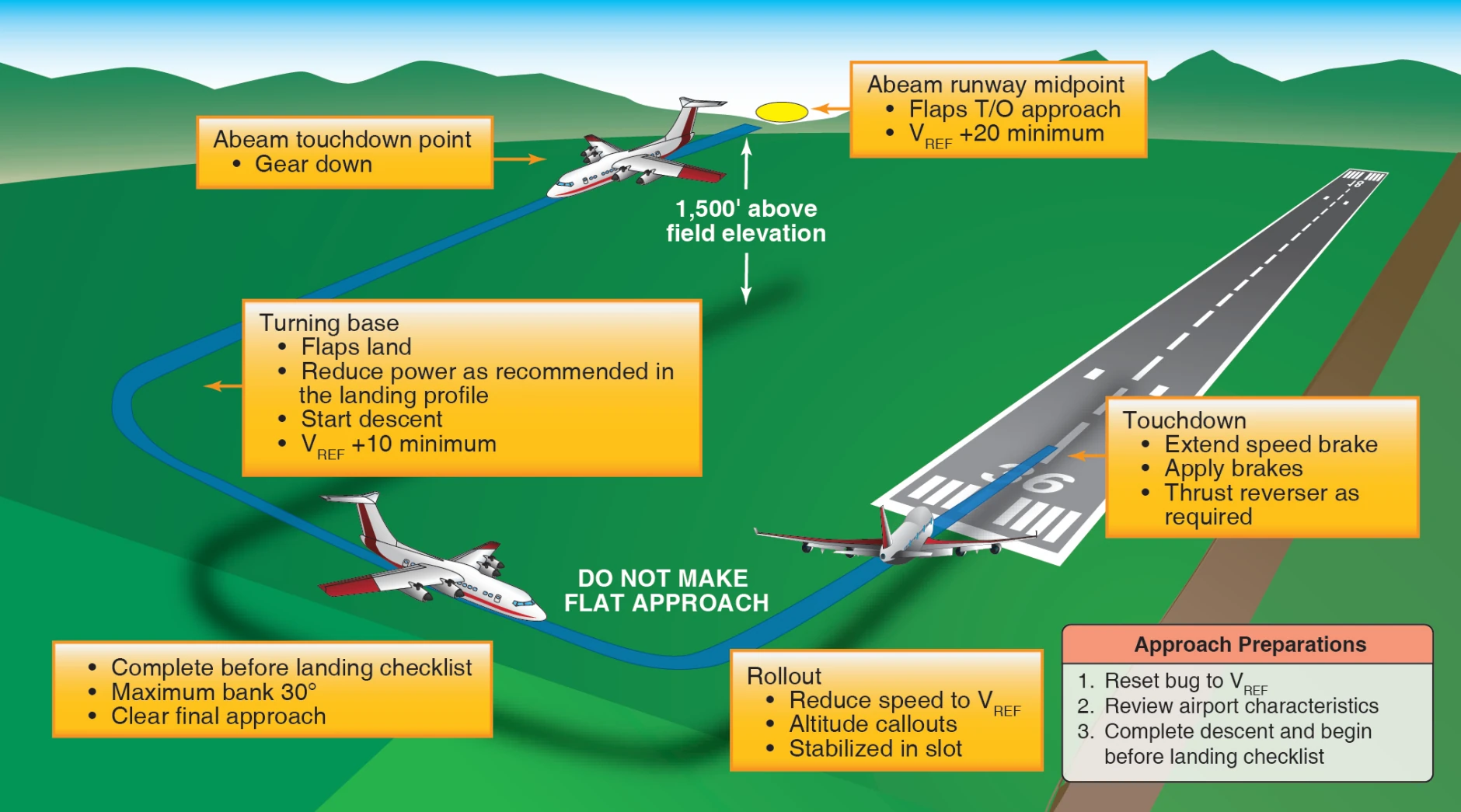
The approach and landing sequence in a jet airplane should be accomplished in accordance with an approach and landing profile developed for the particular airplane. [Figure 16-17]
Significant Differences
A safe approach in any type of airplane culminates in a particular position, speed, and height over the runway threshold. That final flight condition is the target window at which the entire approach aims. Propeller-powered airplanes are able to approach that target from wider angles, greater speed differentials, and a larger variety of glidepath angles. Jet airplanes are not as responsive to power and course corrections, so the final approach should be more stable, more deliberate, and more constant in order to reach the window accurately.
The transitioning pilot should understand that in spite of their impressive performance capabilities, there are many reasons why jet airplanes are less forgiving than piston-engine airplanes during approaches and when correcting approach errors.
- There is no propeller slipstream to produce immediate extra lift at constant airspeed. There is no such thing as salvaging a misjudged glidepath with a sudden burst of power. Added lift can only be achieved by accelerating the airframe.
- Propeller slipstream is not available to lower the power-on stall speed. There is virtually no difference between power-on and power-off stall speed. It is not possible in a jet airplane to jam the thrust levers forward to avoid a stall.
- Jet engine response at low rpm is slower. This characteristic requires that the approach be flown at a stable speed and power setting on final so that sufficient power is available quickly if needed.
- Jet airplanes are consistently heavier and have faster approach speeds than a comparably sized propeller airplane. Since greater force is required to overcome momentum for speed changes or course corrections, the typical jet responds less quickly than the propeller airplane and requires careful planning and stable conditions throughout the approach.
- When the speed does increase or decrease, there is little tendency for the jet airplane to re-acquire the original speed. The pilot needs to make speed adjustments promptly in order to remain on speed.
- Drag increases faster than lift and produces a high sink rate at low speeds. Jet airplane wings typically have a large increase in drag in the approach configuration. When a sink rate does develop, the only immediate remedy is to increase pitch attitude (AOA). Because drag increases faster than lift, that pitch change rapidly contributes to an even greater sink rate unless a significant amount of power is promptly applied.
These flying characteristics of jet airplanes make a stabilized approach an absolute necessity.
Stabilized Approach
The performance charts and the limitations contained in the FAA-approved AFM are predicated on momentum values that result from programmed speeds and weights. Runway length limitations assume an exact 50-foot threshold height at an exact speed of 1.3 times VSO. That “window” is critical and is a prime reason for the stabilized approach. Performance figures also assume that once through the target threshold window, the airplane touches down in a target touchdown zone approximately 1,000 feet down the runway, after which maximum stopping capability is used.
The basic elements to the stabilized approach are listed below as follows:
- The airplane should be in the landing configuration by 1,000 feet AGL in the approach. The landing gear should be down, landing flaps selected, trim set, and fuel balanced. Ensuring that these tasks are completed helps keep the number of variables to a minimum during the final approach.
- The airplane should be on profile before descending below 1,000 feet. Configuration, trim, speed, and glidepath should be at or near the optimum parameters early in the approach to avoid distractions and conflicts as the airplane nears the threshold window. An optimum glidepath angle of about 3° should be established and maintained.
- Indicated airspeed should be between zero and 10 knots above the target airspeed by 500 feet AGL. There are strong relationships between trim, speed, and power in most jet airplanes, and it is important to stabilize the speed in order to minimize those other variables.
- The optimum descent rate is dependent upon ground speed. A rule of thumb is to multiply half of ground speed by
- For example, a 130-knot ground speed should result in a (65 times
- 650 feet per minute descent rate. Typical descent rates fall between 500 and 700 feet per minute. An excessive vertical speed may indicate a problem with the approach.
Every approach should be evaluated at 500 feet. In a typical jet airplane, this is approximately 1 minute from touchdown. If the approach is not stabilized at that height, a go-around should be initiated. [Figure 16-18]