
Chapter 18
Emergency Procedures
Introduction
This chapter describes certain abnormal and emergency situations that may occur in flight. The key to successful management of an emergency situation, and/or preventing an abnormal situation from progressing into a true emergency, is a thorough familiarity with, and adherence to, the procedures developed by the airplane manufacturer. The following guidelines are generic and are not meant to replace the airplane manufacturer’s recommended procedures contained in the Federal Aviation Administration (FAA) approved Airplane Flight Manual and/or Pilot’s Operating Handbook (AFM/POH). Rather, they are meant to enhance the pilot’s general knowledge in the area of abnormal and emergency operations. If any of the guidance in this chapter conflicts in any way with the manufacturer’s recommended procedures for a particular make and model airplane, the manufacturer’s recommended procedures take precedence.
Emergency Landings
This section contains information on emergency landing techniques in small fixed-wing airplanes. The guidelines that are presented apply to the more adverse terrain conditions for which no practical training is possible. The objective is to instill in the pilot the knowledge that almost any terrain can be considered “suitable” for a survivable crash landing if the pilot knows how to use the airplane structure for self-protection and the protection of passengers.
Types of Emergency Landings
The different types of emergency landings are defined as follows:
- Forced landing—an immediate landing, on or off an airport, necessitated by the inability to continue further flight. A typical example of which is an airplane forced down by engine failure.
- Precautionary landing—a premeditated landing, on or off an airport, when further flight is possible but inadvisable. Examples of conditions that may call for a precautionary landing include deteriorating weather, being lost, fuel shortage, and gradually developing engine trouble.
- Ditching—a forced or precautionary landing on water.
A precautionary landing, generally, is less hazardous than a forced landing because the pilot has more time for terrain selection and the planning of the approach. In addition, the pilot can use power to compensate for errors in judgment or technique. The pilot should be aware that too many situations calling for a precautionary landing are allowed to develop into immediate forced landings, when the pilot uses wishful thinking instead of reason, especially when dealing with a self-inflicted predicament. The non-instrument-rated pilot trapped by weather, or the pilot facing imminent fuel exhaustion who does not give any thought to the feasibility of a precautionary landing, accepts an extremely hazardous alternative.
Psychological Hazards
There are several factors that may interfere with a pilot’s ability to act promptly and properly when faced with an emergency. Some of these factors are listed below.
- Reluctance to accept the emergency situation—a pilot who allows the mind to become paralyzed at the thought that the airplane will be on the ground in a very short time, regardless of the pilot’s actions or hopes, is severely handicapped in the handling of the emergency. An unconscious desire to delay the dreaded moment may lead to such errors as: failure to lower the nose to maintain flying speed, delay in the selection of the most suitable landing area within reach, and indecision in general. Desperate attempts to correct whatever went wrong at the expense of airplane control fall into the same category.
- Undue concern about getting hurt—fear is a vital part of the self-preservation mechanism. However, when fear leads to panic, we invite that which we want most to avoid. The survival records favor pilots who maintain their composure and know how to apply the general concepts and procedures that have been developed through the years. The success of an emergency landing is as much a matter of the mind as of skills.
- Desire to save the airplane—the pilot who has been conditioned during training to expect to find a relatively safe landing area, whenever the flight instructor closed the throttle for a simulated forced landing, may ignore all basic rules of airmanship to avoid a touchdown in terrain where airplane damage is unavoidable. Typical consequences are: making a 180° turn back to the runway when available altitude is insufficient; stretching the glide without regard for minimum control speed in order to reach a more appealing field; and accepting an approach and touchdown situation that leaves no margin for error. The desire to save the airplane, regardless of the risks involved, may be influenced by two other factors: the pilot’s financial stake in the airplane and the certainty that an undamaged airplane implies no bodily harm. There are times, however, when a pilot should be more interested in sacrificing the airplane so that the occupants can safely walk away from it.
Basic Safety Concepts
General
A pilot who is faced with an emergency landing in terrain that makes extensive airplane damage inevitable should keep in mind that the avoidance of crash injuries is largely a matter of: (1) keeping the vital structure (cabin area) relatively intact by using dispensable structure (i.e., wings, landing gear, fuselage bottom) to absorb the violence of the stopping process before it affects the occupants and (2) avoiding forceful bodily contact with interior structure. Avoiding forcible contact with interior structure is a matter of seat and body security. Unless the occupant decelerates at the same rate as the surrounding structure, no benefit is realized from its relative intactness. The occupant is brought to a stop violently in the form of a secondary collision.
The advantage of sacrificing dispensable structure is demonstrated daily on the highways. A head-on car impact against a tree at 20 miles per hour (mph) is less hazardous for a properly restrained driver than a similar impact against the driver’s door. Accident experience shows that the extent of crushable structure between the occupants and the principal point of impact on the airplane has a direct bearing on the severity of the transmitted crash forces and, therefore, on survivability.
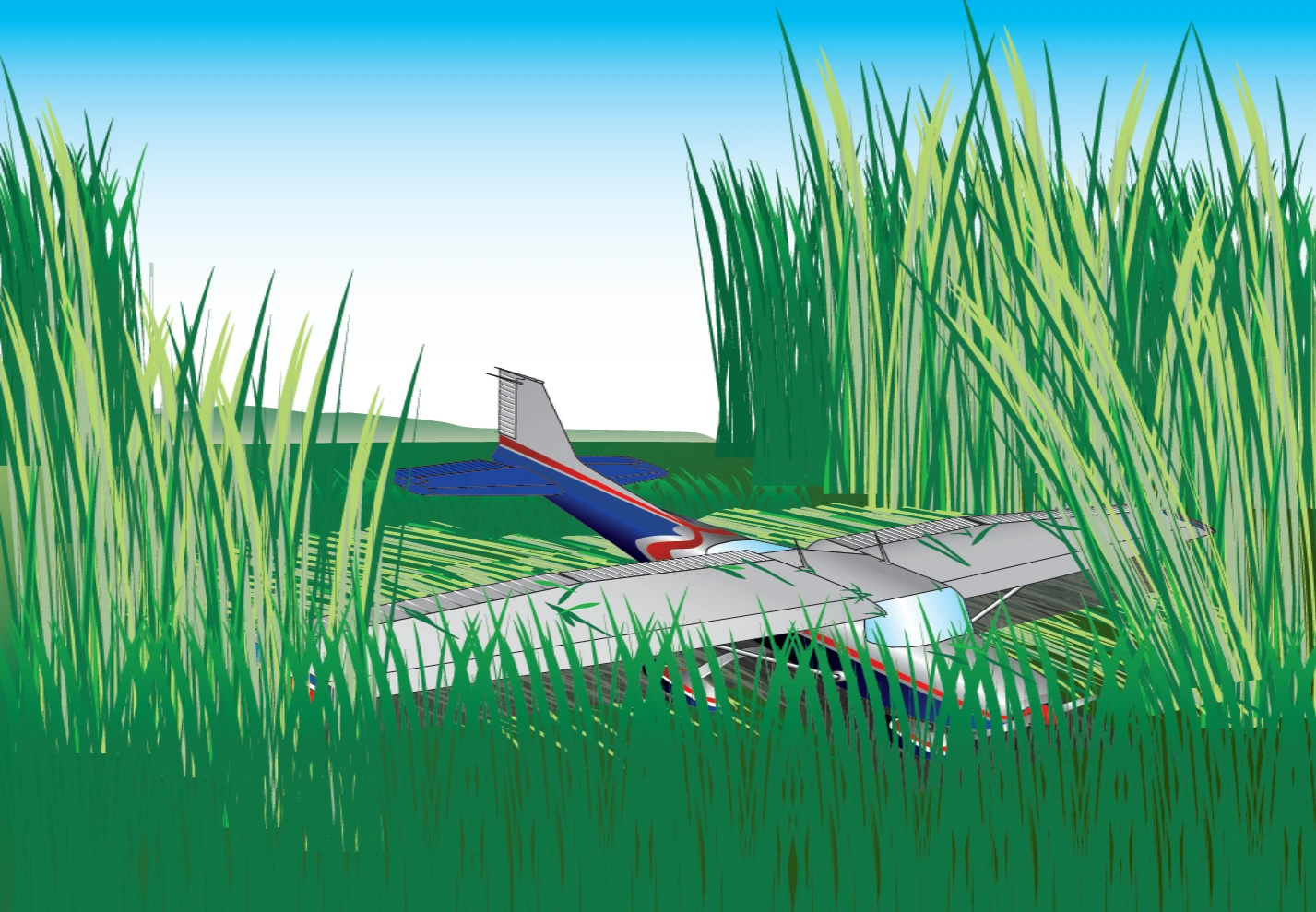
Dispensable airplane structure is not the only available energy absorbing medium in an emergency situation. Vegetation, trees, and even manmade structures may be used for this purpose. Cultivated fields with dense crops, such as mature corn and grain, are almost as effective in bringing an airplane to a stop with repairable damage as an emergency arresting device on a runway. [Figure 18-1] Brush and small trees provide considerable cushioning and braking effect without destroying the airplane. When dealing with natural and manmade obstacles with greater strength than the dispensable airplane structure, the pilot should plan the touchdown in such a manner that only nonessential structure is “used up” in the principal slowing-down process.
The overall severity of a deceleration process is governed by speed (groundspeed) and stopping distance. The most critical of these is speed; doubling the groundspeed means quadrupling the total destructive energy and vice versa. Even a small change in groundspeed at touchdown—be it as a result of wind or pilot technique—affects the outcome of a controlled crash. It is important that the actual touchdown during an emergency landing be made at the lowest possible controllable airspeed, using all available aerodynamic devices.
Most pilots instinctively—and correctly—look for the largest available flat and open field for an emergency landing. Actually, very little stopping distance is required if the speed can be dissipated uniformly; that is, if the deceleration forces can be spread evenly over the available distance. This concept is designed into the arresting gear of aircraft carriers that provides a nearly constant stopping force from the moment of hookup.