
Chapter 18
Emergency Procedures
Terrain Types
Since an emergency landing on suitable terrain resembles a situation in which the pilot should be familiar through training, only the more unusual situations are discussed.
Confined Areas
The natural preference to set the airplane down on the ground should not lead to the selection of an open spot between trees or obstacles where the ground cannot be reached without making a steep descent.
Once the intended touchdown point is reached, and the remaining open and unobstructed space is very limited, it may be better to force the airplane down on the ground than to delay touchdown until it stalls (settles). An airplane decelerates faster after it is on the ground than while airborne. Thought may also be given to the desirability of ground-looping or retracting the landing gear in certain conditions.
A river or creek can be an inviting alternative in otherwise rugged terrain. The pilot should ensure that the water or creek bed can be reached without snagging the wings. The same concept applies to road landings with one additional reason for caution: manmade obstacles on either side of a road may not be visible until the final portion of the approach.
When planning the approach across a road, it should be remembered that most highways and even rural dirt roads are paralleled by power or telephone lines. Only a sharp lookout for the supporting structures or poles may provide timely warning.
Trees (Forest)
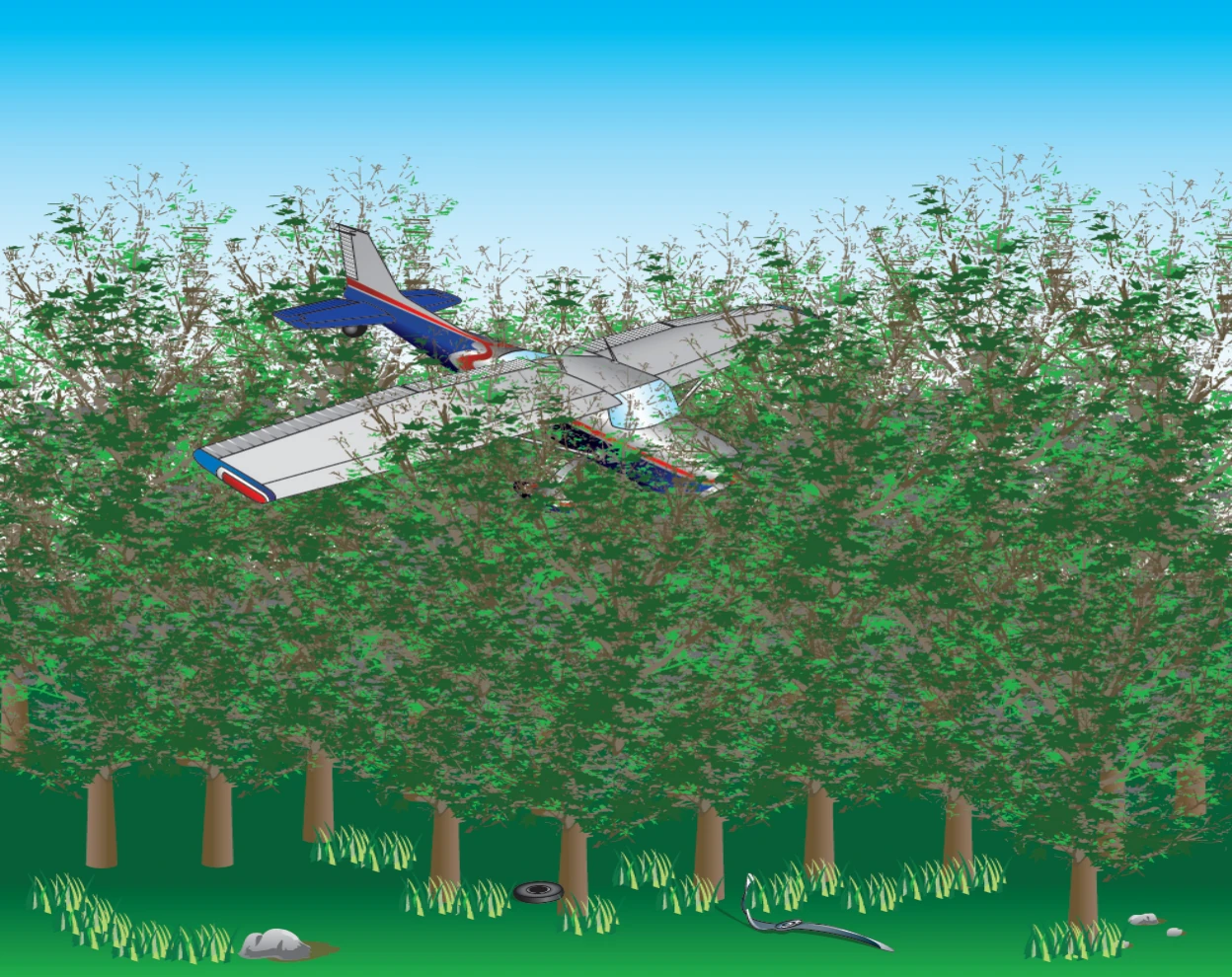
Although a tree landing is not an attractive prospect, the following general guidelines help to make the experience survivable.
- Use the normal landing configuration (full flaps, gear down).
- Keep the groundspeed low by heading into the wind.
- Make contact at minimum indicated airspeed, but not below stall speed, and “hang” the airplane in the tree branches in a nose-high landing attitude. Involving the underside of the fuselage and both wings in the initial tree contact provides a more even and positive cushioning effect, while preventing penetration of the windshield. [Figure 18-4]
- Avoid direct contact of the fuselage with heavy tree trunks.
- Low, closely spaced trees with wide, dense crowns (branches) close to the ground are much better than tall trees with thin tops; the latter allow too much free fall height (a free fall from 75 feet results in an impact speed of about 40 knots, or about 4,000 fpm).
- Ideally, initial tree contact should be symmetrical; that is, both wings should meet equal resistance in the tree branches. This distribution of the load helps to maintain proper airplane attitude. It may also preclude the loss of one wing, which invariably leads to a more rapid and less predictable descent to the ground.
- If heavy tree trunk contact is unavoidable once the airplane is on the ground, it is best to involve both wings simultaneously by directing the airplane between two properly spaced trees. Do not attempt this maneuver, however, while still airborne.
Water (Ditching) and Snow
A well-executed water landing normally involves less deceleration violence than a poor tree landing or a touchdown on extremely rough terrain. Also, an airplane that is ditched at minimum speed and in a normal landing attitude does not immediately sink upon touchdown. Intact wings and fuel tanks (especially when empty) provide floatation for at least several minutes, even if the cabin may be just below the water line in a high-wing airplane.
Loss of depth perception may occur when landing on a wide expanse of smooth water with the risk of flying into the water or stalling in from excessive altitude. To avoid this hazard, the airplane should be “dragged in” when possible. Use no more than intermediate flaps on low-wing airplanes. The water resistance of fully extended flaps may result in asymmetrical flap failure and slowing of the airplane. Keep a retractable gear up unless the AFM/POH advises otherwise.
A landing in snow should be executed like a ditching, in the same configuration and with the same regard for loss of depth perception (white out) in reduced visibility and on wide-open terrain.
Engine Failure After Takeoff (Single-Engine)
A number of variables and pilot actions factor into a successful emergency landing shortly after takeoff. When an engine failure occurs during the initial climb, the pilot should lower the nose of the airplane and establish the proper glide attitude. What happens next if the engine does not restart? Does the pilot select a field directly ahead (or slightly to the side of the takeoff path) or should the pilot turn back toward the point of departure? There's not much time to decide and a lot to consider.
Continuing straight ahead or making a slight turn gives the pilot time to establish a safe landing attitude, and the landing occurs under control and as slowly as possible (assuming a takeoff made into a headwind). This minimizes the risk of injury and usually represents the option with the lowest risk—i.e. the safest option. Turning back requires a more complex analysis and consideration of risk. At some urban airports, there may be numerous hazards in the departure path. In that case, the pilot might turn back, but only if certain the airplane can reach the field from its current position and the pilot has trained and practiced the turn back maneuver.
Turning back to an airport after a low-altitude engine failure, also known as “the impossible turn,” presents many challenges, and a pilot who attempts to turn back without due consideration and training will need considerable luck to prevent disaster. If the airplane strikes the ground during the turn, cartwheeling could occur. If the pilot does not lower the nose sufficiently during the turn, an accelerated stall and fatal crash may occur. Even after executing a successful turn, a return to the airport often results in a downwind approach. The increased groundspeed could rush a pilot not properly trained for landing downwind. The increased groundspeed and associated increase in kinetic energy also raise the likelihood of serious injury if unable to make the field.
If considering a turn back to the runway following an engine failure on takeoff, the pilot should know the expected altitude loss during the turn for the specific make and model airplane as well as whether the airplane can physically glide back to the field after executing the turn. Traditionally, the FAA has given the following example. An airplane has taken off and climbed to an altitude of 300 feet above ground level (AGL) when the engine fails. [Figure 18-5] After a typical 4-second reaction time, the pilot elects to turn back to the runway. Using a standard rate (3° change in direction per second) turn, it takes 1 minute to turn 180°. At a glide speed of 65 knots, the radius of the turn is 2,100 feet, so at the completion of the turn, the airplane is 4,200 feet to one side of the runway. The pilot needs to turn another 45° to head the airplane toward the runway. By this time, the total change in direction is 225° equating to 75 seconds plus the 4-second reaction time. If the airplane in a power-off glide descends at approximately 1,000 fpm, it has descended 1,316, feet placing it 1,016 feet below the runway.