
Chapter 18
Emergency Procedures
The preceding example illustrates why a turn back, if attempted, requires a turn with a higher bank angle. A standard rate or shallow turn consumes too much time, requires too much distance, and generates an unacceptable solution.
Training for a turn back includes practicing turns in both directions at a safe altitude in the make and model flown after simulating an engine failure from a climb. Practice should result in consistent altitude loss and the ability to avoid an accelerated stall when executing a gliding steep turn. Pilots should be alert for and respond appropriately to any stall warning and reduce wing loading during the turn as necessary. There will be some observed variation in altitude loss during training. The pilot should anticipate that during an actual emergency, the expected altitude loss could end up at the high end of the range observed while practicing. Success in training involves the demonstrated ability to evaluate the effect of climb performance of the airplane, determine the better direction to turn back (usually into a crosswind), predict the altitude above ground after the turn, know the distance to the landing zone, and know if the glide performance of the airplane will allow the pilot to make the field. Some airplanes cannot usually make the return successfully, some can make the return under certain conditions, and some can usually return. The pilot should not attempt a turn back unless a successful turn back will result.
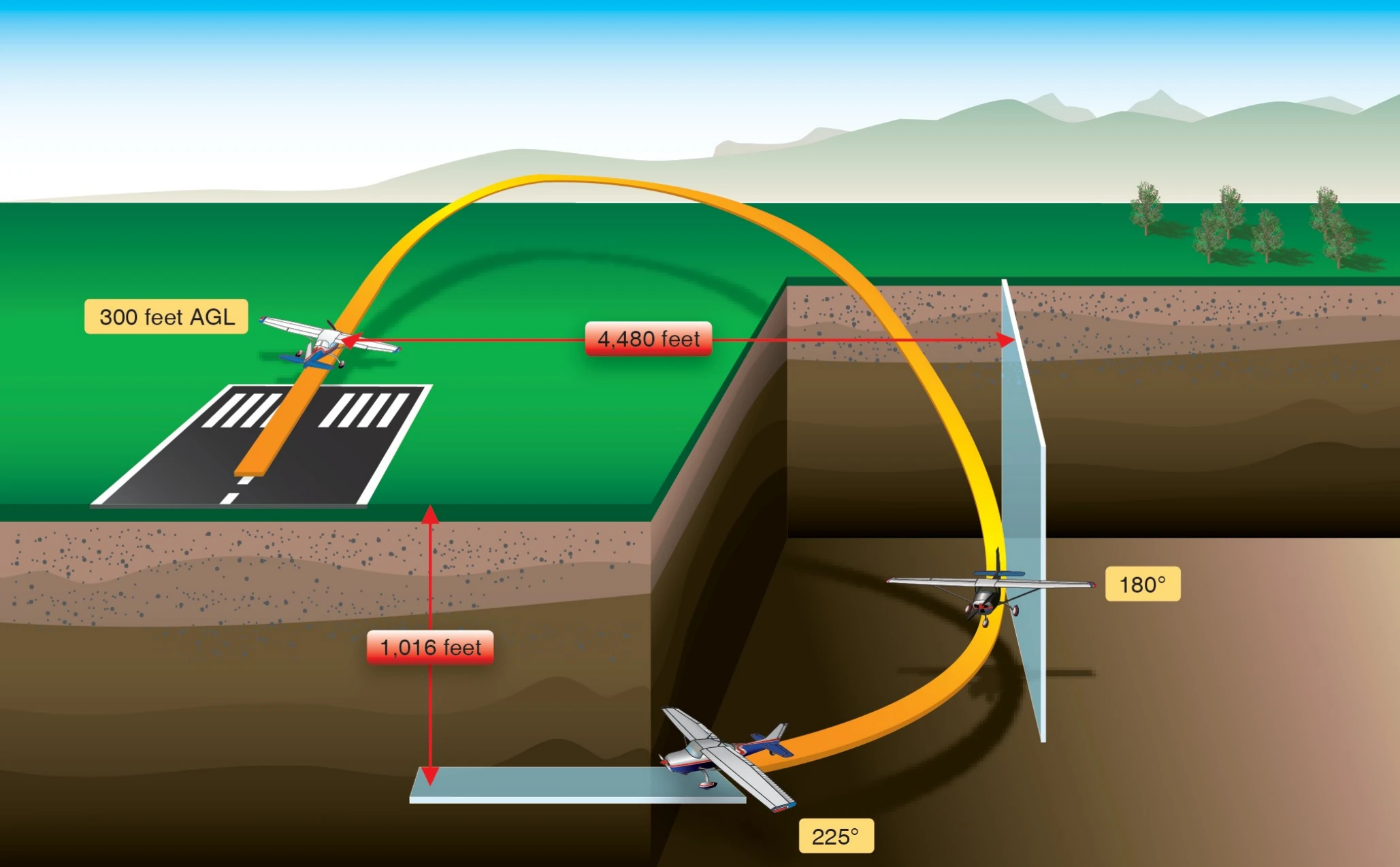
A turn back to the departure runway may require more than a 180° change in direction. There could also be cases where turning back results in overshooting the runway, and the pilot needs to sense the aiming point within seconds after completing a turn back and make any necessary adjustments to achieve the best possible outcome. A turn back at low altitudes presents an unacceptable risk for student pilots, low-time pilots, untrained pilots, pilots without adequate proficiency, and pilots flying airplanes with insufficient glide performance to return to the field. However, experienced pilots interested in knowing when and how to make an emergency turn back after takeoff should use the services of an authorized flight instructor who can explain and demonstrate the practicality (or impracticality) of “the impossible turn” in the specific make and model used during training.
Emergency Descents
An emergency descent is a maneuver for descending as rapidly as possible to a lower altitude or to the ground for an emergency landing. [Figure 18-6] The need for this maneuver may result from an uncontrollable fire, a sudden loss of cabin pressurization, or any other situation demanding an immediate and rapid descent. The objective is to descend the airplane as soon and as rapidly as possible while not exceeding any structural limitations of the airplane. Simulated emergency descents should be made in a turn to check for other air traffic below and to look around for a possible emergency landing area. A radio call announcing descent intentions may be appropriate to alert other aircraft in the area. When initiating the descent, a bank of approximately 30 to 45° should be established to maintain positive load factors (G forces) on the airplane.
Emergency descent training should be performed as recommended by the manufacturer, including the configuration and airspeeds. Except when prohibited by the manufacturer, the power should be reduced to idle, and the propeller control (if equipped) should be placed in the low pitch (or high revolutions per minute (rpm)) position. This allows the propeller to act as an aerodynamic brake to help prevent an excessive airspeed buildup during the descent. The landing gear and flaps should be extended as recommended by the manufacturer. This provides maximum drag so that the descent can be made as rapidly as possible, without excessive airspeed. The pilot should not allow the airplane’s airspeed to pass the never-exceed speed (VNE ), the maximum landing gear extended speed (VLE ), or the maximum flap extended speed (VFE ), as applicable. In the case of an engine fire, a high airspeed descent could blow out the fire. However, the weakening of the airplane structure is a major concern and descent at low airspeed would place less stress on the airplane. If the descent is conducted in turbulent conditions, the pilot also needs to comply with the design maneuvering speed (VA ) limitations. The descent should be made at the maximum allowable airspeed consistent with the procedure used. This provides increased drag and a high rate of descent. The recovery from an emergency descent should be initiated at a high enough altitude to ensure a safe recovery back to level flight or a precautionary landing.
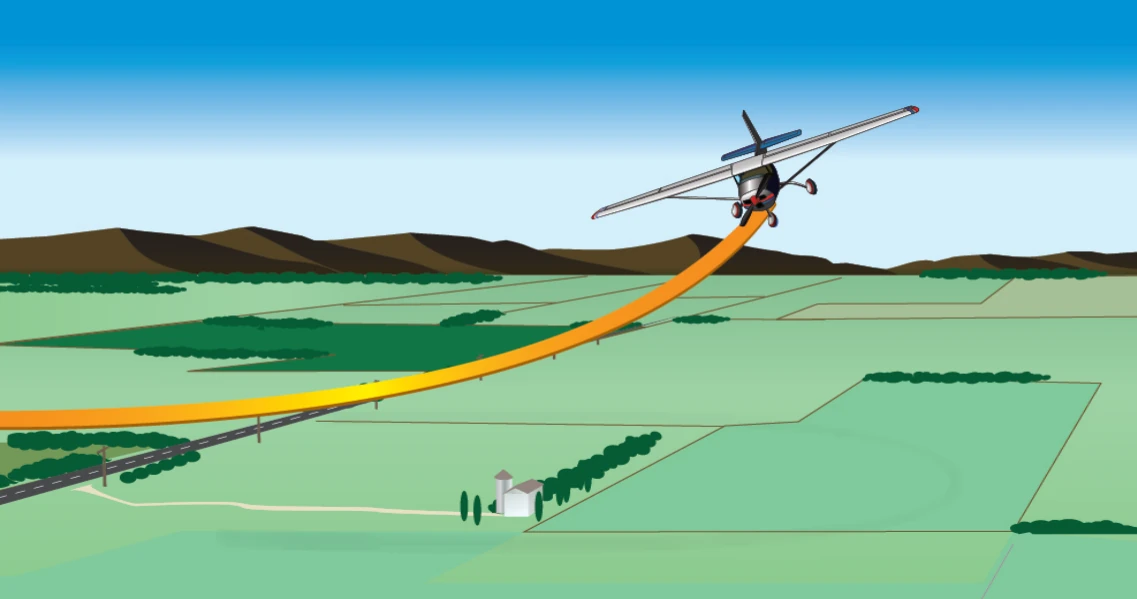
When the descent is established and stabilized during training and practice, the descent should be terminated. In airplanes with piston engines, prolonged practice of emergency descents should be avoided to prevent excessive cooling of the engine cylinders.
In-Flight Fire
A fire in-flight demands immediate and decisive action. The pilot should be familiar with the procedures outlined to meet this emergency contained in the AFM/POH for the particular airplane. For the purposes of this handbook, in-flight fires are classified as in-flight engine fires, electrical fires, and cabin fires.
Engine Fire
An in-flight engine compartment fire is usually caused by a failure that allows a flammable substance, such as fuel, oil, or hydraulic fluid, to come in contact with a hot surface. This may be caused by a mechanical failure of the engine itself, an engine-driven accessory, a defective induction or exhaust system, or a broken line. Engine compartment fires may also result from maintenance errors, such as improperly installed/fastened lines and/or fittings resulting in leaks.
Engine compartment fires can be indicated by smoke and/or flames coming from the engine cowling area. They can also be indicated by discoloration, bubbling, and/or melting of the engine cowling skin in cases where flames and/or smoke are not visible to the pilot. By the time a pilot becomes aware of an in-flight engine compartment fire, it usually is well developed. Unless the airplane manufacturer directs otherwise in the AFM/POH, the first step on discovering a fire should be to shut off the fuel supply to the engine by placing the mixture control in the idle cut off position and the fuel selector shutoff valve to the OFF position. The ignition switch should be left ON in order to use up the fuel that remains in the fuel lines and components between the fuel selector/shutoff valve and the engine. This procedure may starve the engine compartment of fuel and cause the fire to die naturally. If the flames are snuffed out, no attempt should be made to restart the engine.
If the engine compartment fire is oil-fed, as evidenced by thick black smoke, as opposed to a fuel-fed fire, which produces bright orange flames, the pilot should consider stopping the propeller rotation by feathering or other means, such as (with constant-speed propellers) placing the pitch control lever to the minimum rpm position and raising the nose to reduce airspeed until the propeller stops rotating. This procedure stops an engine-driven oil (or hydraulic) pump from continuing to pump the flammable fluid that is feeding the fire.
Some light airplane emergency checklists direct the pilot to shut off the electrical master switch. However, the pilot should consider that unless the fire is electrical in nature, or a crash landing is imminent, deactivating the electrical system prevents the use of panel radios for transmitting distress messages and also causes air traffic control (ATC) to lose transponder returns.
Pilots of powerless single-engine airplanes are left with no choice but to make a forced landing. Pilots of twin-engine airplanes may elect to continue the flight to the nearest airport. However, consideration should be given to the possibility that a wing could be seriously impaired and lead to structural failure. Even a brief but intense fire could cause dangerous structural damage. In some cases, the fire could continue to burn under the wing (or engine cowling in the case of a single- engine airplane) out of view of the pilot. Engine compartment fires that appear to have been extinguished have been known to rekindle with changes in airflow pattern and airspeed.
The pilot should be familiar with the airplane’s emergency descent procedures. The pilot should also bear in mind the following:
- The airplane may be severely structurally damaged to the point that its ability to remain under control could be lost at any moment.
- The airplane may still be on fire and susceptible to explosion.
- The airplane is expendable and the only thing that matters is the safety of those on board.