Chapter 3
Basic Flight Maneuvers
Steep turns require accurate, smooth, and timely flight control inputs. Minor corrections for pitch attitude are accomplished with proportional elevator back pressure while the bank angle is held constant with the ailerons. However, during steep turns, it is not uncommon for a pilot to allow the nose to get excessively low resulting in a significant loss in altitude in a very short period of time. The recovery sequence requires that the pilot first reduce the angle of bank with coordinated use of opposite aileron and rudder and then increase the pitch attitude by increasing elevator back pressure. If recovery from an excessively nose-low, steep bank condition is attempted by use of the elevator only, it only causes a steepening of the bank and unnecessary stress on the airplane. Steep turn performance can be improved by an appropriate application of power to overcome the increase in drag. Depending on the purpose of a steep turn and the magnitude of control force needed, trimming additional elevator back pressure as the bank angle goes beyond 30° may assist the pilot during the turn.
Since the airplane continues turning as long as there is any bank, the rollout from the turn should be started before reaching the desired heading. The amount of lead required to rollout on the desired heading depends on the degree of bank used in the turn. A rule of thumb is to lead by one-half the angle of bank. For example, if the bank is 30°, lead the rollout by 15°. The rollout from a turn is similar to the roll-in except the flight controls are applied in the opposite direction. Aileron and rudder are applied in the direction of the rollout or toward the high wing. As the angle of bank decreases, the elevator pressure should be relaxed as necessary to maintain altitude. As the wings become level, the flight control pressures should be smoothly relaxed so that the controls are neutralized as the airplane returns to straight-and-level flight. If trim was used, such as during a steep turn, forward elevator pressure may be required until the trim can be adjusted. As the rollout is being completed, attention should be given to outside visual references, as well as the flight instruments to determine that the wings are being leveled and the turn stopped.
Because the elevator and ailerons are on one control, practice is required to ensure that only the intended pressure is applied to the intended flight control. For example, a beginner pilot is likely to unintentionally add pressure to the pitch control when the only bank was intended. This cross-coupling may be diminished or enhanced by the design of the flight controls; however, practice is the appropriate measure for smooth, precise, and accurate flight control inputs. For example, diving when turning right and climbing when turning left in airplanes is common with stick controls, because the arm tends to rotate from the elbow joint, which induces a secondary arc control motion if the pilot is not extremely careful. Likewise, lowering the nose is likely to induce a right turn, and raising the nose to climb tends to induce a left turn. These actions would apply for a pilot using the right hand to move the stick. Airplanes with a control wheel may be less prone to these inadvertent actions, depending on control positions and pilot seating. In any case, the pilot should retain the proper sight picture of the nose following the horizon, whether up, down, left, or right and isolate undesired motion.
Common errors in level turns are:
- Failure to adequately clear in the direction of turn for aircraft traffic.
- Gaining or losing altitude during the turn.
- Not holding the desired bank angle constant.
- Attempting to execute the turn solely by instrument reference.
- Leaning away from the direction of the turn while seated.
- Insufficient feel for the airplane as evidenced by the inability to detect slips or skids without flight instruments.
- Attempting to maintain a constant bank angle by referencing only the airplane’s nose.
- Making skidding flat turns to avoid banking the airplane.
- Holding excessive rudder in the direction of turn.
- Gaining proficiency in turns in only one direction.
- Failure to coordinate the controls.
Climbs and Climbing Turns
When an airplane enters a climb, excess lift needs to be developed to overcome the weight or gravity. This requirement to develop more lift results in more induced drag, which either results in decreased airspeed or an increased power setting to maintain a minimum airspeed in the climb. An airplane can only sustain a climb when there is sufficient thrust to offset increased drag; therefore, climb rate is limited by the excess thrust available.
The pilot should know the engine power settings, natural horizon pitch attitudes, and flight instrument indications that produce the following types of climb:
- Normal climb—performed at an airspeed recommended by the airplane manufacturer. Normal climb speed is generally higher than the airplane’s best rate of climb. The additional airspeed provides for better engine cooling, greater control authority, and better visibility over the nose of the airplane. Normal climb is sometimes referred to as cruise climb.
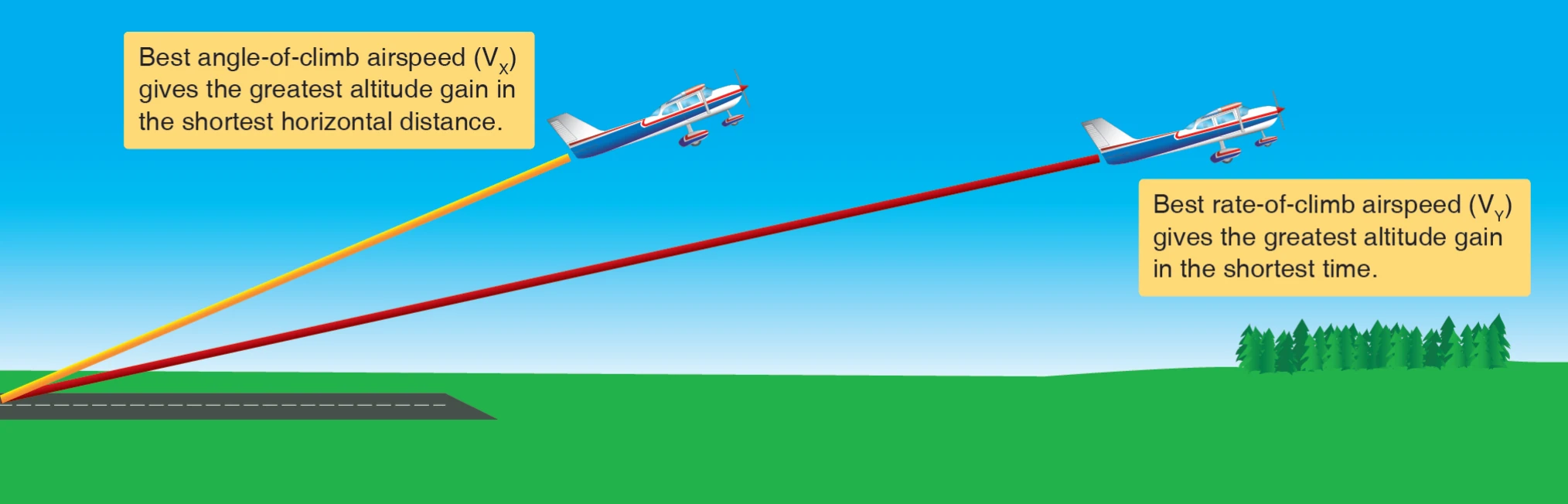
- Best rate of climb (VY)—produces the most altitude gained over a given amount of time. This airspeed is typically used when initially departing a runway without obstructions until it is safe to transition to a normal or cruise climb configuration.
- Best angle of climb (VX)—performed at an airspeed that produces the most altitude gain over a given horizontal distance. The best angle of climb results in a steeper climb, although the airplane takes more time to reach the same altitude than it would at best rate of climb airspeed. The best angle of climb is used to clear obstacles, such as a strand of trees, after takeoff. [Figure 3-19]
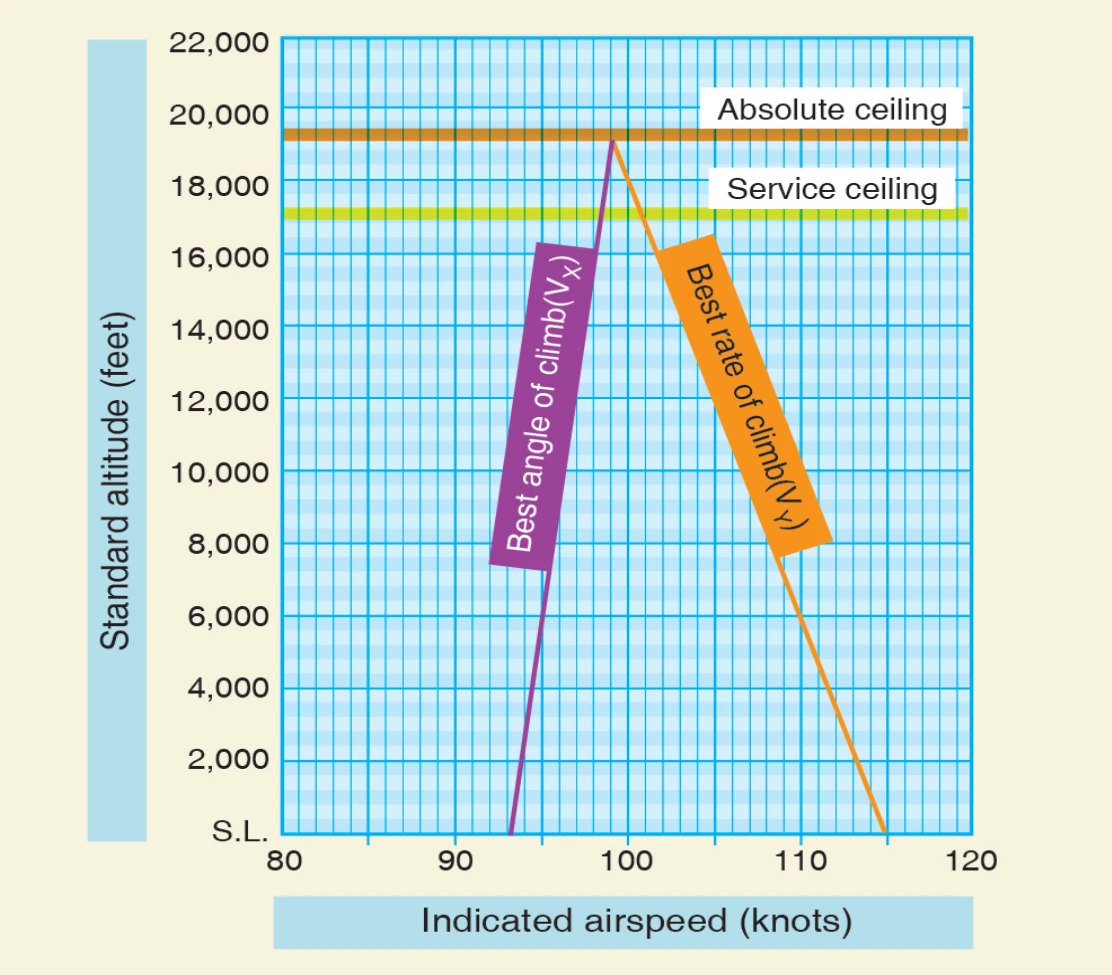
It should be noted that as altitude increases, the airspeed for best angle of climb increases and the airspeed for best rate of climb decreases. Performance charts contained in the Airplane Flight Manual or Pilot’s Operating Handbook (AFM/POH) should be consulted to ensure that the correct airspeed is used for the desired climb profile at the given environmental conditions. There is a point at which the best angle of climb airspeed and the best rate of climb airspeed intersect. This occurs at the absolute ceiling at which the airplane is incapable of climbing any higher. [Figure 3-20]
Establishing a Climb
A straight climb is entered by gently increasing back pressure on the elevator flight control to the pitch attitude referencing the airplane’s nose to the natural horizon while simultaneously increasing engine power to the climb power setting. The wingtips should be referenced in maintaining the climb attitude while cross-checking the flight instruments to verify performance. In many airplanes, as power is increased, an increase in slipstream over the horizontal stabilizer causes the airplane’s pitch attitude to increase more than desired. The pilot should be prepared for slipstream effects but also for the effect of changing airspeed and changes in lift. The pilot should be prepared to use the required flight control pressures to achieve the desired pitch attitude.
If a climb is started from cruise flight, the airspeed gradually decreases as the airplane enters a stabilized climb attitude. The thrust required to maintain straight-and-level flight at a given airspeed is not sufficient to maintain the same airspeed in a climb. Increase drag in a climb stems from increased lift demands made upon the wing to increase altitude. Climbing requires an excess of lift over that necessary to maintain level flight. Increased lift will generate more induced drag. That increase in induced drag is why more power is needed and why a sustained climb requires an excess of thrust.
For practical purposes gravity or weight is a constant. A vector diagram shows why more lift is necessary during a climb, as the vertical component of lift generated from the wings is no longer perpendicular to the wings and adds to drag. The total vertical force is increased by adding a vertical component of thrust from the powerplant, and the power should be advanced to the recommended climb power. On airplanes equipped with an independently controllable-pitch propeller, this requires advancing the propeller control prior to increasing engine power. Some airplanes may be equipped with cowl flaps to facilitate effective engine cooling. The position of the cowl flaps should be set to ensure cylinder head temperatures remain within the manufacturer’s specifications.
Engines that are normally aspirated experience a reduction of power as altitude is gained. As altitude increases, air density decreases, which results in a reduction of power. The indications show a reduction in revolutions per minute (rpm) for airplanes with fixed pitch propellers; airplanes that are equipped with controllable propellers show a decrease in manifold pressure. The pilot should reference the engine instruments to ensure that climb power is being maintained and that pressures and temperatures are within the manufacturer’s limits. As power decreases in the climb, the pilot continually advances the throttle or power lever to maintain specified climb settings.
The pilot should understand propeller effects during a climb and when using high power settings. The propeller in most airplanes rotates clockwise when seen from the pilot’s position. As pitch attitude is increased, the center of thrust from the propeller moves to the right and becomes asymmetrical. This asymmetric condition is often called “P-factor.” This is the result of the increased AOA of the descending propeller blade, which is the right side of the propeller disc when seen from the flight deck. As the center of propeller thrust moves to the right, a left turning yawing moment moves the nose of the airplane to the left. This is compensated by the pilot through right rudder pressure. In addition, torque that acts opposite to the direction of propeller rotation causes the airplane to roll to the left. Under these conditions, torque and P-factor cause the airplane to roll and yaw to the left. To counteract this, right rudder and aileron flight control pressures should be used. During the initial practice of climbs, this may initially seem awkward; however, after some experience the correction for propeller effects becomes instinctive.
As the airspeed decreases during the climb’s establishment, the airplane’s pitch attitude tends to lower unless the pilot increases the elevator flight control pressure. Nose-up elevator trim should be used so that the pitch attitude can be maintained without the pilot holding back elevator pressure. Throughout the climb, since the power should be fixed at the climb power setting, airspeed is controlled by the use of elevator pressure. The pitch attitude to the natural horizon determines if the pitch attitude is correct and should be cross-checked to the flight instruments to verify climb performance. [Figure 3-21]