
Chapter 6
Takeoffs and Departure Climbs
Introduction
About twenty percent of all yearly general aviation (GA) accidents occur during takeoff and departure climbs, and more than half of those accidents are the result of some sort of failure of the pilot. A significant number of takeoff accidents are the result of loss of control of the airplane. When compared to the entire profile of a normal flight, this phase of a flight is relatively short, but the pilot workload is intense. This chapter discusses takeoffs and departure climbs in airplanes under normal conditions and under conditions that require maximum performance.
Though it may seem relatively simple, the takeoff often presents the most hazards of any part of a flight. The importance of thorough knowledge of procedures and techniques coupled with proficiency in performance cannot be overemphasized.
The discussion in this chapter is centered on airplanes with tricycle landing gear (nose-wheel). Procedures for conventional gear airplanes (tail-wheel) are discussed in Chapter 14: Transition to Tailwheel Airplanes. The manufacturer’s recommended procedures pertaining to airplane configuration, airspeeds, and other information relevant to takeoffs and departure climbs in a specific make and model airplane are contained in the Federal Aviation Administration (FAA)-approved Airplane Flight Manual and/or Pilot’s Operating Handbook (AFM/POH) for that airplane. If any of the information in this chapter differs from the airplane manufacturer’s recommendations as contained in the AFM/POH, the airplane manufacturer’s recommendations take precedence.
Terms and Definitions
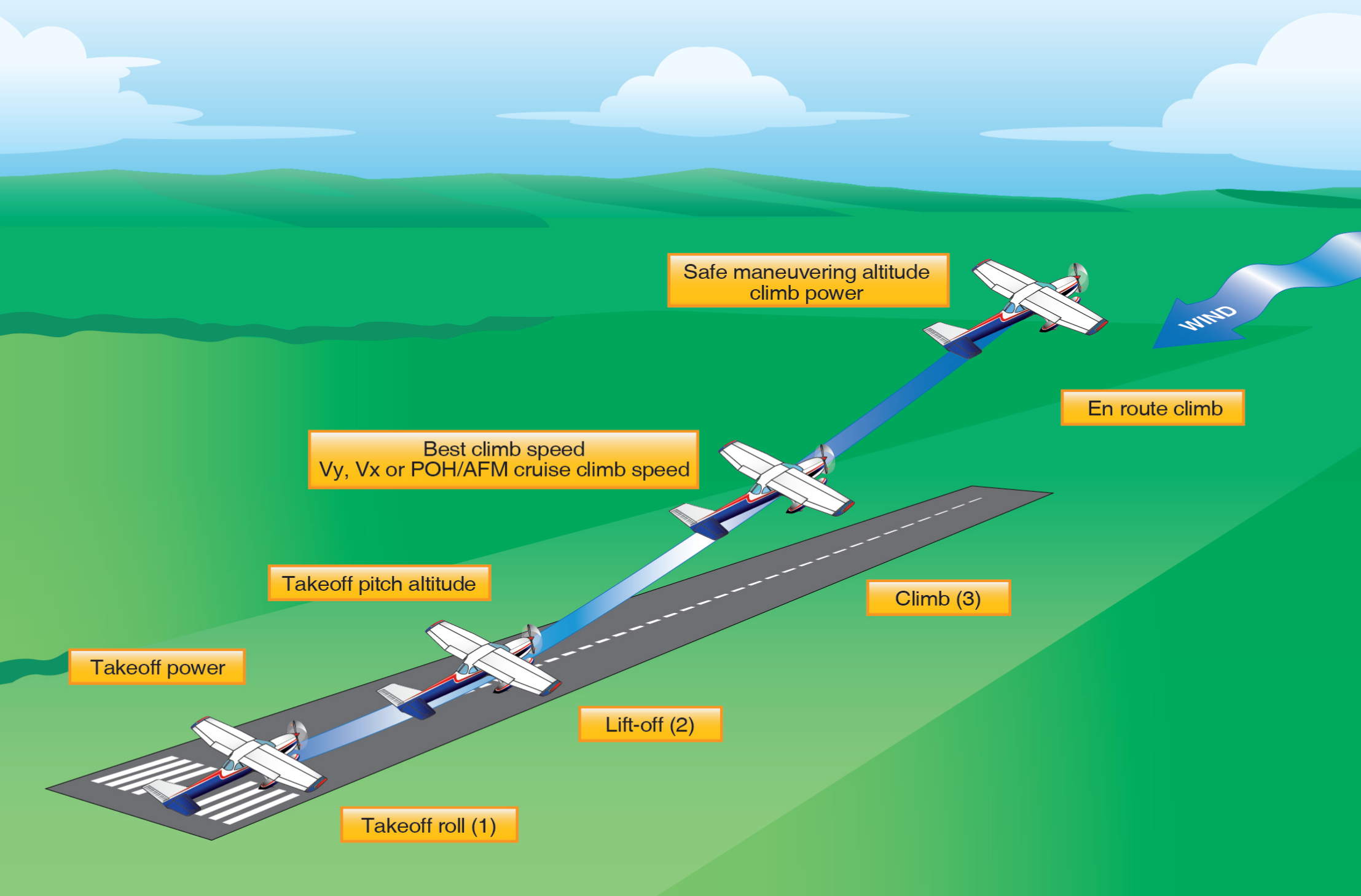
Although the takeoff and climb is one continuous maneuver, it will be divided into three separate steps for purposes of explanation: 1.) takeoff roll; 2.) lift-off; and 3.) initial climb after becoming airborne. Refer to Figure 6-1 and the detail below.
- Takeoff roll (ground roll) is the portion of the takeoff procedure during which the airplane is accelerated from a standstill to an airspeed that provides sufficient lift for it to become airborne.
- Lift-off is when the wings are lifting the weight of the airplane off the surface. In most airplanes, this is the result of the pilot rotating the nose up to increase the angle of attack (AOA).
- The initial climb begins when the airplane leaves the surface and a climb pitch attitude has been established. Normally, it is considered complete when the airplane has reached a safe maneuvering altitude or an en route climb has been established.
Prior to Takeoff
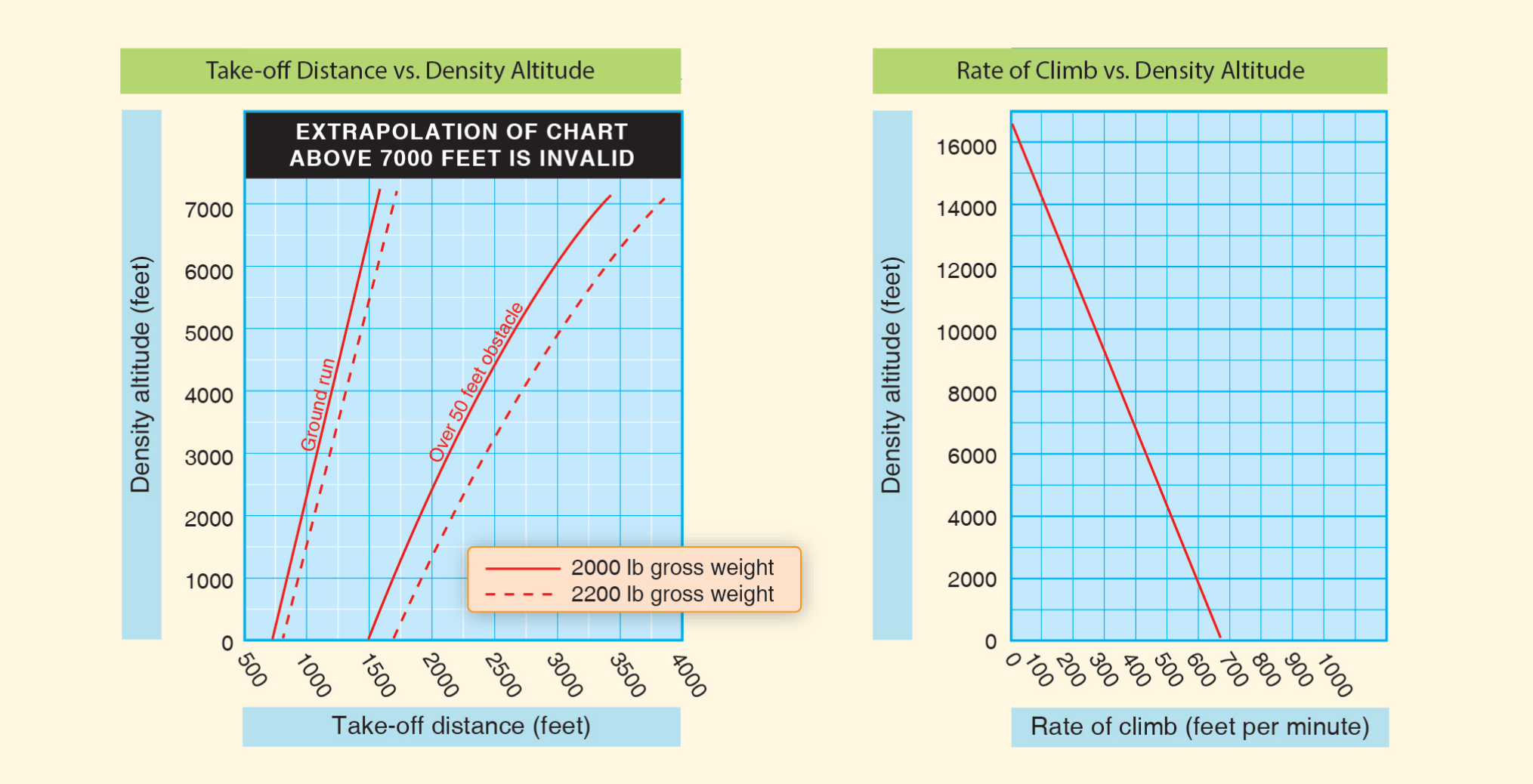
Before going to the airplane, the pilot should check the POH/AFM performance charts to determine the predicted performance and decide if the airplane is capable of a safe takeoff and climb for the conditions and location. [Figure 6-2] High density altitudes reduce engine and propeller performance, increase takeoff rolls, and decrease climb performance. A more detailed discussion of density altitude and how it affects airplane performance can be found in the Pilot’s Handbook of Aeronautical Knowledge (FAA-H-8083-25, as revised).
All run-up and pre-takeoff checklist items should be completed before taxiing onto the runway or takeoff area. As a minimum before every takeoff, all engine instruments should be checked for proper and usual indications, and all controls should be checked for full, free, and correct movement. The pilot should also consider available options if an engine failure occurs after takeoff. These options include the preferred direction for any emergency turns to landing sites based on the departure path, altitude, wind conditions, and terrain. In addition, the pilot should make certain that the approach and takeoff paths are clear of other aircraft. At nontowered airports, pilots should announce their intentions on the common traffic advisory frequency (CTAF) assigned to that airport. When operating from a towered airport, pilots need to contact the tower operator and receive a takeoff clearance before taxiing onto the active runway.
Taking off immediately behind another aircraft, particularly a large and heavy transport airplane, creates the risk of a wake turbulence encounter, and a possible loss of control. However, if an immediate takeoff behind a large heavy aircraft is necessary, the pilot should plan to minimize the chances of flying through an aircraft’s wake turbulence by avoiding the other aircraft’s flightpath or rotating prior to the point at which the preceding aircraft rotated. While taxiing onto the runway, the pilot should select ground reference points that are aligned with the runway direction to aid in maintaining directional control and alignment with the runway center line during the climb out. These may be runway centerline markings, runway lighting, distant trees, towers, buildings, or mountain peaks.
Normal Takeoff
A normal takeoff is one in which the airplane is headed into the wind; there are times that a takeoff with a tail wind is necessary. However, the pilot should consult the POH/AFM to ensure the aircraft is approved for a takeoff with a tail wind and that there is sufficient performance and runway length for the takeoff. The pilot should also ensure that the takeoff surfaces are firm and of sufficient length to permit the airplane to gradually accelerate to normal lift-off and climb-out speed, and there are no obstructions along the takeoff path.
There are two reasons for making a takeoff as nearly into the wind as possible. First, since the airplane depends on airspeed, a headwind provides some of that airspeed even before the airplane begins to accelerate into the wind. Second, a headwind decreases the ground speed necessary to achieve flying speed. Slower ground speeds yield shorter ground roll distances and allow use of shorter runways while reducing wear and stress on the landing gear.
Takeoff Roll
For takeoff, the pilot uses the rudder pedals in most general aviation airplanes to steer the airplane’s nose-wheel onto the runway centerline to align the airplane and nose-wheel with the runway. After releasing the brakes, the pilot should advance the throttle smoothly and continuously to takeoff power. An abrupt application of power may cause the airplane to yaw sharply to the left because of the torque effects of the engine and propeller. This is most apparent in high horsepower engines. As the airplane starts to roll forward, assure both feet are on the rudder pedals so that the toes or balls of the feet are on the rudder portions, not on the brake. Check the engine instruments for indications of a malfunction during the takeoff roll.
In nose-wheel type airplanes, pressures on the elevator control are not necessary beyond those needed to steady it. Applying unnecessary pressure only aggravates the takeoff and prevents the pilot from recognizing when elevator control pressure is actually needed to establish the takeoff attitude.
As the airplane gains speed, the elevator control tends to assume a neutral position if the airplane is correctly trimmed. At the same time, the rudder pedals are used to keep the nose of the airplane pointed down the runway and parallel to the centerline. The effects of engine torque and P-factor at the initial speeds tend to pull the nose to the left. The pilot should use whatever rudder pressure is needed to correct for these effects or winds. The pilot should use aileron controls into any crosswind to keep the airplane centered on the runway centerline. The pilot should avoid using the brakes for steering purposes as this will slow acceleration, lengthen the takeoff distance, and possibly result in severe swerving.