Chapter 6
Takeoffs and Departure Climbs
During initial climb, it is important that the takeoff path remain aligned with the runway to avoid drifting into obstructions or into the path of another aircraft that may be taking off from a parallel runway. A flight instructor should help the student identify two points inline ahead of the runway to use as a tracking reference. As long as those two points are inline, the airplane is remaining on the desired track. Proper scanning techniques are essential to a safe takeoff and climb, not only for maintaining attitude and direction, but also for avoiding collisions near the airport.
When the student pilot nears the solo stage of flight training, it should be explained that the airplane’s takeoff performance will be much different when the instructor is not in the airplane. Due to decreased load, the airplane will become airborne earlier and climb more rapidly. The pitch attitude that the student has learned to associate with initial climb may also differ due to decreased weight, and the flight controls may seem more sensitive. If the situation is unexpected, it may result in increased anxiety that may remain until after the landing. Frequently, the existence of this anxiety and the uncertainty that develops due to the perception of an “abnormal” takeoff results in poor performance on the subsequent landing.
Common Errors
Common errors in the performance of normal takeoffs and departure climbs are:
- Failure to review AFM/POH and performance charts prior to takeoff.
- Failure to adequately clear the area prior to taxiing into position on the active runway.
- Abrupt use of the throttle.
- Failure to check engine instruments for signs of malfunction after applying takeoff power.
- Failure to anticipate the airplane’s left turning tendency on initial acceleration.
- Overcorrecting for left turning tendency.
- Relying solely on the airspeed indicator rather than developing an understanding of visual references and tracking clues of airplane airspeed and controllability during acceleration and lift-off.
- Failure to attain proper lift-off attitude.
- Inadequate compensation for torque/P-factor during initial climb resulting in a sideslip.
- Over-control of elevators during initial climb-out and lack of elevator trimming.
- Limiting scan to areas directly ahead of the airplane (pitch attitude and direction), causing a wing (usually the left) to drop immediately after lift-off.
- Failure to attain/maintain best rate-of-climb airspeed (VY ) or desired climb airspeed.
- Failure to employ the principles of attitude flying during climb-out, resulting in “chasing” the airspeed indicator.
Crosswind Takeoff
While it is usually preferable to take off directly into the wind whenever possible or practical, there are many instances when circumstances or judgment indicate otherwise. Therefore, the pilot must be familiar with the principles and techniques involved in crosswind takeoffs, as well as those for normal takeoffs. A crosswind affects the airplane during takeoff much as it does during taxiing. With this in mind, the pilot should be aware that the technique used for crosswind correction during takeoffs closely parallels the crosswind correction techniques used for taxiing.
Takeoff Roll
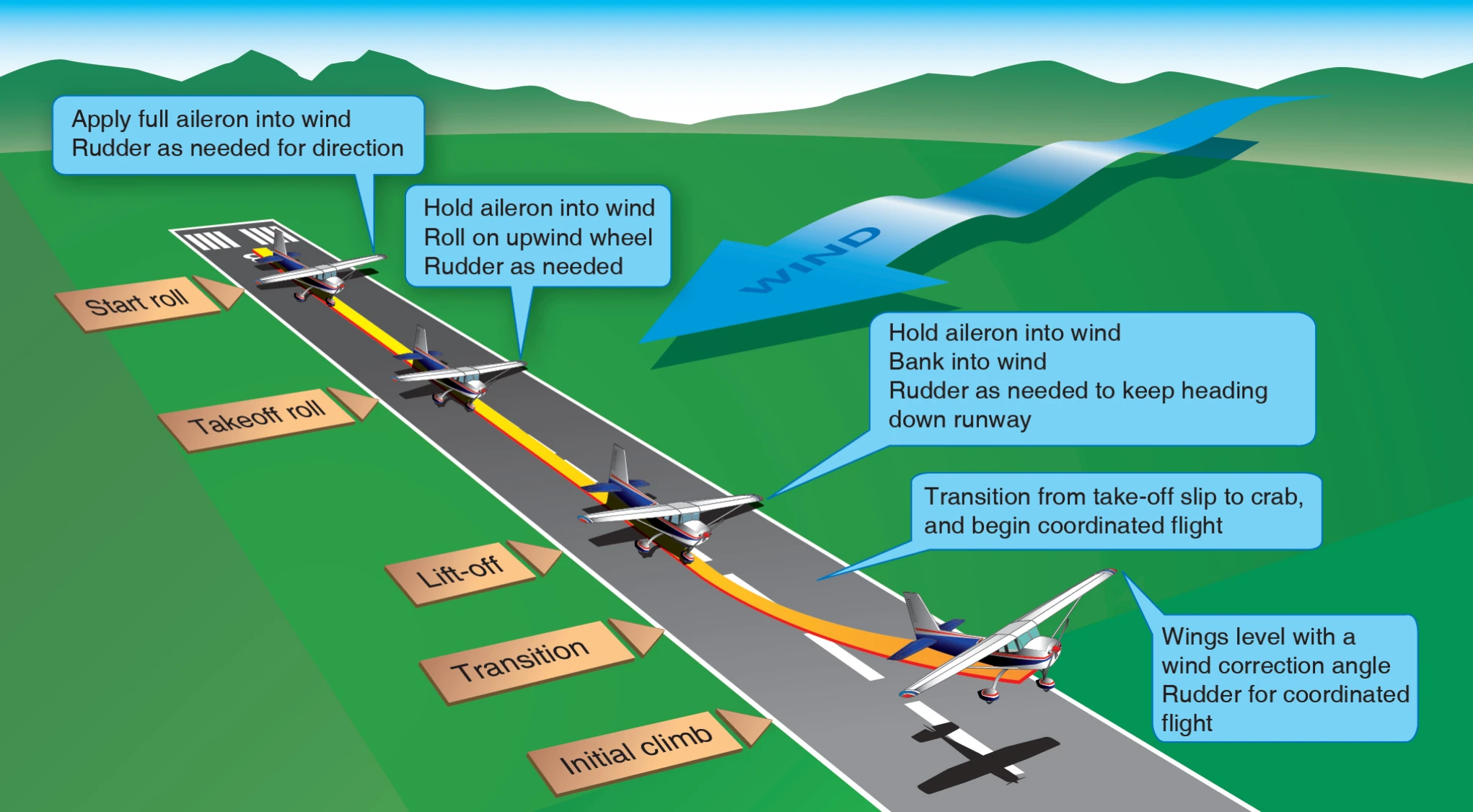
The technique used during the initial takeoff roll in a crosswind is generally the same as the technique used in a normal takeoff roll, except that the pilot needs to apply aileron pressure into the crosswind. This raises the aileron on the upwind wing, imposes a downward force on that wing to counteract the lifting force of the crosswind, and thus prevents the wing from rising. The pilot should remember that since the ailerons and rudder are deflected, drag will increase; therefore, less initial takeoff performance should be expected until the airplane is wings-level in coordinated flight in the climb.
While taxiing into takeoff position, it is essential that the pilot check the windsock and other wind direction indicators for the presence of a crosswind. If a crosswind is present, the pilot should apply full aileron pressure into the wind while beginning the takeoff roll. The pilot should maintain this control position, as the airplane accelerates, and until the ailerons become effective in maneuvering the airplane about its longitudinal axis. As the ailerons become effective, the pilot will feel an increase in pressure on the aileron control.
While holding aileron pressure into the wind, the pilot should use the rudder to maintain a straight takeoff path. [Figure 6-4] Since the airplane tends to weathervane into the wind while on the ground, the pilot will typically apply downwind rudder pressure. When the pilot increases power for takeoff, the resulting P-factor causes the airplane to yaw to the left. While this yaw may be sufficient to counteract the airplane’s tendency to weathervane into the wind in a crosswind from the right, it may aggravate this tendency in a crosswind from the left. In any case, the pilot should apply rudder pressure in the appropriate direction to keep the airplane rolling straight down the runway.
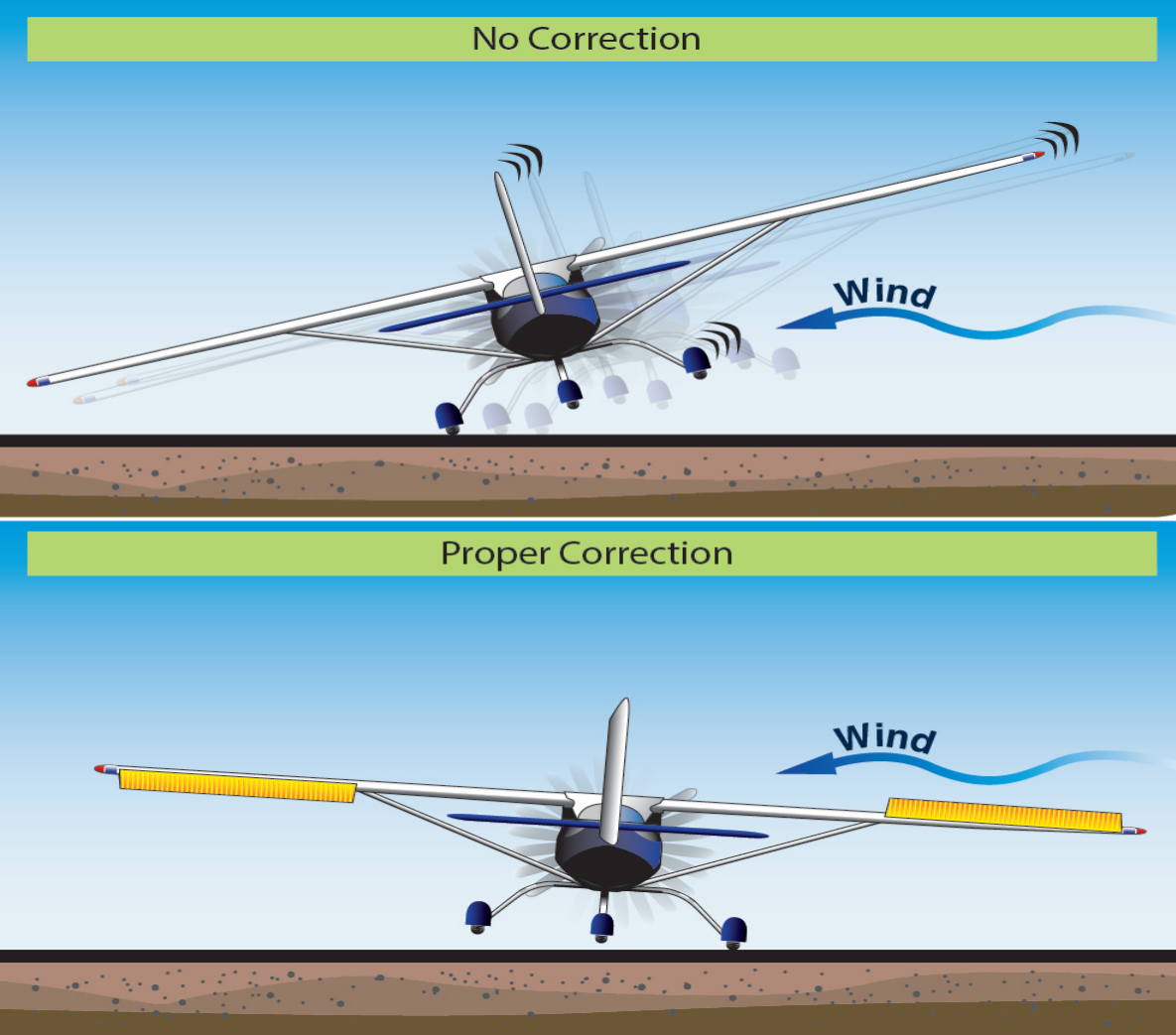
As the forward speed of the airplane increases, the pilot should apply sufficient aileron pressure into the crosswind to keep the wings level. The effect of the crosswind component will not completely vanish; therefore, the pilot needs to maintain some aileron pressure throughout the takeoff roll. If the upwind wing rises, the amount of wing surface exposed to the crosswind will increase, which may cause the airplane to lose lateral alignment with the runway centerline and to "skip." [Figure 6-5] The pilot uses rudder pressure to keep the airplane’s longitudinal axis parallel to the runway centerline.
This “skipping” is usually indicated by a series of very small bounces caused by the airplane attempting to fly and then settling back onto the runway. During these bounces, the crosswind also tends to move the airplane sideways, and these bounces develop into side-skipping. This side-skipping imposes severe side stresses on the landing gear and may result in structural failure.
During a crosswind takeoff roll, it is important that the pilot hold sufficient aileron pressure into the wind not only to keep the upwind wing from rising but to hold that wing down so that the airplane sideslips into the wind enough to counteract drift immediately after lift-off.
Lift-Off
As the nose-wheel raises off of the runway, the pilot should hold aileron pressure into the wind. This may cause the downwind wing to rise and the downwind main wheel to lift off the runway first, with the remainder of the takeoff roll being made on that one main wheel. This is acceptable and is preferable to side-skipping.
If a significant crosswind exists, the pilot should hold the main wheels on the ground slightly longer than in a normal takeoff so that a smooth but very definite lift-off can be made. This allows the airplane to leave the ground under more positive control and helps it remain airborne while the pilot establishes the proper amount of wind correction. More importantly, this procedure avoids imposing excessive side-loads on the landing gear and prevents possible damage that would result from the airplane settling back to the runway while drifting.
As both main wheels leave the runway, the airplane begins to drift sideways with the wind, as ground friction is no longer a factor in preventing lateral movement. To minimize this lateral movement and to keep the upwind wing from rising, the pilot should establish and maintain the proper amount of crosswind correction prior to lift-off by applying aileron pressure into the wind. The pilot should also apply rudder pressure, as needed, to prevent weathervaning.