
Chapter 8
Airport Traffic Patterns
Introduction
Airport traffic patterns ensure that air traffic moves into and out of an airport safely. The direction and placement of the pattern, the altitude at which it is to be flown, and the procedures for entering and exiting the pattern may depend on local conditions. Information regarding the procedures for a specific airport can be found in the Chart Supplements. General information on airport operations and traffic patterns can also be found in the Aeronautical Information Manual (AIM).
Airport Traffic Patterns and Operations
Just as roads and streets are essential for operating automobiles, airports or airstrips are essential for operating airplanes. Since flight begins and ends at an airport or other suitable landing field, pilots need to learn the traffic rules, traffic procedures, and traffic pattern layouts in use at various airports.
When an automobile is driven on congested city streets, it can be brought to a stop to give way to conflicting traffic. Airplane pilots do not have that option. Consequently, traffic patterns and traffic control procedures exist to minimize conflicts during takeoffs, departures, arrivals, and landings. The exact nature of each airport traffic pattern is dependent on the runway in use, wind conditions (which determine the runway in use), obstructions, and other factors.
Airports vary in complexity from small grass or sod strips to major terminals with paved runways and taxiways. Regardless of the type of airport, a pilot should know and abide by the applicable rules and operating procedures. In addition to checking the traffic pattern and operating procedures for airports of intended use in the Chart Supplements, pilots should know how to interpret any airport visual markings and signs that may be encountered. In total, the information provided to the pilot keeps air traffic moving with maximum safety and efficiency. However, the use of any traffic pattern, service, or procedure does not diminish the pilot’s responsibility to see and avoid other aircraft from ramp-out to ramp-in.
When operating at an airport with an operating control tower, the pilot receives a clearance to approach or depart, as well as pertinent information about the traffic pattern by radio. The tower operator can instruct pilots to enter the traffic pattern at any point or to make a straight-in approach without flying the usual rectangular pattern. Many other deviations are possible if the tower operator and the pilot work together in an effort to keep traffic moving smoothly. Jets or heavy airplanes will frequently fly wider and/or higher patterns than lighter airplanes, and will sometimes make a straight-in approach for landing.
A pilot is not expected to have extensive knowledge of all traffic patterns at all airports, but if the pilot is familiar with the basic rectangular pattern, it is easy to make proper approaches and departures from most airports, regardless of whether or not they have control towers. However, if there is not a control tower, it is the pilot’s responsibility to determine the direction of the traffic pattern, to comply with appropriate traffic rules, and to display common courtesy toward other pilots operating in the area. When operating at airports without a control tower, the pilot may not see all traffic. Therefore, the pilot should develop the habit of continued scanning even when air traffic appears light or nil. Adherence to the basic rectangular traffic pattern reduces the possibility of conflicts and reduces the probability of a midair collision.
Standard Airport Traffic Patterns
An airport traffic pattern includes the direction and altitude of the pattern and procedures for entering and leaving the pattern. Unless the airport displays approved visual markings indicating that turns should be made to the right, the pilot should make all turns in the pattern to the left.
Figure 8-1 shows a standard rectangular traffic pattern. The traffic pattern altitude is usually 1,000 feet above the elevation of the airport surface. The use of a common altitude at a given airport is the key factor in minimizing the risk of collisions at airports without operating control towers.
Aircraft speeds are restrained by 14 CFR part 91, section 91.117. When operating in the traffic pattern at most airports with an operating control tower, aircraft typically fly at airspeeds no greater than 200 knots (230 miles per hour (mph)). Sensible practice suggests flying at or below these speeds when operating in the traffic pattern of an airport without an operating control tower. In any case, the pilot should adjust the airspeed, when necessary, so that it is compatible with the airspeed of other aircraft in the traffic pattern.
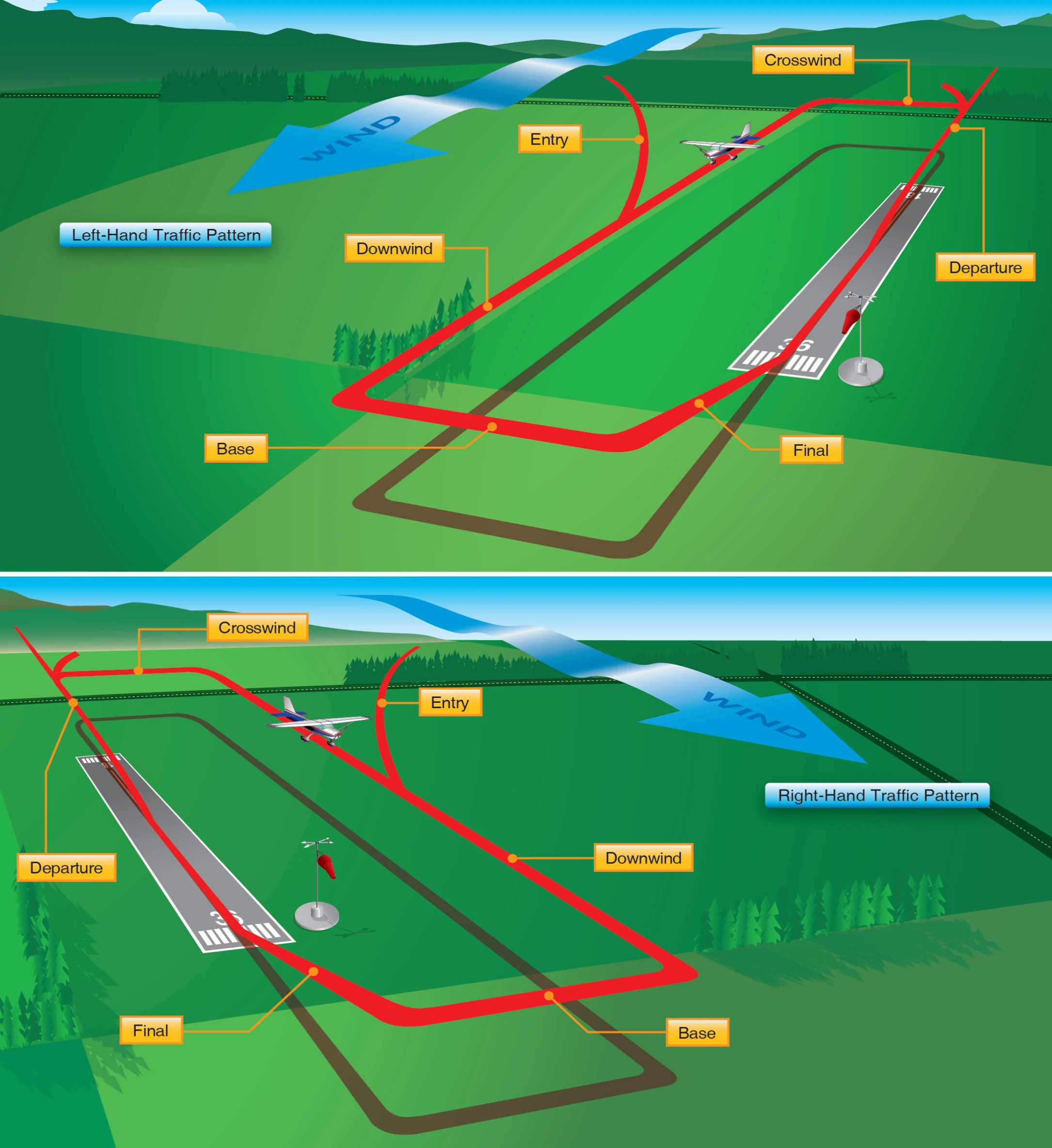
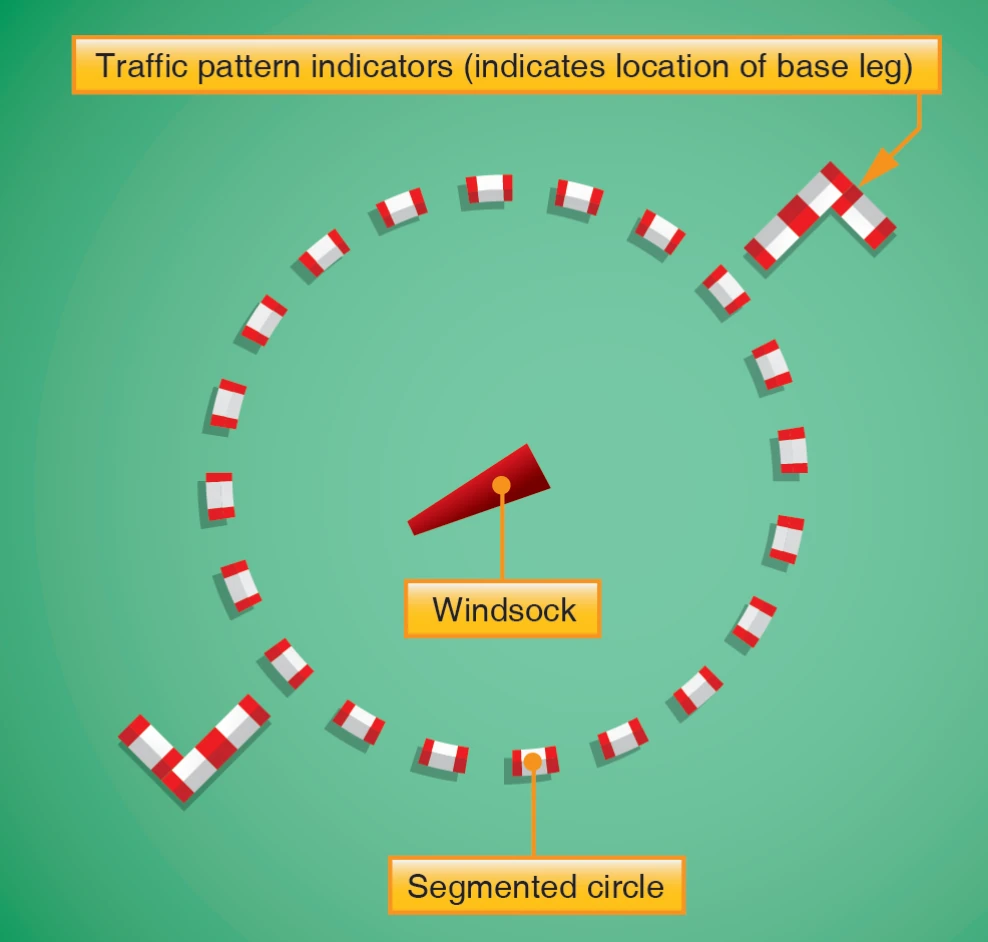
When entering the traffic pattern at an airport without an operating control tower, inbound pilots are expected to observe other aircraft already in the pattern and to conform to the traffic pattern in use. The pilot should enter the traffic pattern at a point well clear of any other observed aircraft. If there are no other aircraft observed, the pilot should check traffic indicators and wind indicators on the ground to determine which runway and traffic pattern direction to use. [Figure 8-2] Many airports have L-shaped traffic pattern indicators displayed with a segmented circle adjacent to the runway. The short member of the L shows the direction in which traffic pattern turns are made when using the runway parallel to the long member. The pilot should check the indicators from a distance or altitude well above the traffic pattern in case any other aircraft are in the traffic pattern.
Consider the following points when arriving at an airport for landing:
- The pilot should be aware of the appropriate traffic pattern altitude before entering the pattern and remain clear of the traffic flow until established on the entry leg.
- The traffic pattern is normally entered at a 45° angle to the downwind leg, headed toward a point abeam the midpoint of the runway to be used for landing.
- The pilot should ensure that the entry leg is of sufficient length to provide a clear view of the entire traffic pattern and to allow adequate time for planning the intended path in the pattern and the landing approach.
- Entries into traffic patterns while descending create specific collision hazards and should be avoided.
The downwind leg is a course flown parallel to the landing runway, but in a direction opposite to the intended landing direction. This leg is flown approximately 1/2 to 1 mile out from the landing runway and at the specified traffic pattern altitude. When flying on the downwind leg, the pilot should complete all before-landing checks and extend the landing gear if the airplane is equipped with retractable landing gear. Pattern altitude is maintained until at least abeam the approach end of the landing runway. At this point, the pilot should reduce power and begin a descent. The pilot should continue the downwind leg past a point abeam the approach end of the runway to a point approximately 45° from the approach end of the runway, and make a medium-bank turn onto the base leg. Pilots should consider tailwinds and not descend too much on the downwind in order to have sufficient altitude to continue the descent on the base leg.
The base leg is the transitional part of the traffic pattern between the downwind leg and the final approach leg. Depending on the wind condition, the pilot should establish the base leg at a sufficient distance from the approach end of the landing runway to permit a gradual descent to the intended touchdown point. While on the base leg, the ground track of the airplane is perpendicular to the extended centerline of the landing runway, although the longitudinal axis of the airplane may not be aligned with the ground track if turned into the wind to counteract drift.
While on the base leg and before turning onto the final approach, the pilot should ensure that there is no close proximity to another aircraft already established on final approach. When two or more aircraft are approaching an airport for the purpose of landing, the aircraft at the lower altitude has the right-of-way. However, pilots should not take advantage of this rule to cut in front of another aircraft that is on final approach to land or to overtake that aircraft. If the turn to final would create a collision hazard, a go-around or avoidance maneuver is in order. A pilot trying to overtake another aircraft might be tempted to make an overly steep turn to final. If rushing the turn to increase the distance from another aircraft, there is good reason to abandon the approach and go around.