
Chapter 5
The Teaching Process
Cooperative or Group Learning Method
Cooperative or group learning organizes learners into small groups who can work together to maximize understanding. Research indicates that learners completing cooperative learning group tasks tend to have better test scores, higher self-esteem, improved social skills, and greater comprehension of the subjects they are studying. Perhaps the most significant characteristic of group learning is that it continually requires active participation in the learning process.
Conditions and Controls
In spite of its advantages, success with cooperative or group learning depends on conditions and controls. First of all, instructors need to begin planning early to determine what the group is expected to learn and to be able to do on their own. The group task may emphasize academic achievement, cognitive abilities, or physical skills, but the instructor should use clear and specific objectives to describe the knowledge and/or abilities the learners are to acquire and then demonstrate on their own.
The following conditions and controls are useful for cooperative learning:
- Small, heterogeneous groups
- Clear, complete instructions of what learners are to do, in what order, with what materials, and when appropriate—what learners are to do as evidence of their mastery of targeted content and skills
- Learner perception of targeted objectives as their own, personal objectives
- The opportunity for learner success
- Learner access to and comprehension of required information
- Sufficient time for learning
- Individual accountability
- Recognition and rewards for group success
- Time after completion of group tasks for learners to systematically reflect upon how they worked together as a team
In practice, collaborative, learner-led, instructor-led, or working group strategies are types of group learning. In these examples, the leader or the instructor serves as a coach or facilitator who interacts with the group, as necessary, to keep it on track or to encourage everyone in the group to participate.
Demonstration-Performance Method
Best used for the mastery of mental or physical skills that require practice, the demonstration-performance method is based on the principle that people learn by doing. In this method, learners observe the skill and then try to reproduce it. It is well suited for the aircraft maintenance instructor who uses it in the shop to teach welding, and the flight instructor who uses it in teaching piloting skills.
Every instructor should recognize the importance of learner performance in the process. Early in demonstration and performance lesson, the instructor should identify the most important learning outcomes. Next, explain and demonstrate the steps involved in performing the skill being taught. Then, allow learners time to practice each step, so they can increase their ability to perform the skill.
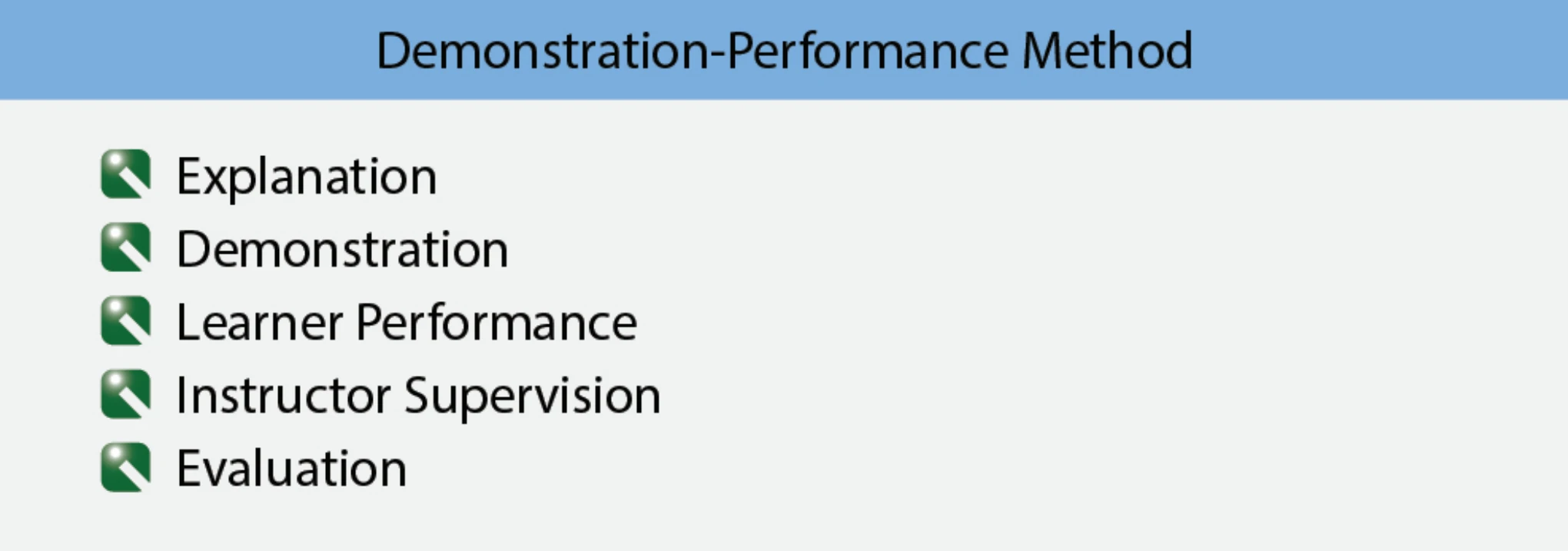
The demonstration-performance method is divided into five phases: explanation, demonstration, learner performance, instructor supervision, and evaluation. [Figure 5-15]
Explanation Phase
Explanations need to be clear, pertinent to the objectives of the particular lesson to be presented, and based on the known experience and knowledge of the learners. In teaching a skill, the instructor conveys to the learners the precise actions they are to perform. In addition to the necessary steps, the instructor should describe the end result of these efforts. Before leaving this phase, the instructor should encourage learners to ask questions about any step of the procedure that they do not understand.
Demonstration Phase
The instructor shows learners the actions necessary to perform a skill. Extraneous activity should be excluded from the demonstration so that learners clearly understand the desired actions. If the demonstration deviates from the explanation, this deviation should be immediately acknowledged and explained.
Learner Performance and Instruction Supervision Phases
While they involve separate actions, the learner’s performance of the physical or mental skills that and the instructor’s supervision occur at the same time.
The instructor needs to allot enough time for meaningful activity. Through doing, learners learn to follow correct procedures and to reach established standards. It is important that learners be given an opportunity to perform the skill as soon as possible after a demonstration. In flight training, the instructor may allow the learner to follow along on the controls during the demonstration of a maneuver. Immediately thereafter, the instructor should have the learner attempt to perform the maneuver, coaching as necessary. In the opening scenario, learners performed a task (weight and balance computation) as a group, and prior to terminating the performance phase, they were allowed to independently complete the task at least once with supervision and coaching as necessary.