
Chapter 5
The Teaching Process
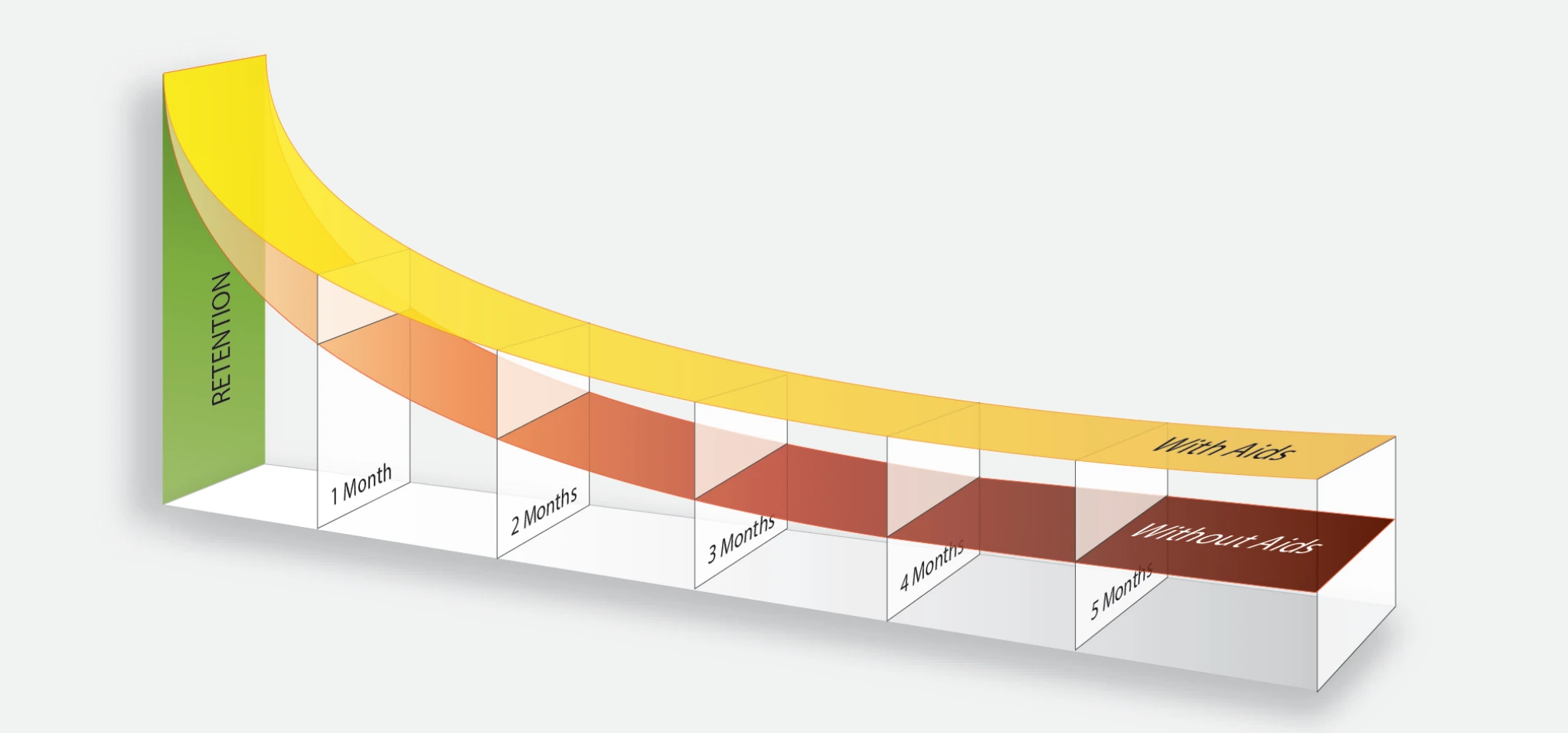
Clearly, a major goal of all instruction is for the learner to be able to retain as much knowledge of the subject as possible, especially the key points. Numerous studies have attempted to determine how well instructional aids serve this purpose. Indications from the studies vary greatly—from modest results, which show a 10 to 15 percent increase in retention, to more optimistic results in which retention is increased by as much as 80 percent. [Figure 5-16]
Good instructional aids also can help solve certain language barrier problems. Consider the continued expansion of technical terminology in everyday usage. This, coupled with culturally diverse backgrounds of today’s learners, makes it necessary for instructors to be precise in their choice of terminology. Words or terms used in an instructional aid should be carefully selected to convey the same meaning for the learner as they do for the instructor. They should provide an accurate visual image and make learning easier.
Another use for instructional aids is to clarify the relationships between material objects and concepts. When relationships are presented visually, they often are much easier to understand. For example, the subsystems within a physical unit are relatively easy to relate to each other through the use of schematics or diagrams. Symbols, graphs, and diagrams can also show relationships of location, size, time, frequency, and value. By symbolizing the factors involved, it is even possible to visualize abstract relationships.
Instructors are frequently asked to teach more and more in a smaller time frame. Instructional aids can help them do this. For example, instead of using many words to describe a sound, object, or function, the instructor plays a recording of the sound, shows a picture of the object, or presents a diagram of the function. Consequently, the learner gains knowledge faster and more accurately, and the instructor saves time in the process.
Guidelines for Use of Instructional Aids
The use of any instructional aid should be planned, based on its ability to support a specific point in a lesson. The following process can be used to determine if and where instructional aids are necessary:
- Clearly establish the lesson objective. Be certain of what is to be communicated.
- Gather the necessary data by researching for support material.
- Organize the material into an outline or a lesson plan. The plan should include all key points that need to be covered. This may include important safety considerations.
- Select the ideas to be supported with instructional aids. The aids should be concentrated on the key points. Aids are often appropriate when long segments of technical description are necessary, when a point is complex and difficult to put into words, when instructors find themselves forming visual images, or when learners are puzzled by an explanation or description.
Aids should be simple and compatible with the learning outcomes to be achieved. Obviously, an explanation of elaborate equipment may require detailed schematics or mock-ups, but less complex equipment may lend itself to only basic shapes or figures. Since aids are normally used in conjunction with a verbal presentation, words on the aid should be kept to a minimum. In many cases, visual symbols and slogans can replace in-depth explanations. The instructor should avoid the temptation to use the aids as a crutch. The tendency toward unnecessarily distracting artwork should be avoided.
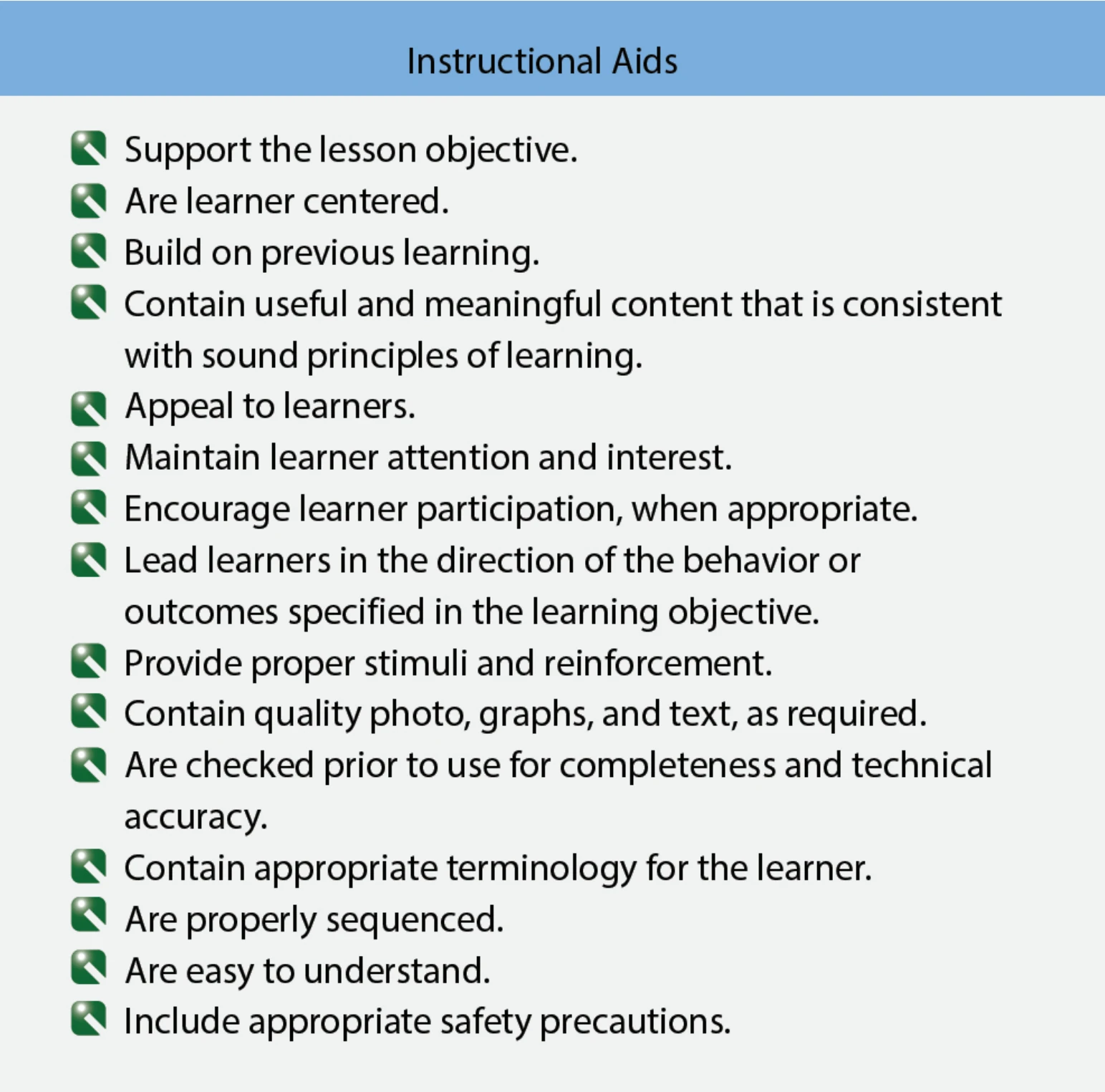
Instructional aids should appeal to the learner and be based on sound principles of instructional design. When practical, they should encourage learner participation. They also should be meaningful to the learner, lead to the desired behavioral objectives, and provide appropriate reinforcement. Aids that involve mastering a physical skill should guide learners toward mastery of the skill or task specified in the lesson objective.
Instructional aids have no value in the learning process if they cannot be heard or seen. Recordings of sounds and speeches should be tested for correct volume and quality in the actual environment in which they will be used. Visual aids should be visible to the entire class. All lettering and illustrations need to be large enough to be seen easily by the learners farthest from the aids. Colors should provide clear contrast.
While many instructional aids come with purchased material, the effectiveness of instructor-produced aids and the ease of their preparation can be increased by initially planning them in rough draft form. The rough draft should be carefully checked for technical accuracy, proper terminology, grammar, spelling, basic balance, clarity, and simplicity. Instructional aids should also be reviewed to determine whether their use is feasible in the training environment and whether they are appropriate for the learners. See the figure for a summary of the desired qualities of instructional aids. [Figure 5-17]
Types of Instructional Aids
Some of the most common and economical aids are marker boards and supplemental print materials, including charts, diagrams, and graphs. Other aids include projected material, video, computer-based programs, and models, mock-ups, or cut-aways.
Marker Board
The marker board is a classroom tool for instructors. Its versatility and effectiveness provide several advantages for most types of instruction. First, the material presented can be erased, allowing the surface to be used again and again; and second, the boards serve as an excellent medium for joint learner-instructor activity in the classroom.
Supplemental Print Material
Print media, including photographs, reproductions of pictures, drawings, murals, cartoons, and other print materials are valuable supplemental aids. Charts, diagrams, and graphs are also in this category. Many of these items are suitable for long-term use on bulletin boards and in briefing areas. Pictures, drawings, and photographs are especially effective because they provide common visual imagery for both instructors and learners. In addition, they also provide realistic details necessary for visual recognition of important subject material. In many cases, this type of supplemental training media may be reproduced in a format for projection on a screen or other clear surface.