
Chapter 5
The Teaching Process
This method relies on discussion and the exchange of ideas. Everyone has the opportunity to comment, listen, think, and participate. By being actively engaged in discussing the lecture, learners improve their recall and ability to use the information.
It is important for the instructor to keep the discussion focused on the subject matter. The instructor may need to initiate leading questions, comment on any disagreements, ensure that all learners participate, and summarize what has been learned.
Tying the discussion method into the lecture method not only provides active participation, it also allows learners to develop higher order thinking skills (HOTS). The give and take of the discussion method also helps learners evaluate ideas, concepts, and principles. When using this method, instructors should keep their own discussion to a minimum since the goal is learner participation.
Guided Discussion Method
Instructors can also use another form of discussion, the guided discussion method, to ensure the learner has correctly received and interpreted subject information. The learner needs a level of knowledge about the topic to be discussed, either through reading prior to class or a short lecture to set up the topic to be discussed. This training method employs instructor-guided discussion with the instructor maintains control of the discussion. It can be used during classroom periods and preflight and postflight briefings. The discussions reflect whatever level of knowledge and experience the learners have gained.
The goal of guided discussions is to draw out the knowledge of the learner. The greater the participation becomes, the more effective the learning will be. All members of the group should follow the discussion. The instructor should treat everyone impartially, encourage questions, exercise patience and tact, and comment on all responses with the goal of reinforcing a learning objective related to the lesson. The instructor acts as a facilitator to encourage discussion between learners without sarcasm.
Use of Questions in a Guided Discussion
In the guided discussion, learning is achieved through the skillful use of questions. Questions can be categorized by function and characteristics.
The instructor often uses a lead-off question to open up an area for discussion. After the discussion develops, the instructor may ask a follow-up question to guide the discussion. The reasons for using a follow-up question may vary. The instructor may want a learner to explain something more thoroughly, or may need to bring the discussion back to a point from which it has strayed. An instructor may answer a question with a question and direct that question back to the person posing the question or other participant.
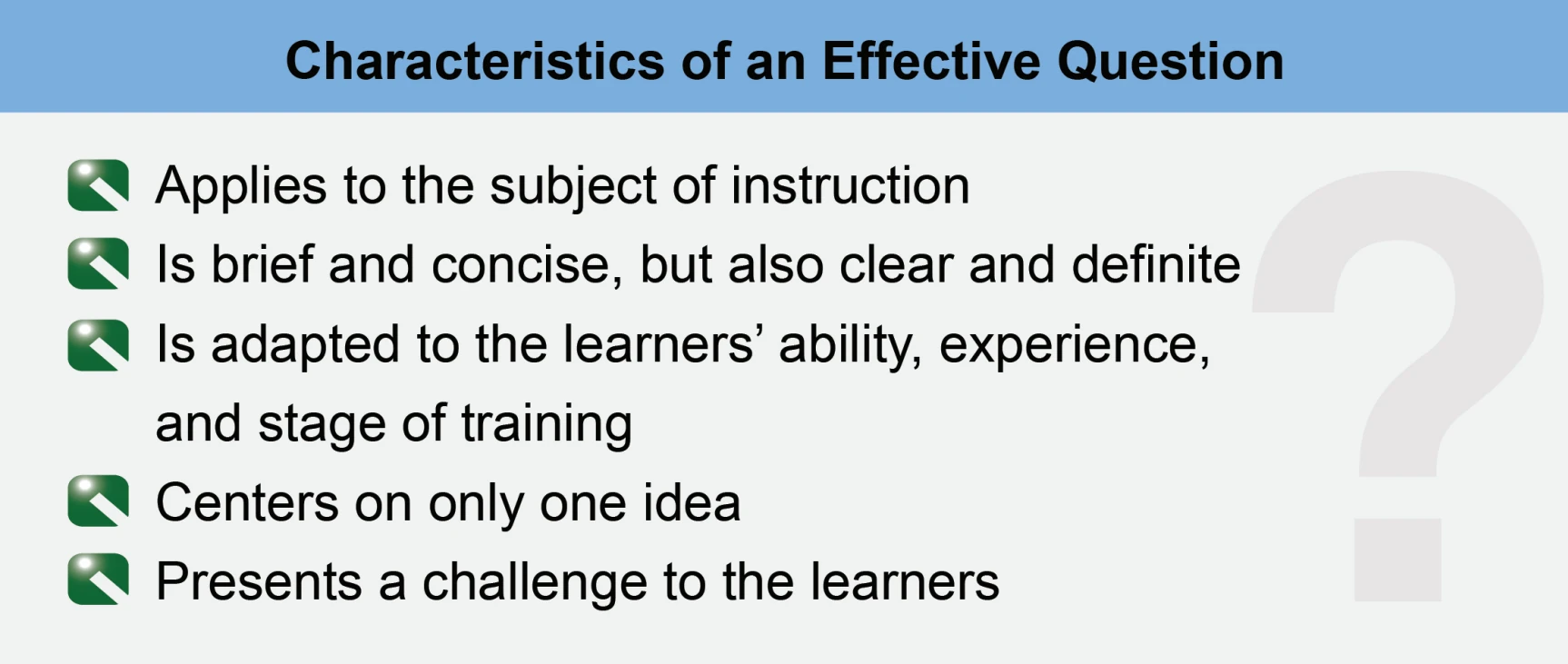
Questions are so much a part of teaching that they are often taken for granted. Effective use of questions may result in more learning than any other single technique used by instructors. Instructors should avoid questions that can be answered by short factual statements or yes or no responses and ask open-ended questions that are thought provoking and require more mental activity. Since most aviation training is at the understanding level or higher, questions should require learners to grasp concepts, explain similarities and differences, and to infer cause-and-effect relationships. [Figure 5-10]
Planning a Guided Discussion
Planning a guided discussion is similar to planning a lecture. (Note that the following suggestions include many that are appropriate for planning cooperative learning, to be discussed later in the chapter.)
- Select an appropriate topic. Unless the learners have some knowledge to exchange with each other, they cannot reach the desired learning outcomes. If necessary, make assignments that give the learners an adequate background for discussing the lesson topic.
- State the specific lesson objective at the understanding level of learning. Through discussion, the learners develop an understanding of the subject by sharing knowledge, experiences, and backgrounds. The desired learning outcomes should stem from the objective.
- Conduct adequate research to become familiar with the topic. The instructor should always be alert for ideas that will enhance a lesson for a particular group of learners. Similarly, the instructor can consider any prediscussion assignment while conducting research for the classroom period. During this research process, the instructor should also earmark reading material that appears to be appropriate as background material for learners. Such material should be well organized and based on fundamentals.
- Organize the main and subordinate points of the lesson in a logical sequence. The guided discussion has three main parts: introduction, discussion, and conclusion. The introduction consists of three elements: attention, motivation, and overview. During the discussion, the instructor should be certain that the main points discussed build logically with the objective. The conclusion consists of the summary of the main points. By organizing in this manner, the instructor phrases the questions to help the learners obtain a firm grasp of the subject matter and to minimize the possibility of a rambling discussion.
- Plan at least one lead-off question for each desired learning outcome. While preparing questions, the instructor should remember that the purpose is to stimulate discussion, not merely to get answers. Lead-off questions should usually begin with how or why. For example, it is better to ask “Why does an aircraft normally require a longer takeoff run at Denver than at New Orleans?” instead of “Would you expect an aircraft to require a longer takeoff run at Denver or at New Orleans?” Learners can answer the second question by merely saying “Denver,” but the first question is likely to start a discussion of air density, engine efficiency, and the effect of temperature on performance.
Learner Preparation for a Guided Discussion
It is the instructor’s responsibility to help learners prepare themselves for the discussion. Each learner should be encouraged to accept responsibility for contributing to the discussion and benefiting from it. Throughout the time the instructor prepares the learners for their discussion, they should be made aware of the lesson objective(s). In certain instances, the instructor has no opportunity to assign preliminary work. In such cases, it is practical and advisable to give the learners a brief general survey of the topic during the introduction. Normally, learners should not be asked to discuss a subject without some background in that subject.
Guiding a Discussion—Instructor Technique
The techniques used to guide a discussion require practice and experience. The instructor needs to keep up with the discussion and know when to intervene with questions or redirect the group’s focus. The following information provides a framework for successfully conducting the guided discussion.
Introduction
The introduction should include an attention element, a motivation element, and an overview of key points. To encourage enthusiasm and stimulate discussion, the instructor should create a relaxed, informal atmosphere. Each learner should be given the opportunity to discuss the various aspects of the subject, and feel free to do so. Moreover, the learner should feel a personal responsibility to contribute. The instructor should try to make the learners feel that their ideas and active participation are wanted and needed.