
Chapter 7
Planning Instructional Activity
Introduction
Susan (learner) and Bill (flight instructor) are flying a lesson scenario which consists of a short cross-country leg to a local airport for some practice landings followed by a return to the home airport located in Class C airspace. While practicing landings at the nontowered airport, Susan notes that the ceiling is lowering, and the crosswind is beginning to increase. In his own mind, Bill is convinced that they can practice landings for another 30 minutes to an hour and still return to home base. However, instead of telling Susan this, while taxiing back after a full stop landing, he first asks her several questions.
- Has the flight situation changed since they left the home field?
- What does she think of the weather situation?
- How can we gain more information?
- Check with Flight Service by cell phone or on the radio?
- Stop at the local Fixed Based Operator (FBO) and call back to the home FBO to check on weather?
- Are there other issues?
- Fuel?
- Schedule?
- Aircraft equipment (instrument flight rules (IFR)/visual flight rules (VFR)) and pilot capability?
Susan decides that she would be more comfortable returning to the home airport and practicing landings there to stay out of the weather. Although not his plan, it is a good plan based on accurate situational awareness and good risk management skills, so Bill agrees. Susan is now beginning to gain confidence by practicing her judgment and decision-making skills. In the postflight critique, Susan leads a discussion of this and other decisions she has made in order to learn more about understanding hazards and mitigating risk.
In the past, the aviation instructor was a capable pilot or aviation technician with a general understanding of basic teaching methods and techniques. Currently, the Federal Aviation Administration (FAA) places greater emphasis on the instructor’s role and skill as a teacher and mentor. The instructor should understand how to create and use lesson objectives and lesson plans. The instructor should know how to assess learning and motivate learners through proper feedback and by setting a good example. The learning that takes place is a direct result of the instructor's active lesson preparation, delivery, observation, and assessment.
Historically, aviation instruction focused on the performance of specific procedures and/or maneuvers, and measured learning with objective standards. Changing technology and innovations in learning provide today’s aviation instructors with the opportunity to use new methods and teach to new standards. One of these methods, introduced in Chapter 5, The Teaching Process, is scenario-based training (SBT). While SBT is an integral component of today’s aviation training, the instructor is crucial to its implementation. By emphasizing SBT, the instructor functions in the learning environment as an advisor and guide for the learner.
This chapter reviews the planning required by the professional aviation instructor as it relates to four key topics—course of training, blocks of learning, training syllabus, and lesson plans. It also explains how to integrate SBT, aeronautical decision-making (ADM), and risk management into the aviation training lesson.
Course of Training
Whatever the method of teaching, the key to developing well-planned and organized aviation instruction includes using lesson plans and a training syllabus that meet all regulatory certification requirements. Much of the basic planning necessary for the flight instructor and maintenance instructor is provided by the knowledge and proficiency requirements published in Title 14 of the Code of Federal Regulations (14 CFR) parts 61 and 65, approved school syllabi, and the various texts, manuals, and training courses available.
As discussed in Chapter 5, The Teaching Process, a course of training is a series of studies leading to attainment of a specific goal such as a certificate of completion, graduation, or an academic degree. An instructor plans instructional content around the course of training by determining the objectives and standards, which in turn determine individual lesson plans, test items, and levels of learning. For a complete discussion of these items, see Chapter 5.
Blocks of Learning
After the overall training objectives have been established, the next step is the identification of the blocks of learning which constitute the necessary parts of the total objective. Just as in building a pyramid, some blocks are submerged in the structure and never appear on the surface, but each is an integral and necessary part of the structure. Thus, the various blocks are not isolated subjects, but essential parts of the whole. During the process of identifying the blocks of learning to be assembled for the proposed training activity, the instructor should also examine each block to ensure it is an integral part of the structure. Extraneous blocks of instruction are expensive frills, especially in-flight instruction, and detract from, rather than assist in, the completion of the final objective.
While determining the overall training objectives is a necessary first step in the planning process, early identification of the foundation blocks of learning is also essential. Training for any such complicated and involved task as piloting or maintaining an aircraft requires the development and assembly of many segments or blocks of learning in their proper relationships. In this way, a learner can master the segments or blocks individually and can progressively combine these with other related segments until their sum meets the overall training objectives.
The blocks of learning identified during the planning and management of a training activity should be fairly consistent in scope. They should represent units of learning which can be measured and evaluated—not a sequence of periods of instruction. For example, the flight training of a private pilot might be divided into the following major blocks: achievement of the knowledge and skills necessary for solo, the knowledge and skills necessary for solo cross-country flight, and the knowledge and skills appropriate for obtaining a private pilot certificate. [Figure 7-1]
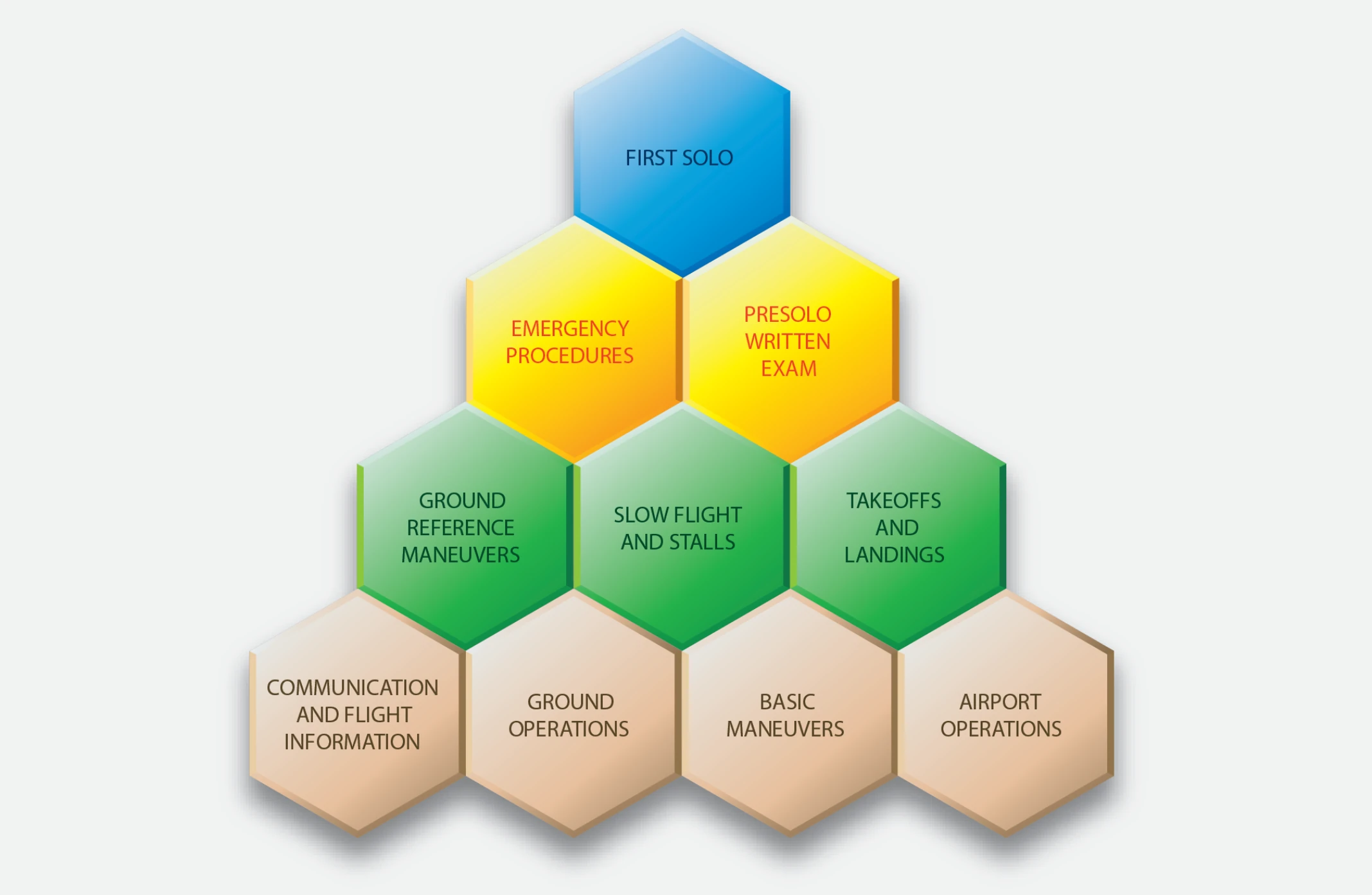
Use of the building block approach provides the learner with a boost in self-confidence. This normally occurs each time a block is completed. Otherwise, an overall goal, such as earning a mechanic’s certificate, may seem unobtainable. If the larger blocks are broken down into smaller blocks of instruction, each on its own is more manageable. Humans learn from the simple to the complex. For example, a learner pilot should understand and master the technique of a normal landing prior to being introduced to short-field and soft-field landings. A helicopter pilot should be proficient in running landings before the instructor introduces a no hydraulics approach and landing.
By becoming familiar with the learner’s aviation background, an instructor can plan the sequence of instruction blocks. Does the applicant have previous aeronautical experience or possess a pilot certificate in another category? This information will help the instructor design appropriate training blocks. For example, if the learner is a helicopter pilot who is transitioning to an airplane, he or she will understand speed control, but not necessarily know how to achieve it in an airplane. The instructor can plan blocks of instruction that build on what the learner already knows.
Training Syllabus
Instructors need a practical guide to help them make sure the training is accomplished in a logical sequence and that all of the requirements are completed and properly documented. A well organized, comprehensive syllabus can fulfill these needs.