
Chapter 7
Planning Instructional Activity
The aviation instructor is the key to the success of SBT. Remember, the overall learning objective is for the learner to be ready to exercise sound judgment and make good decisions. For example, the flight instructor should be ready to turn the responsibility for planning and execution of the flight over to the learner as soon as possible. The flight instructor continues to demonstrate and instruct skill maneuvers in the traditional manner; but, when the learner begins to make decisions, the flight instructor should revert to the role of mentor and learning facilitator.
SBT Lesson Plan
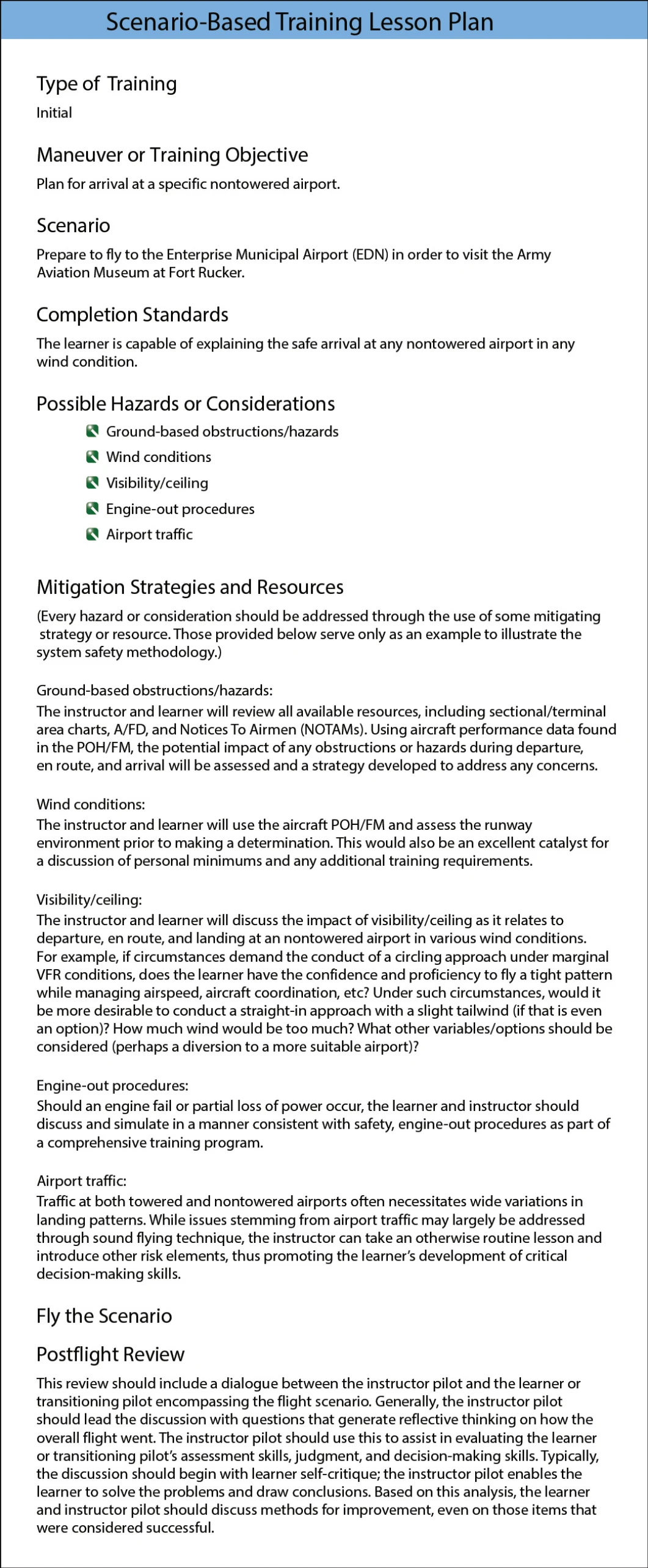
The SBT lesson plan differs from the traditional lesson plan. [Figure 7-7] In this example, the instructor pilot tells the learner to plan for arrival at a specific nontowered airport. The planning should take into consideration the possible wind conditions, arrival paths, airport information and communication procedures, available runways, recommended traffic patterns, courses of action, and preparation for unexpected situations. Upon arrival at the airport, the learner makes decisions (with guidance and feedback, as necessary) to safely enter and fly the traffic pattern. This is followed by a discussion of what was done, why it was done, the consequences, other possible courses of action, and how it applies to other airports. In contrast to the learner who trained under the traditional lesson plan, the learner who trains under the SBT format is not only capable of a specific flight maneuver, he or she is now capable of detailing a safe arrival at any nontowered airport in a variety of wind condition.
Pre-Scenario Planning
For SBT instruction to be effective, it is vital that the aviation instructor and learner establish the following information:
Flight scenario:
- Scenario destination(s)
- Desired learning outcomes
- Desired level of learner performance
- Possible inflight scenario changes
Nonflight scenario:
- Narrative of the task goal
- Desired learning outcomes
- Desired level of learner performance
- Possible scenario changes
The aviation industry is moving from traditional knowledge-related learning outcomes to an emphasis on increased internalized learning in which learners assess situations and react appropriately. Enhancement of knowledge and understanding usually accompanies a dynamic learning experience.
Reality is the ultimate learning situation and SBT attempts to get as close as possible to this ideal. It addresses learning that occurs in a context or situation. It is based on the concept of situated cognition, which is the idea that knowledge cannot be known and fully understood independent of its context. In other words, humans learn better from realistic situations where they are counted on to perform.
For example, realistic cross-country flight scenarios planned and executed by the pilot in training with assistance from the flight instructor begin the early development of flight deck management skills, situational awareness, and ADM. Continued engagement by the learner in the planning, executing, and assessment of each scenario reinforces development throughout the training. It is important to remember the learner is responsible for planning the flight scenario from a menu of short cross-country flights developed by the training provider. While the flight instructor will certainly assist the learner in aircraft performance data, weight and balance, and general aircraft layout prior to the first lesson, the sooner the learner assumes these responsibilities, the better the learning environment. The scenario descriptions offered in the FAA generic syllabi are a starting point for the training provider. Scenarios can be tailored for the local weather and terrain conditions and are most effective when they replicate the environment most likely encountered by the learners.
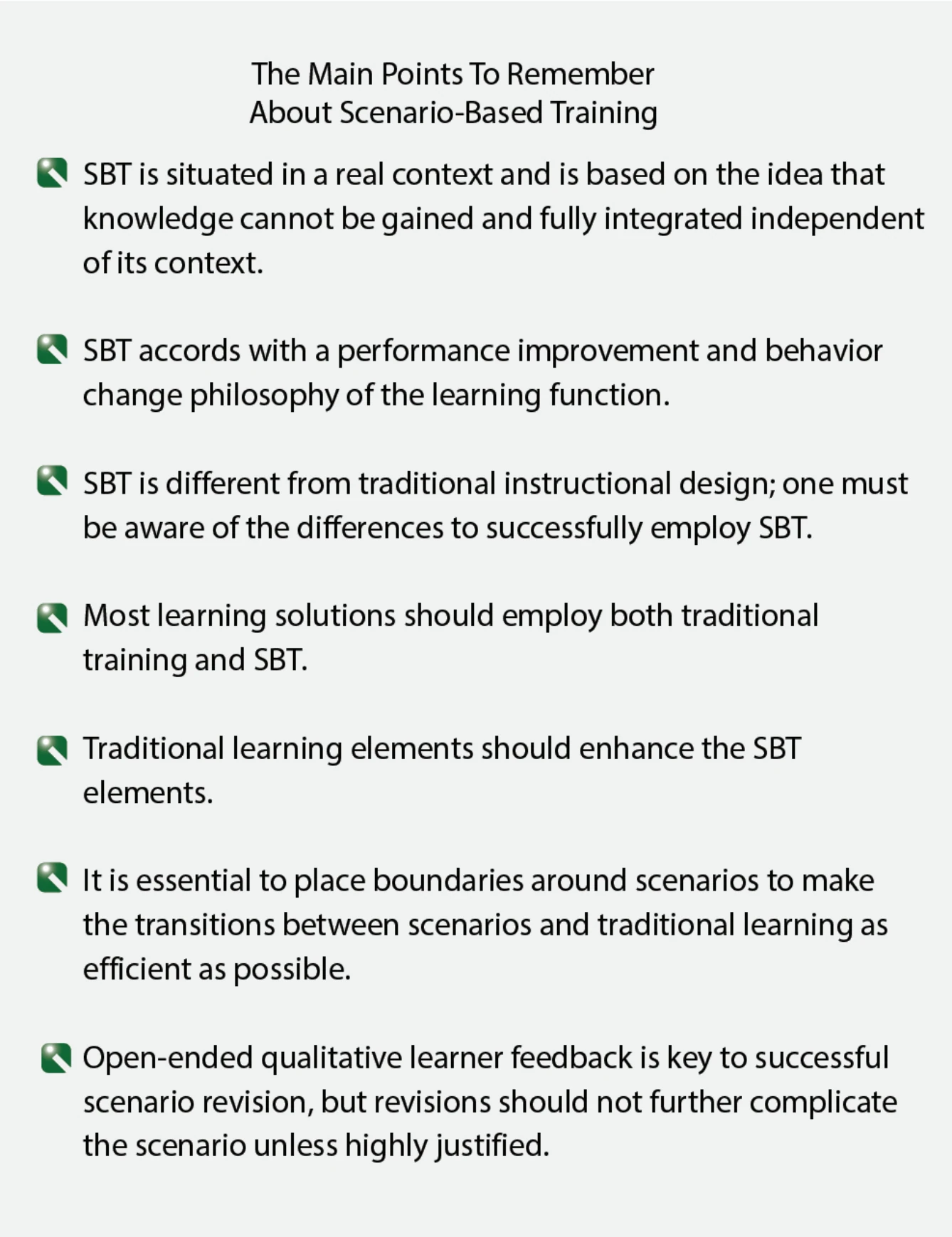
SBT is a compilation of basic learning theory, adult learning concepts, and the best of the traditional aviation training procedures. Above all, it is about learning complex tasks in a realistic environment at a pace and in a structure the individual learner can comprehend and process. [Figure 7-8] Good teaching techniques are still important, but only if they aid in learning. More detailed information about SBT can be found at www.faa.gov/training_testing/training/fits/more/. ([source link](https://www.faa.gov/training_testing/training/fits/more))
Single-Pilot Resource Management
SRM is the art and science of managing all the resources (both on-board the aircraft and from outside sources) available to a single pilot (prior and during flight) to ensure that the successful outcome of the flight is never in doubt.
The emergence of very light jet (VLJ) aircraft may also affect air travel. [Figure 7-9] Central to their economic success is the concept of single-pilot operations. Since the aircraft is heavily automated, the pilot’s workload may actually be less than the current workload in some high performance single-engine aircraft. This allows more time for the pilot to gather and analyze information about weather, winds, landing conditions, fuel state, pilot physical condition, and passenger desires.

However, unless the pilot is trained to manage all of these factors and to let the aircraft automation assist, the workload may be very high. SRM training helps the pilot maintain situational awareness by managing the automation and associated aircraft control and navigation tasks. This enables the pilot to accurately assess, manage risk, and make accurate and timely decisions. SBT enhances SRM because SBT helps pilots learn how to gather information, analyze it, and make decisions.