Chapter 8
Aviation Instructor Responsibilities and Professionalism
Introduction
Since learners look to aviation instructors as role models, it is important that instructors not only know how to teach, but that they project a knowledgeable and professional image. This chapter addresses the responsibilities of aviation instructors as trainers and as safety advocates. It explains how aviation instructors can enhance their professional image, and offers suggestions and sources of information to assist in professional development.
Aviation Instructor Responsibilities
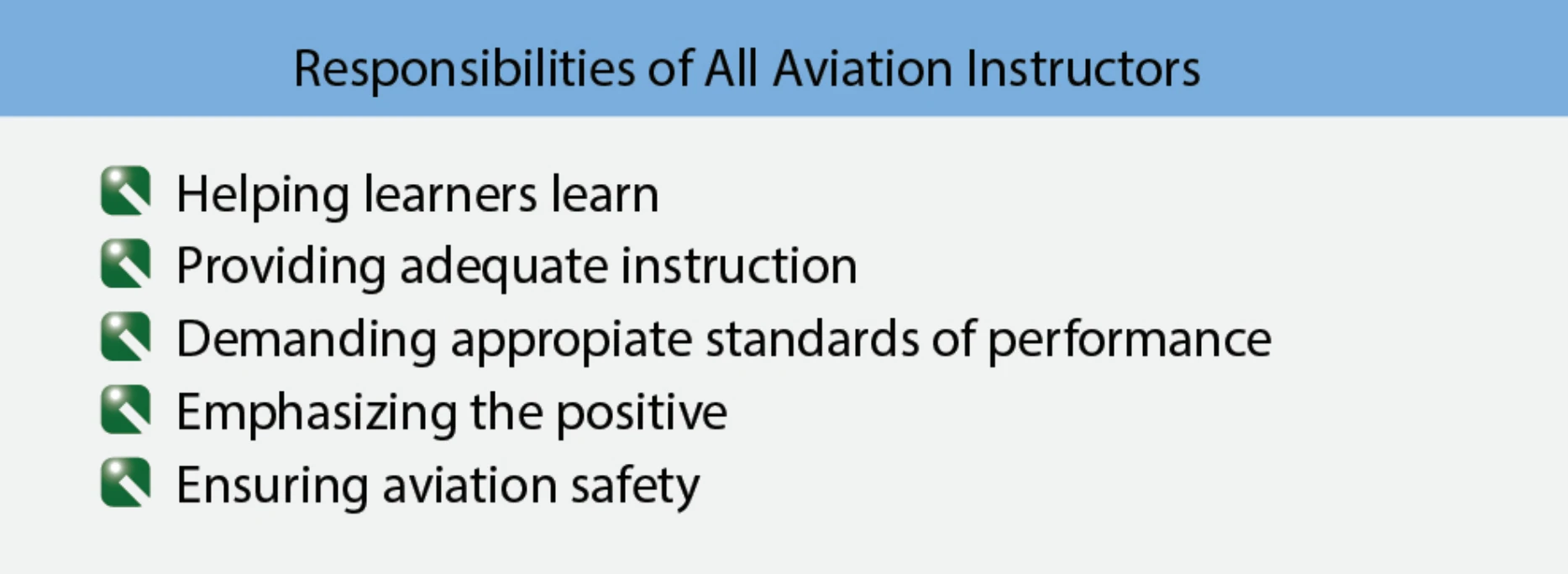
The job of an aviation instructor is to transfer knowledge. Previous chapters have discussed how people learn, the teaching process, and teaching methods. To summarize in brief, instructors help learners meet and exceed established standards. Instructors measure learner performance against those standards and give positive reinforcement along the way. [Figure 8-1]
Helping Learners
Learning should be an enjoyable experience. By making each lesson a pleasurable experience, the instructor helps the learner maintain a high level of motivation. This does not mean the instructor sacrifices standards of performance to make things easy. The learner experiences satisfaction by doing a good job or by meeting the challenge of a difficult task.
The idea that people need to be led to learning by making it easy is a fallacy. Though learners might initially be drawn to less difficult tasks, they ultimately devote more effort to activities that bring rewards. The use of standards, and measurement against standards, is key to helping learners. Meeting standards holds its own satisfaction for learners. People want to feel capable; they are proud of the successful achievement of difficult goals.
Learning should be interesting. Knowing the objective of each period of instruction gives meaning and interest to the learner, as well as the instructor. Not knowing lesson objectives often leads to confusion, disinterest, and uneasiness on the part of the learner.
Providing Adequate Instruction
To tailor his or her teaching technique to the learner, the flight instructor analyzes the learner’s personality, thinking, and ability. No two learners are alike, and a particular method of instruction may not be equally effective for all learners. The instructor talks with a learner at some length to learn about their background, interests, temperament, and way of thinking, and should be prepared to change his or her methods of instruction as the learner advances through successive stages of training.
An instructor who incorrectly analyzes a learner may find the instruction does not produce the desired results. For example, the instructor at first thinks the individual is not a quick learner because that learner is quiet and reserved. Such a learner may fail to act at the proper time due to lack of self-confidence, even though the situation is correctly understood. In this case, instruction is directed toward developing learner self-confidence, rather than drill on flight fundamentals. In another case, too much criticism may discourage a timid person, whereas brisk instruction may force a more diligent application to the learning task. A learner requiring more time to learn also requires instructional methods that combine tact, keen perception, and delicate handling. If such a learner receives too much help and encouragement, a feeling of incompetence may develop.
For learners who exhibit slow progress due to discouragement or lack of confidence, instructors should assign more easily attained goals. Before attempting a complex task, the instructor separates it into discrete elements, and the learner practices and becomes good at each element. For example, instruction in S-turns may begin with consideration for headings only. Elements of altitude control, drift correction, and coordination can be introduced one at a time. As the learner gains confidence and ability, goals are increased in difficulty.
Conversely, fast learners can also create challenges for the instructor. Because these learners make few mistakes, they may assume that the correction of errors is unimportant. Overconfidence may result, which leads to faulty performance. For these learners, the instructor constantly raises the standard of performance for each lesson, demanding greater effort. Individuals learn only if aware of their errors, and better retention of skills exists for learners who focus their attention on an analysis of their performance. On the other hand, deficiencies should not be invented solely for the learners’ benefit. Unfair criticism immediately destroys a learner's confidence in the instructor.
In some ways, an aviation instructor serves as a practical psychologist. As discussed in Chapters 2, Human Behavior, and 3, The Learning Process, an instructor can meet this responsibility by becoming familiar and conversant in the fundamentals of instructing and through a careful analysis of and continuing interest in learners.
Most new instructors tend to adopt the teaching methods used by their own instructors or the methods by which they themselves learn best. The fact that one has learned under a certain system of instruction does not mean that the best and most efficient learning occurred. The new instructor needs to remain open-minded and seek other resources and information to develop enhanced teaching ability.
Standards of Performance
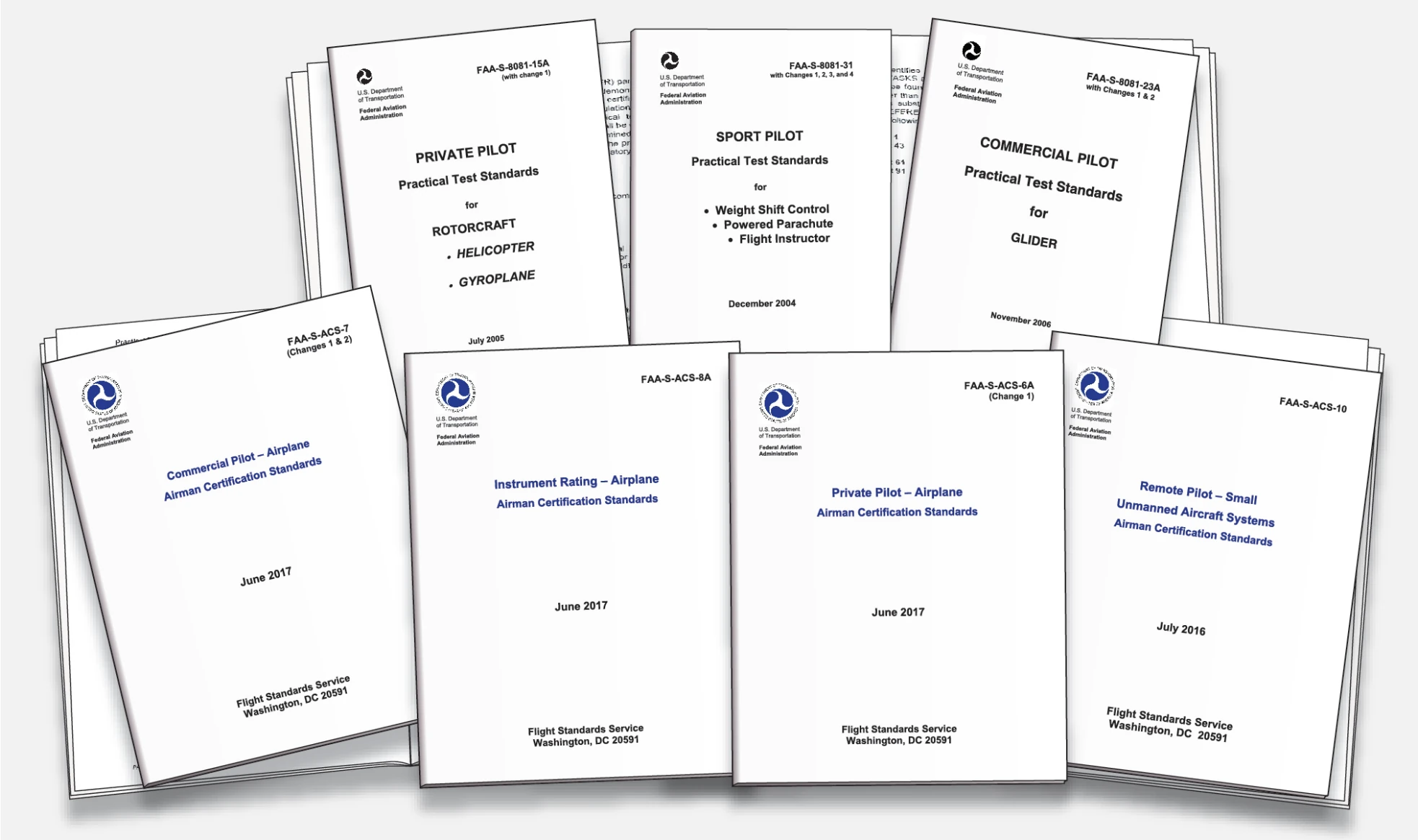
An aviation instructor is responsible for training an applicant to established standards in all subject matter areas, procedures, and maneuvers included in the tasks within each area of operation in the appropriate Airman Certification (ACS)/Airman Practical Test Standards (PTS). It should be emphasized that the ACS/PTS book is a testing document, not a teaching document. [Figure 8-2]