
Chapter 8
Aviation Instructor Responsibilities and Professionalism
The way instructors conduct themselves and the attitudes they display make an impression on learners. An aviation instructor's ability to teach in a manner that gives learners a positive image of aviation contributes to the instructor's success. [Figure 8-3]

Chapter 3, The Learning Process, emphasized that a negative self-concept inhibits the perceptual process, that fear adversely affects learner perceptions, that the feeling of being threatened limits the ability to perceive, and that negative motivation is not as effective as positive motivation. Merely knowing about these factors is not enough. Instructors need to detect these factors in their learners and strive to prevent negative feelings from undermining the instructional process.
Consider how the following negative scenarios conducted during the first lesson might adversely influence and turn off a new learner pilot who has limited or no aviation experience:
- An indoctrination in preflight procedures with emphasis on the critical precautions taken before every flight because “…emergencies in flight can be caused by an improper preflight and are often disastrous.”
- Instruction and hands-on training in the care taken in taxiing an airplane because “…if you go too fast, you lose directional control of the aircraft.”
- Introduction and demonstration of stalls, because “… this is how so many people lose their lives in airplanes.”
- Illustrating and demonstrating forced landings during the first lesson, because “…one should always be prepared to cope with a rope break in a glider.”
These new experiences might make the new learner wonder if learning to fly is a good idea.
In contrast, consider a first flight lesson in which the preflight inspection is presented to familiarize the learner with the aircraft and its components, and the flight is a perfectly normal one to a nearby airport, with return. Following the flight, the instructor can call the learner’s attention to the ease with which the trip was made in comparison with other modes of transportation, and the fact that no critical incidents were encountered or expected.
This does not mean stalls and emergency procedures should be omitted from training. It only illustrates the positive approach in which the learner does not receive overwhelming information. Using a syllabus that considers the learner's ability to comprehend new information means a foundation exists for that information. The introduction of emergency procedures after the learner has developed an acquaintance with normal operations is less likely to be discouraging and frightening, or to inhibit learning by the imposition of fear.
Nothing in aviation that demands that learners suffer as part of their instruction. Every effort should be made to ensure instruction is given under positive conditions that reinforce training. Instructors may provide flexible training and modify the method of instruction when learners have difficulty grasping a task. In essence, a learner’s failure to perform often results from an instructor’s inability to transfer the required information.
Emphasize the positive because positive instruction results in positive learning.
Minimizing Learner Frustration
Minimizing learner frustrations in the classroom, shop, or during flight training is an instructor’s responsibility.
Instructors can encourage rather than discourage learning by following some basic rules.
For example, lesson plans used as part of an organized curriculum help the learner pilot measure training progress. Since most pilots don’t want to be learners, the ability to measure their progress or “see an end in sight” reduces frustration and increases pilot motivation. [Figure 8-4]
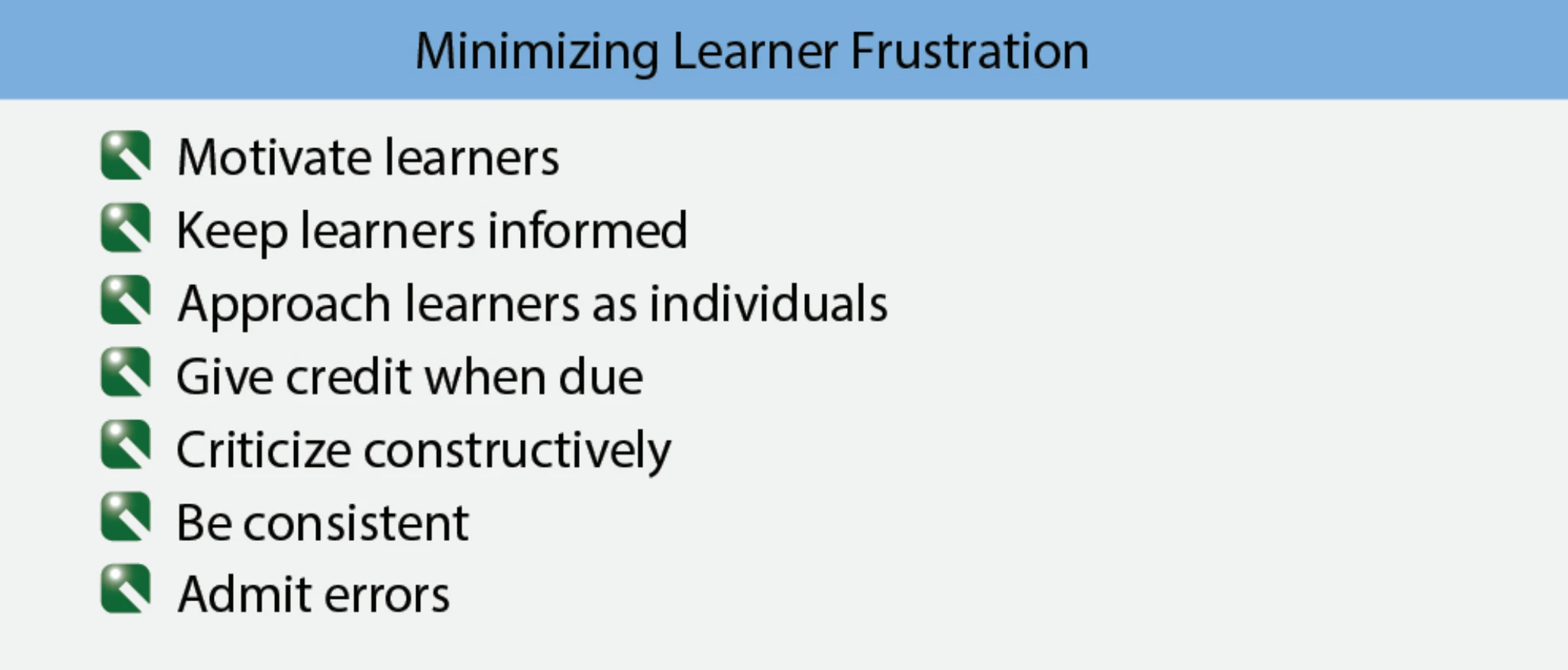
Motivate learners—more can be gained from wanting to learn than from being forced to learn. Too often, learners do not realize how a particular lesson or course can help them reach an important goal. When learners can see the benefits and purpose of the lesson or course, their enjoyment and their efforts increase.
Keep learners informed—learners feel insecure when they do not know what is expected of them or what is going to happen to them. Instructors can minimize feelings of insecurity by telling learners what is expected of them and what they can expect in return. Instructors keep learners informed in various ways, including giving them an overview of the course, keeping them posted on their progress, and giving them adequate notice of examinations, assignments, or other requirements.
Approach learners as individuals—when instructors limit their thinking to the whole group without considering the individuals who make up that group, their efforts are directed at an average personality that really fits no one. Each group has its own personality that stems from the characteristics and interactions of its members. Each individual within the group has a unique personality.
Give credit when due—when learners do something extremely well, they normally expect their abilities and efforts to be noticed. Otherwise, they may become frustrated. Praise or credit from the instructor is usually ample reward and provides an incentive to do even better. Praise pays dividends in learner effort and achievement when deserved, but when given too freely, it becomes valueless.
Criticize constructively—although it is important to give praise and credit when deserved, it is equally important to identify mistakes and failures. It does not help to tell learners they have made errors and not provide explanations. If a learner has made an earnest effort but is told that the work is unsatisfactory, with no other explanation, frustration occurs. Errors cannot be corrected if they are not identified, and if they are not identified, they will probably be perpetuated through faulty practice. On the other hand, if the learner is briefed on the errors and is told how to correct them, progress can be made.