
Chapter Appendix C
Certificates, Ratings, and Endorsements
14 CFR part 61, section 61.39(a)(1) requires that the applicant pass a knowledge test. When preparing an applicant for certification (e.g., recreational, private, commercial or instrument), the flight instructor may provide the learner with an endorsement to certify he or she has the required knowledge in accordance with 14 CFR part 61, section 61.35. Bear in mind that some additional ratings do not require a knowledge test. For information concerning additional aircraft certifications not requiring knowledge tests, refer to AC 61-65. Flight instructors (not including sport pilot instructors) take an FOI knowledge test or an aircraft subject matter test as required by 14 CFR part 61, sections 61.183(e) and 61.183(f). Added flight instructor ratings require a knowledge test on subject matter (part 61, section 61.183(f)), but the current added rating tests are shorter than the original flight instructor certification test under part 61, section 61.183(f).
Sport pilot applicants take a knowledge test required by 14 CFR part 61, section 61.307(a). The regulation requires a logbook endorsement from an authorized instructor in order to be able to take the knowledge test. 14 CFR part 61, section 61.405(a) requires a logbook endorsement from an authorized instructor for sport pilot instructor applicants. A Fundamentals of Instructing test may also apply in accordance with part 61, section 61.405(a)(1).
If the applicant fails a knowledge test, the applicant needs an endorsement from an authorized instructor who gave additional training in accordance with 14 CFR part 61, section 61.49(a) in order to retake the test. There is an unsigned endorsement provided on the knowledge test report that may be utilized by the instructor.
Additional Training and Endorsements
Flight instructors may provide training and endorsements for certificated pilots. AC 61-98, Currency Requirement and Guidance for the Flight Review and Instrument Proficiency Check, contains relevant information for certificated pilots and flight instructors for flight review required by 14 CFR part 61, section 61.56 or meeting recent flight experience requirements of section 61.57.
The AC includes general guidance in each of these areas, references to other related documents, and sample training plans that are pertinent to this type of training.
Flight Reviews
The requirements for a flight review are contained in 14 CFR part 61, section 61.56. The flight review is the aeronautical equivalent of a regular medical checkup and ongoing health improvement program.
Effective pilot refresher training should be based on specific objectives and standards. The objectives should include a thorough checkout appropriate to the pilot certificate and aircraft ratings held, and the standards should be at least those required for the issuance of that pilot certificate. Before beginning any training, the pilot and the instructor should agree fully on these objectives and standards, and, as training progresses, the pilot should be kept appraised of progress toward achieving those goals.
A flight review is an excellent opportunity for a flight instructor to review pilot decision-making (ADM) skills. To get the information needed to evaluate ADM skills, including risk management, give the pilot multiple opportunities to make decisions and ask questions about those decisions. For example, ask the pilot to explain why the alternate airport selected for a diversion exercise is a safe and appropriate choice. What are the possible hazards, and what can the pilot do to mitigate them? Be alert to the pilot’s information and automation management skills as well. For example, does the pilot perform regular “common sense crosschecks?” For more ideas on generating scenarios that teach risk management, visit www.faa.gov/regulations_policies/ handbooks_manuals/aviation/pilot_risk/. ([source link](https://www.faa.gov/regulations_policies/handbooks_manuals/aviation/pilot_risk/))
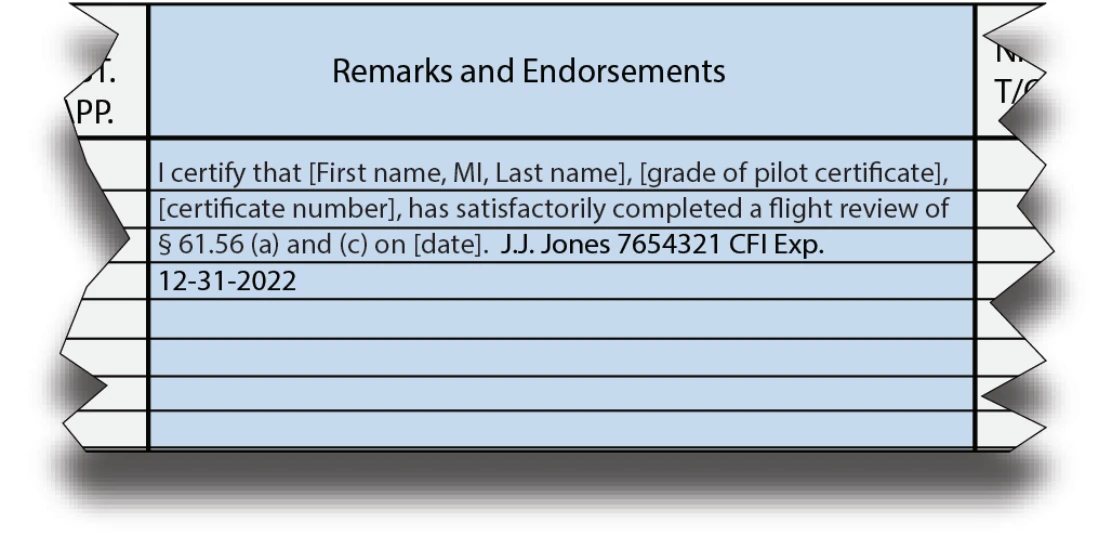
AC 61-98, Currency Requirement and Guidance for the Flight Review and Instrument Proficiency Check, provides guidance for conducting a flight review. An appendix in the AC includes a sample flight review checklist, which contains portions of 14 CFR part 61, section 61.56 and a sample endorsement. At the conclusion of a successful flight review, the logbook of the pilot should be endorsed, as recommended. [Figure C-2]
Instrument Proficiency Checks
Instrument rated pilots who fail to meet instrument currency requirements of 14 CFR part 61, section 61.57(c) for more than 6 calendar months are required by 14 CFR part 61, section 61.57(d) to complete an instrument proficiency check (IPC) in order to regain their instrument flying privileges. This does not apply to pilots meeting certain exceptions outlined in section 61.57(e).
14 CFR part 61, section 61.57(d) contains the requirements for an IPC. AC 61-98 contains guidance for the conduct of an (IPC). The Instrument Rating Airman Certification Standards (ACS) provides additional IPC information.
Aircraft and instrument ratings appropriate to the aircraft being flown need to be listed on the flight instructor’s instructor certificate as indicated in 14 CFR part 61, section 61.57(d)(2).
Instructors as Certifying Officials for Student and Remote Certificates
14 CFR part 61, section 61.85(b) and part 107, section 107.63(b)(1) allow instructors to accept a Student Pilot or Remote Pilot Application. AC 61-141, Flight Instructors as Certifying Officials for Student Pilot and Remote Pilot Applicants, has process details for instructors and applicants.
Aircraft Checkouts/Transitions
Certificated pilots depend on flight instructors for aircraft checkouts and transition training including high performance airplanes, tail wheel airplanes, motor gliders, and aircraft capable of flight at high altitudes. The flight instructor who checks out and certifies the competency of a pilot in an aircraft for which a type rating is not required by regulation accepts major responsibility for the safety of future passengers. Many newer light airplanes are comparable in performance and complexity to transport airplanes. For these, the flight instructor’s checkout should be at least as thorough as an official type rating practical test. Other considerations include: