Chapter 3
Aircraft Fabric Covering
The third way is for a manufacturer to secure approval through the Type Certificate Data Sheet (TCDS) for a new process. For example, Piper Aircraft Co. originally covered their PA-18s in cotton. Later, they secured approval to recover their aircraft with Dacron fabric. Recovering an older PA-18 with Dacron in accordance with the TCDS would be a major repair, but not an alteration as the TCDS holder has current approval for the fabric.
Advisory Circular (AC) 43.13-1, Acceptable Methods, Techniques, and Practices—Aircraft Inspection and Repair, contains acceptable practices for covering aircraft with fabric. It is a valuable source of general and specific information on fabric and fabric repair that can be used on Form 337 to justify procedures requested for a field approval. Submitting an FAA Form 337 does not guarantee a requested field approval. The FSDO inspector considers all aspects of the procedures and their effect(s) on the aircraft for which the request is being filed. Additional data may be required for approval.
Title 14 of the Code of Federal Regulations (14 CFR) part 43, Appendix A, states which maintenance actions are considered major repairs and which actions are considered major alterations. Fabric re-covering is considered a major repair and FAA Form 337 is executed whenever an aircraft is re-covered with fabric. Appendix A also states that changing parts of an aircraft wing, tail surface, or fuselage when not listed in the aircraft specifications issued by the FAA is a major alteration. This means that replacing cotton fabric with polyester fabric is a major alteration. A properly executed FAA Form 337 also needs to be approved in order for this alteration to be legal.
FAA Form 337, which satisfies the documentation requirements for major fabric repairs and alterations, requires participation of an FAA-certificated Airframe and Powerplant (A&P) mechanic with an Inspection Authorization (IA) in the re-covering process. Often the work involved in re-covering a fabric aircraft is performed by someone else, but under the supervision of the IA (IA certification requires A&P certification). This typically means the IA inspects the aircraft structure and the re-cover job at various stages to be sure STC or field approval specifications are being followed. The signatures of the IA and the FSDO inspector are required on the approved FAA Form 337. The aircraft logbook also must be signed by the FAA-certificated A&P mechanic. It is important to contact the local FSDO before making any major repair or alteration.
Approved Materials
There are a variety of approved materials used in aircraft fabric covering and repair processes. In order for the items to legally be used, the FAA must approve the fabric, tapes, threads, cords, glues, dopes, sealants, coatings, thinners, additives, fungicides, rejuvenators, and paints for the manufacturer, the holder of an STC, or a field approval.
Fabric
A Technical Standard Order (TSO) is a minimum performance standard issued by the FAA for specified materials, parts, processes, and appliances used on civil aircraft. For example, TSO-C15d, Aircraft Fabric, Grade A, prescribes the minimum performance standards that approved aircraft fabric must meet. Fabric that meets or exceeds the TSO can be used as a covering. Fabric approved to replace Grade-A cotton, such as polyester, must meet the same criteria. TSO-C15d also refers to another document, Society of Automotive Engineers (SAE) Aerospace Material Specification (AMS) 3806D, which details properties a fabric must contain to be an approved fabric for airplane cloth. Lighter weight fabrics typically adhere to the specifications in TSO-C14b, which refers to SAEAMS 3804C.
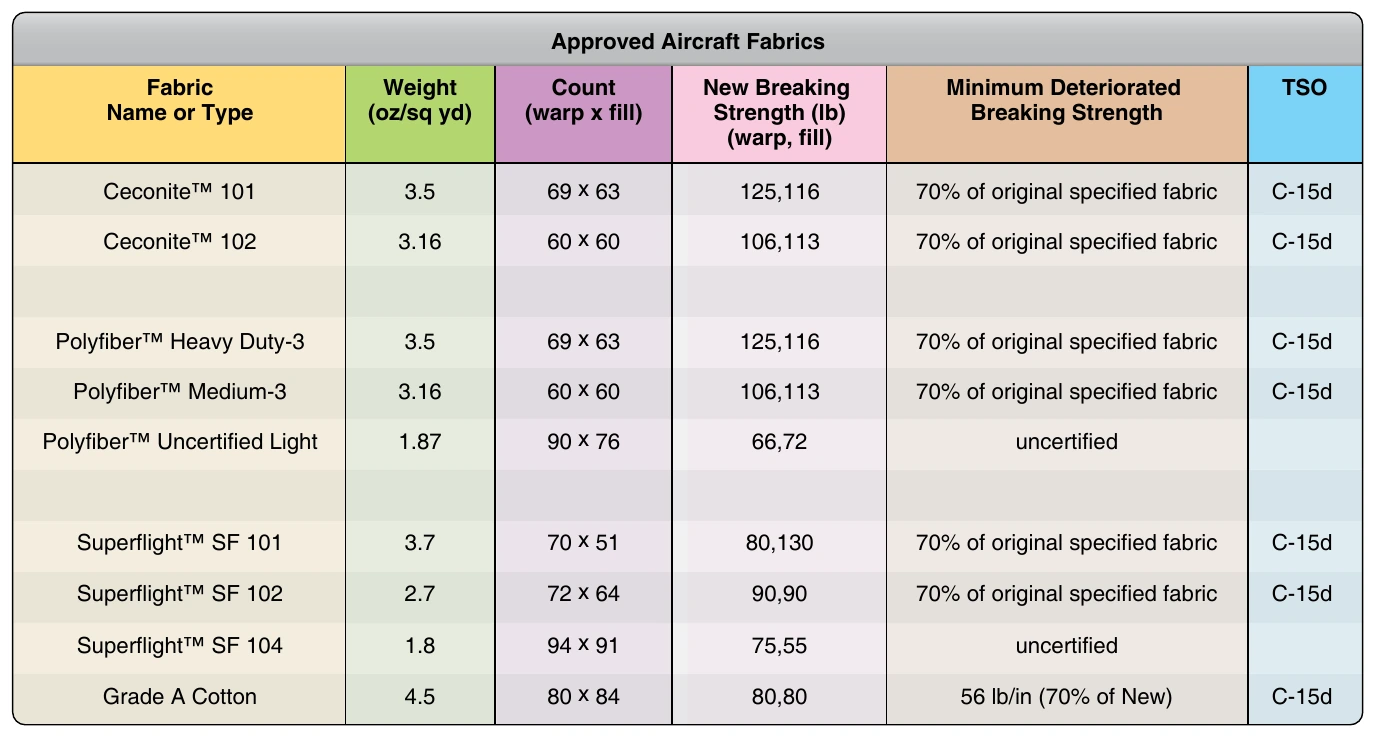
When a company is approved to manufacture or sell an approved aviation fabric, it applies for and receives a Parts Manufacturer Approval (PMA). Currently, only a few approved fabrics are used for aircraft coverings, such as the polyester fabrics Ceconite™, Stits/Polyfiber™, and Superflite™. These fabrics and some of their characteristics are shown in Figure 3-4. The holders of the PMA for these fabrics have also developed and gained approval for the various tapes, chords, threads, and liquids that are used in the covering process. These approved materials, along with the procedures for using them, constitute the STCs for each particular fabric covering process. Only the approved materials can be used. Substitution of other materials is forbidden and results in the aircraft being unairworthy.
Other Fabric Covering Materials
The following is an introduction to the supplemental materials used to complete a fabric covering job per manufacturer’s instruction or a STC.
Anti-Chafe Tape
Anti-chafe tape is used on sharp protrusions, rib caps, metal seams, and other areas to provide a smoother surface to keep the fabric from being torn. It is usually self-adhesive cloth tape and is applied after the aircraft is cleaned, inspected, and primed, but before the fabric is installed.
Reinforcing Tape
Reinforcing tape is most commonly used on rib caps after the fabric covering is installed to protect and strengthen the area for attaching the fabric to the ribs.
Rib Bracing
Rib bracing tape is used on wing ribs before the fabric is installed. It is applied spanwise and alternately wrapped around a top rib cap and then a bottom rib cap progressing from rib to rib until all are braced. [Figure 3-5] Lacing the ribs in this manner holds them in the proper place and alignment during the covering process.
Surface Tape
Surface tape, made of polyester material and often pre-shrunk, is obtained from the STC holder. This tape, also known as finishing tape, is applied after the fabric is installed. It is used over seams, ribs, patches, and edges. Surface tape can have straight or pinked edges and comes in various widths. For curved surfaces, bias cut tape is available, which allows the tape to be shaped around a radius.