Chapter 4
Aircraft Metal Structural Repair
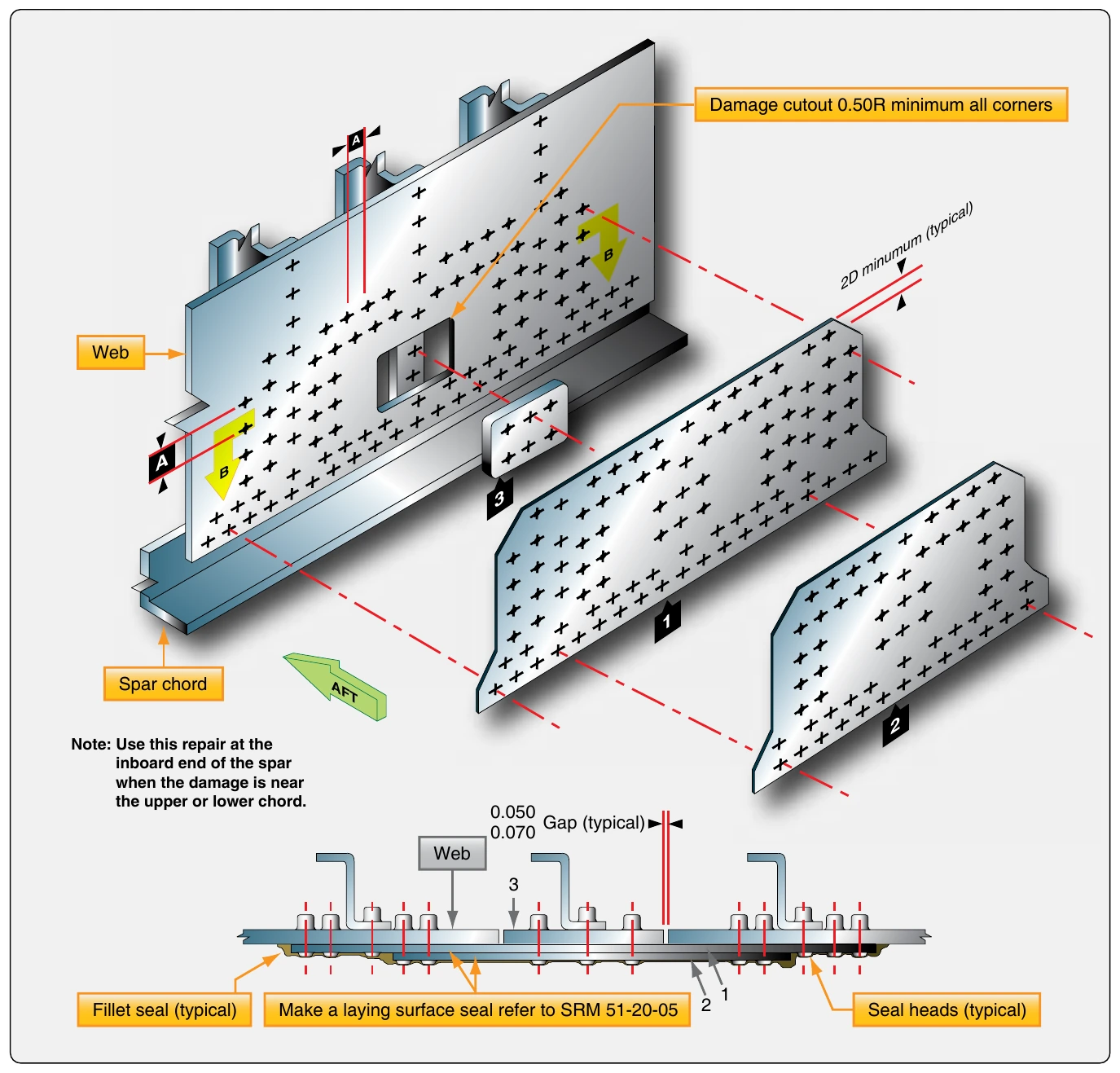
Figures 4-189 and 4-190 are examples of typical spar repairs. The damage to the spar web can be repaired with a round or rectangular doubler. Damage smaller than 1-inch is typically repaired with a round doubler and larger damage is repaired with a rectangular doubler.
- Remove the damage and radius all corners to 0.5-inch.
- Fabricate doubler; use same material and thickness. The doubler size depends on edge distance (minimum of 2D) and rivet spacing (4-6D).
- Drill through the doubler and the original skin and secure doubler with Clecos.
- Install rivets.
Rib & Web Repair
Web repairs can be classified into two types:
- Those made to web sections considered critical, such as those in the wing ribs.
- Those considered less critical, such as those in elevators, rudders, flaps, and the like.
Web sections must be repaired in such a way that the original strength of the member is restored. In the construction of a member using a web, the web member is usually a light gauge aluminum alloy sheet forming the principal depth of the member. The web is bounded by heavy aluminum alloy extrusions known as cap strips. These extrusions carry the loads caused by bending and also provide a foundation for attaching the skin. The web may be stiffened by stamped beads, formed angles, or extruded sections riveted at regular intervals along the web.
The stamped beads are a part of the web itself and are stamped in when the web is made. Stiffeners help to withstand the compressive loads exerted upon the critically stressed web members. Often, ribs are formed by stamping the entire piece from sheet stock. That is, the rib lacks a cap strip, but does have a flange around the entire piece, plus lightening holes in the web of the rib. Ribs may be formed with stamped beads for stiffeners, or they may have extruded angles riveted on the web for stiffeners.
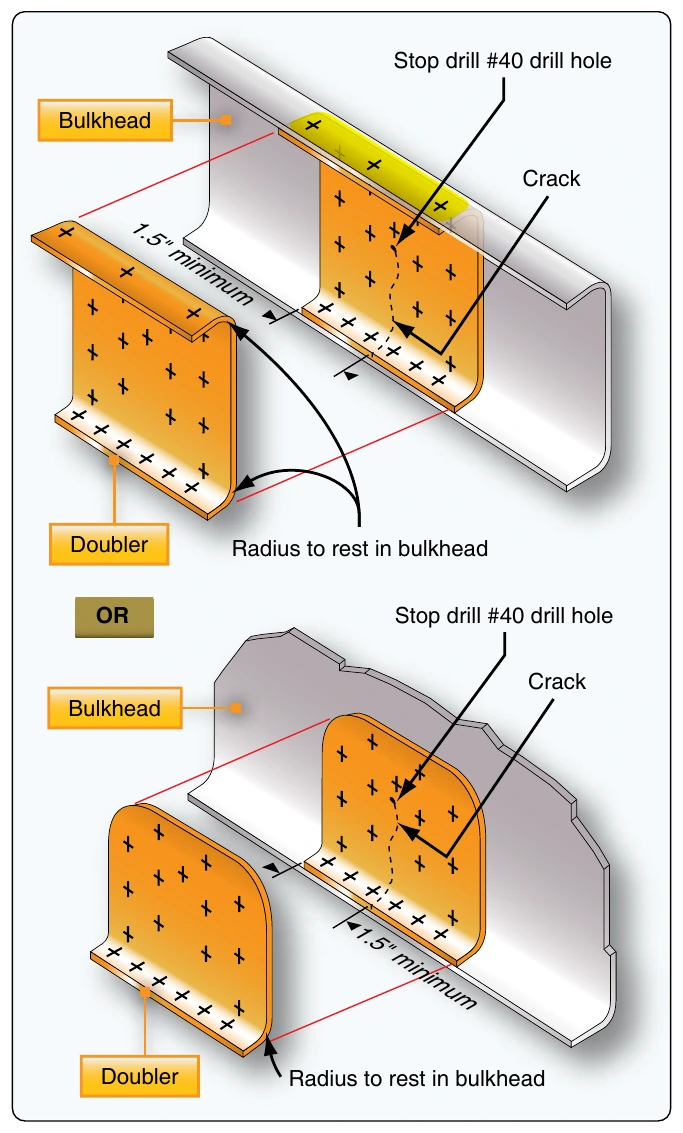
Most damages involve two or more members, but only one member may be damaged and need repairing. Generally, if the web is damaged, cleaning out the damaged area and installing a patch plate are all that is required.
The patch plate should be of sufficient size to ensure room for at least two rows of rivets around the perimeter of the damage that includes proper edge distance, pitch, and transverse pitch for the rivets. The patch plate should be of material having the same thickness and composition as the original member. If any forming is necessary when making the patch plate, such as fitting the contour of a lightening hole, use material in the “0” condition and then heat treat it after forming.
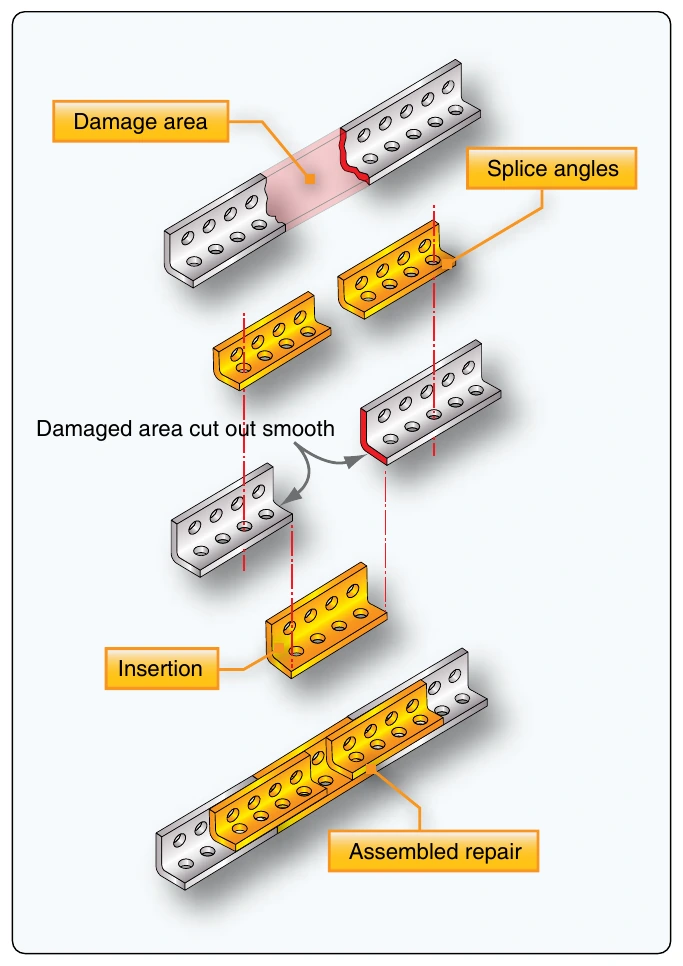
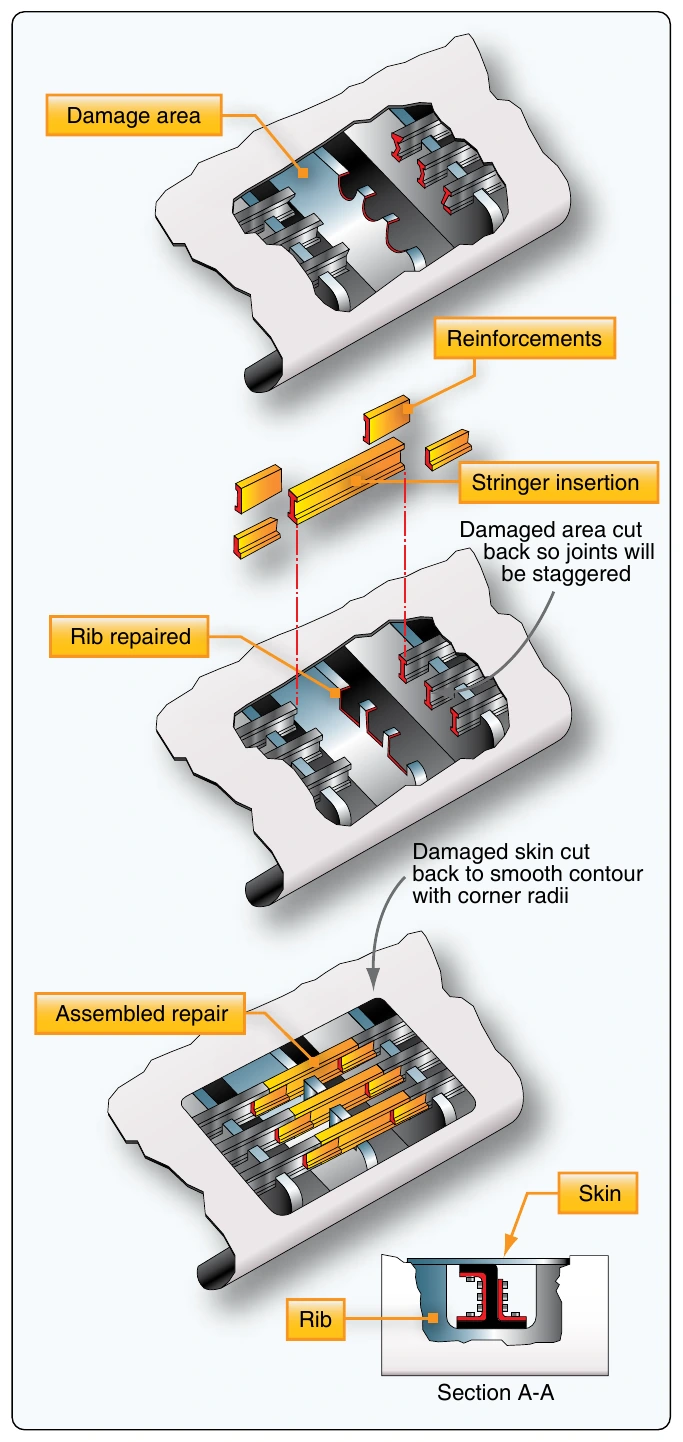
Damage to ribs and webs that requires a repair larger than a simple plate probably needs a patch plate, splice plates, or angles and an insertion. [Figure 4-191]
Leading Edge Repair
The leading edge is the front section of a wing, stabilizer, or other airfoil. The purpose of the leading edge is to streamline the forward section of the wings or control surfaces to ensure effective airflow. The space within the leading edge is sometimes used to store fuel. This space may also house extra equipment, such as landing lights, plumbing lines, or thermal anti-icing systems.
The construction of the leading edge section varies with the type of aircraft. Generally, it consists of cap strips, nose ribs, stringers, and skin. The cap strips are the main lengthwise extrusions, and they stiffen the leading edges and furnish a base for the nose ribs and skin. They also fasten the leading edge to the front spar.
The nose ribs are stamped from aluminum alloy sheet or machined parts. These ribs are U-shaped and may have their web sections stiffened. Regardless of their design, their purpose is to give contour to the leading edge. Stiffeners are used to stiffen the leading edge and supply a base for fastening the nose skin. When fastening the nose skin, use only flush rivets.
Leading edges constructed with thermal anti-icing systems consist of two layers of skin separated by a thin air space. The inner skin, sometimes corrugated for strength, is perforated to conduct the hot air to the nose skin for anti-icing purposes.
Damage can be caused by contact with other objects, namely, pebbles, birds, and hail. However, the major cause of damage is carelessness while the aircraft is on the ground.