
Chapter 5
Aircraft Welding
Landing Gear Repairs
Some components of a landing gear may be repaired by welding while others, when damaged, may require replacement. Representative types of repairable and nonrepairable landing gear assemblies are shown in
The landing gear types shown in A, B, and C of this figure are repairable axle assemblies. They are formed from steel tubing and may be repaired by any of the methods described in this chapter or in FAA Advisory Circular (AC) 43.13-1, Acceptable Methods, Techniques, and Practices—Aircraft Inspection and Repair. However, it must be determined if the assemblies were heat treated. Assemblies originally heat treated must be reheat treated after a welding repair.
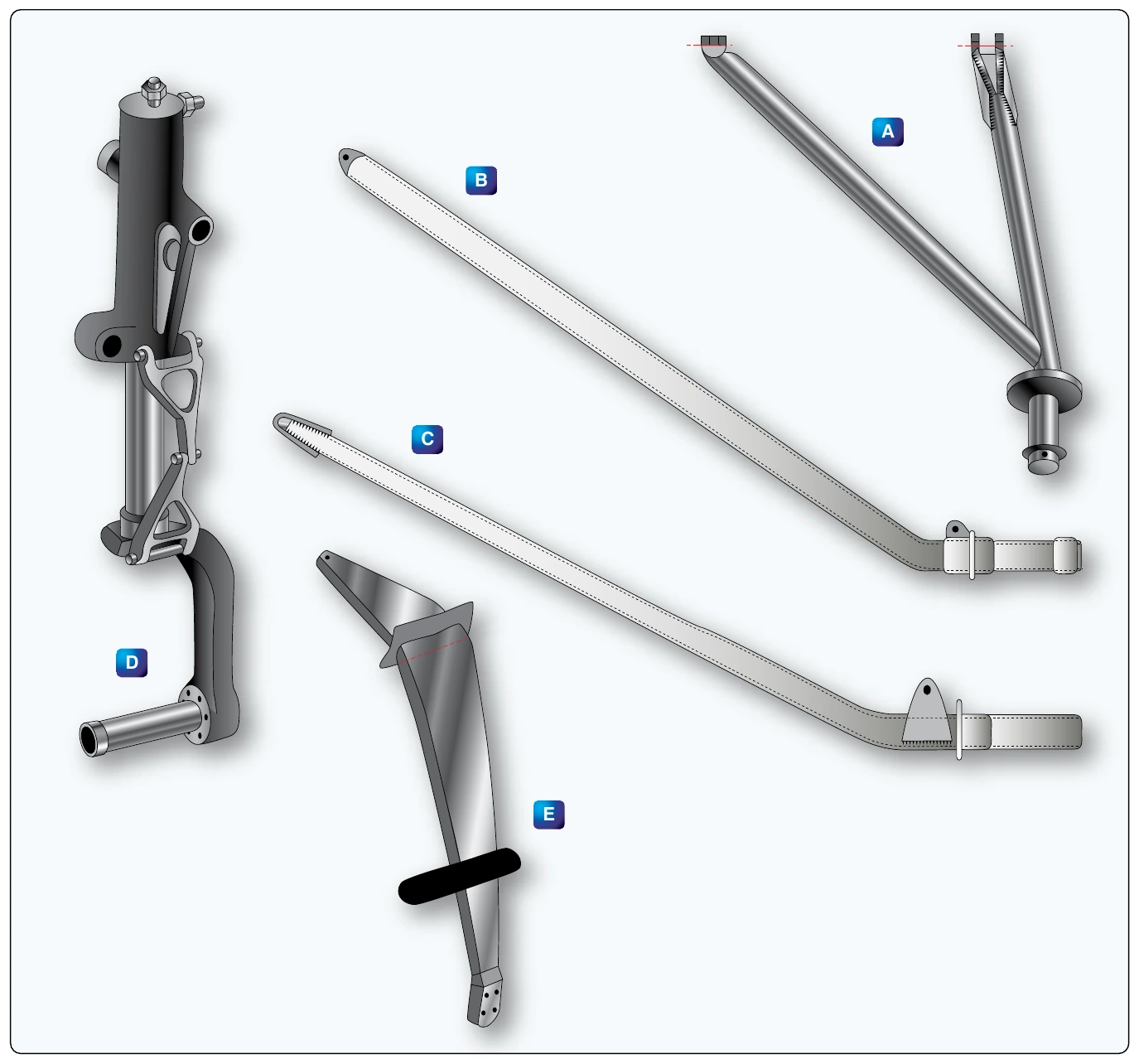
The landing gear assembly type D is generally nonrepairable for the following reasons:
- The lower axle stub is usually made from a highly heat-treated nickel alloy steel and machined to close tolerances. It should be replaced when damaged.
- During manufacture, the upper oleo section of the assembly is heat treated and machined to close tolerances to assure proper functioning of the shock absorber. These parts would be distorted by any welding repair and should be replaced if damaged to ensure the part was airworthy.
The spring-steel leaf, shown as type E, is a component of a standard main landing gear on many light aircraft. The spring-steel part is, in general, nonrepairable, should not be welded on, and should be replaced when it is excessively sprung or otherwise damaged.
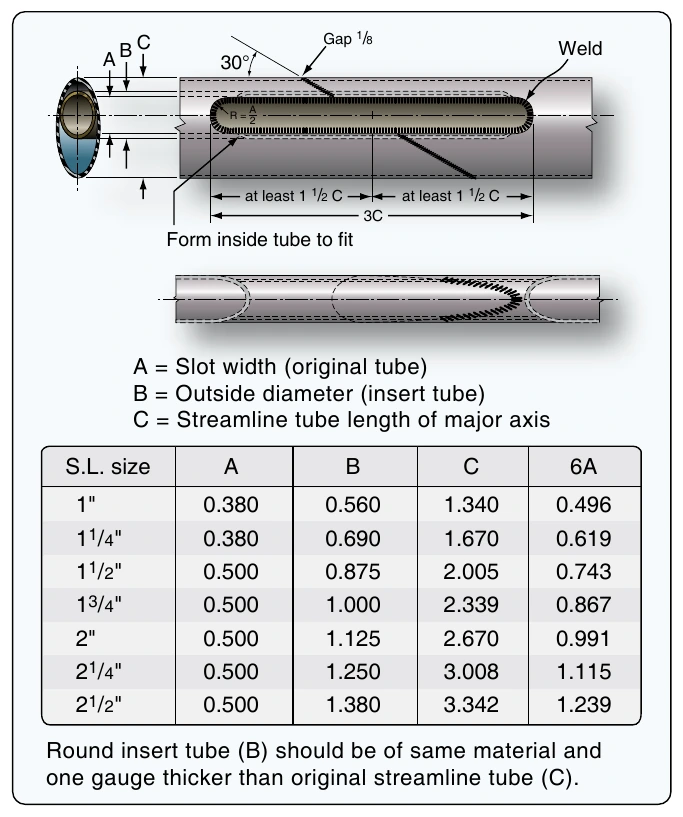
Streamline tubing, used for some light aircraft landing gear, may be repaired using a round insert tube of the same material and having a wall thickness of one gauge thicker than the original streamline tube and inserting and welding as shown in Figure 5-52.
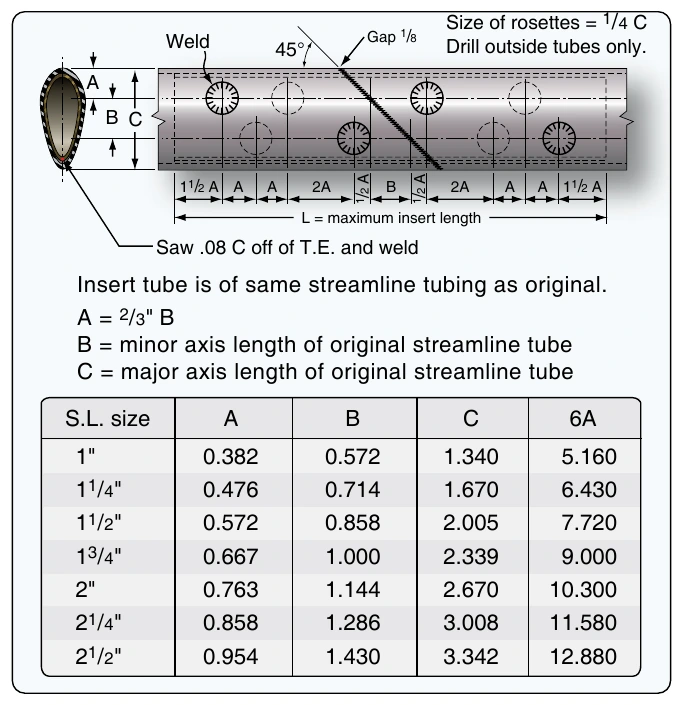
The streamline landing gear tube may also be repaired by inserting a tube of the same streamline original tubing and welding. This can be accomplished by cutting off the trailing edge of the insert and fitting it into the original tube. Once fitted, remove the insert, weld the trailing edge back together, and reinsert into the original tube. Use the figures and weld as indicated in Figure 5-53.
Engine Mount Repairs
All welding on an engine mount should be performed by an experienced welder and be of the highest quality, since vibration tends to accentuate any minor defect.
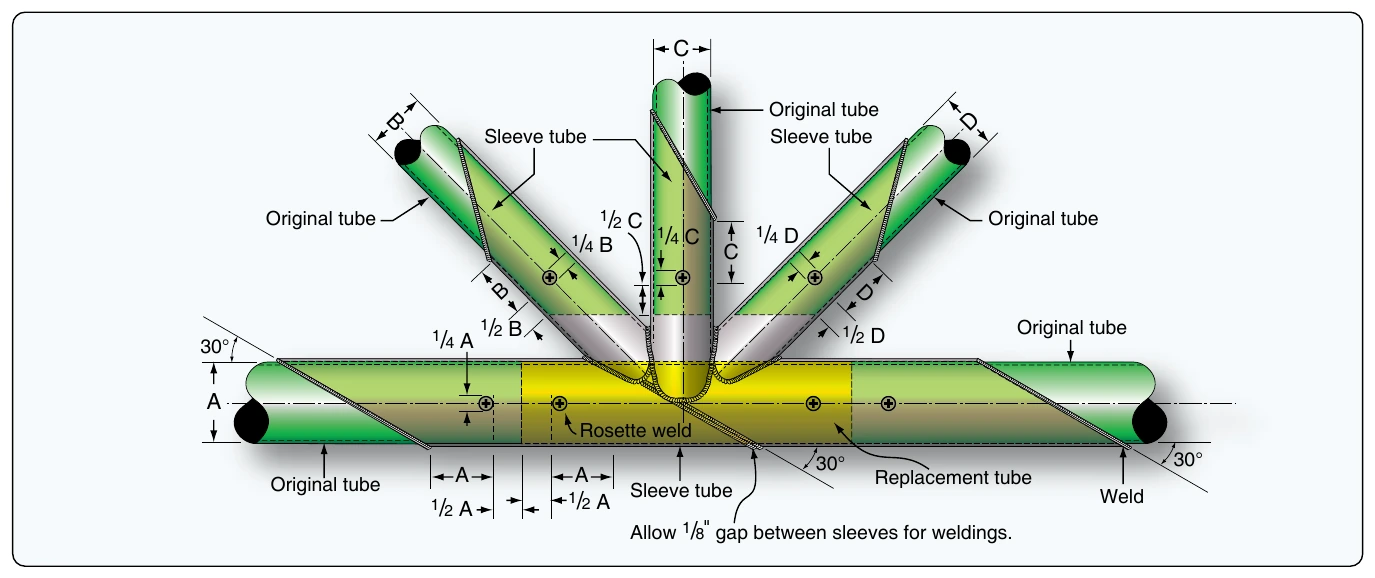
The preferred method to repair an engine mount member is by using a larger diameter replacement tube telescoped over the stub of the original member using fish-mouth and rosette welds. 30° scarf welds are also acceptable in place of the fish-mouth welds.
One of the most important aspects to keep in mind when repairing an engine mount is that the alignment of the structure must be maintained. This can be accomplished by attaching to a fixture designed for that purpose, or bolting the mount to an engine and/or airframe before welding.
All cracked welds should be ground out and only high-grade filler rod of the appropriate material should be used.
If all members of the mount are out of alignment, the mount should be replaced with one supplied by the manufacturer or with one built to conform to the manufacturer’s drawings and specifications.
Minor damage, such as a crack adjacent to an engine attachment lug, can be repaired by rewelding the ring and extending a gusset or a mounting lug past the damaged area. Engine mount rings that are extensively damaged must not be repaired unless the method of repair is specifically approved by FAA Engineering, a Designated Engineering Representative (DAR), or the repair is accomplished in accordance with FAA-approved instructions.
If the manufacturer stress relieved the engine mount after welding, the engine mount should again be stress relieved after weld repairs are made.