The satisfactory performance of any modern aircraft depends to a very great degree on the continuing reliability of electrical systems and subsystems. Improperly or carelessly installed or maintained wiring can be a source of both immediate and potential danger. The continued proper performance of electrical systems depends on the knowledge and technique of the mechanic who installs, inspects, and maintains the electrical system wires and cables.
Ohm’s Law
Ohm’s Law describes the basic mathematical relationships of electricity. The law was named after German Physicist
Formula: George Simon Ohm (1789–1854). Basically, Ohm’s Law ; states that the current (electron flow) through a conductor ; is directly proportional to the voltage (electrical pressure)
applied to that conductor and inversely proportional to the resistance of the conductor. The unit used to measure resistance is called the ohm. The symbol for the ohm is the
Formula: Greek letter omega (Ω). In mathematical formulas, the capital
letter R refers to resistance. The resistance of a conductor and the voltage applied to it determine the number of amperes
Formula: of current flowing through the conductor. Thus, 1 ohm of ; resistance limits the current flow to 1 ampere in a conductor ; to which a voltage of 1 volt is applied. The primary formula ; derived from Ohm’s Law is: E = I × R (E = electromotive ; force measured in volts, I = current flow measured in amps, ; and R = resistance measured in ohms). This formula can also
be written to solve for current or resistance:
Formula: I = E ; R ; R = E ; I
Ohm’s Law provides a foundation of mathematical formulas that predict how electricity responds to certain conditions.
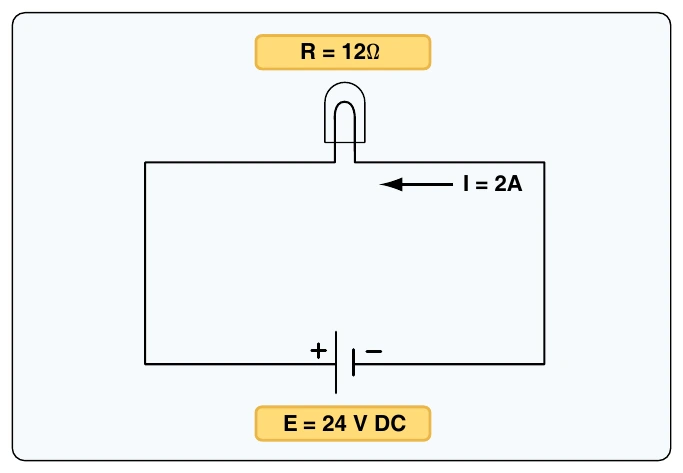
Figure 9-1. Ohm's Law used to calculate how much current a lamp will pass when connected to a 24-volt DC power source.
Formula: [Figure 9-1] For example, Ohm’s Law can be used to ; calculate that a lamp of 12 Ohms (Ω) passes a current of ; 2 amps when connected to a 24-volt direct current (DC) ; power source.
Example 1 A 28-volt landing light circuit has a lamp with 4 ohms of resistance. Calculate the total current of the circuit.
Formula: I = E ; R ; I = 28 volts ; 4Ω ; I = 7 amps
Example 2 A 28-volt deice boot circuit has a current of 6.5 amps. Calculate the resistance of the deice boot.
Formula: R = E ; I ; R = 28 volts ; 6.5 amps ; R = 4.31Ω
Formula: Figure 9-2 formula reference: Ohm's law: E = I × R; I = E / R; R = E / I, where E is voltage in volts, I is current in amperes, and R is resistance in ohms. Source text: A To find I (amperes), place thumb over I ; and divide E by R ; as indicated. ; I X R ; B To find R (ohms), place thumb over R ; R and divide as ; indicated. ; 0 ; I X R ; C To find E (volts), place thumb over E ; E and multiply as ; indicated. ; I X R
Formula: Example 3 ; A taxi light has a resistance of 4.9Ω and a total current of
Cookie Preferences
We use cookies to operate this website, improve performance, understand site traffic, and personalize your experience. Essential cookies are always active because they are required for the website to function.
Required for basic site functionality and security.
Help us understand how visitors use the website so we can improve it.
May be used for advertising, remarketing, or social media features.
You can update your choices anytime using Cookie Settings. View Privacy Policy