
Chapter 1
Safety, Ground Operations, & Servicing
Safety Around Hazardous Materials
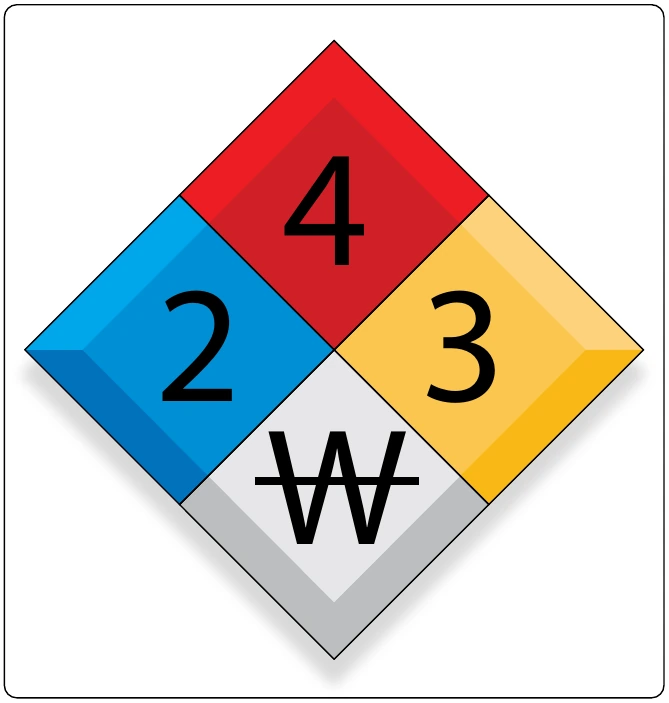
Material safety diamonds are important with regard to shop safety. These diamond-shaped labels are a simple and quick way to determine the risk of hazardous material within the associated container and, if used properly with the tags, indicate what personal safety equipment to use.
The most observable portion of the Safety Data Sheets (SDSs) (formerly known as Material Safety Data Sheet (MSDS)) label is the risk diamond. It is a four-color segmented diamond that represents flammability (red), reactivity (yellow), health (blue), and special hazard (white). In the flammability, reactivity, and health blocks, there is a number from 0 to 4. Zero represents little or no hazard to the user, while 4 means that the material is very hazardous. The special hazard segment contains a word or abbreviation to represent the specific hazard. Some examples are RAD for radiation, ALK for alkali materials, Acid for acidic materials, and CARC for carcinogenic materials. The letter W with a line through it stands for high reactivity to water. [Figure 1-2]
The SDS is a more detailed version of the chemical safety issues. These forms have the detailed breakdown of the chemicals, including formulas and action to take if personnel come in contact with the chemicals. All sheets have the same information requirements; however, the exact location of the information on the sheet may vary depending on the SDS manufacturer. These forms are necessary for a safe shop that meets all the requirements of the governing safety body, the U.S. Department of Labor Occupational Safety and Health Administration (OSHA).
Safety Around Machine Tools
Hazards in a shop increase when the operation of lathes, drill presses, grinders, and other types of machines are used. Each machine has its own set of safety practices. The following discussions are necessary to avoid injury.
The drill press can be used to bore and ream holes, to do facing, milling, and other similar types of operations. The following precautions can reduce the chance of injury:
- Wear eye protection.
- Securely clamp all work.
- Set the proper revolutions per minute (rpm) for the material used.
- Do not allow the spindle to feed beyond its limit of travel while drilling.
- Stop the machine before adjusting work or attempting to remove jammed work.
- Clean the area when finished.
Lathes are used in turning work of a cylindrical nature. This work may be performed on the inside or outside of the cylinder. The work is secured in the chuck to provide the rotary motion, and the forming is done by contact with a
- Wear eye protection.
- Use sharp cutting tools.
- Allow the chuck to stop on its own. Do not attempt to stop the chuck by hand pressure.
- Examine tools and work for cracks or defects before starting the work.
- Do not set tools on the lathe. Tools may be caught by the work and thrown.
- Before measuring the work, allow it to stop in the lathe.
Milling machines are used to shape or dress; cut gear teeth, slots, or key ways; and similar work. The following precautions can reduce the chance of injury:
- Wear eye protection.
- Clean the work bed prior to work.
- Secure the work to the bed to prevent movement during milling.
- Select the proper tools for the job.
- Do not change the feed speed while working.
- Lower the table before moving under or away from the work.
- Ensure all clamps and bolts are passable under the arbor.
Grinders are used to sharpen tools, dress metal, and perform other operations involving the removal of small amounts of metal. The following precautions can reduce the chance of injury:
- Wear eye protection, even if the grinder has a shield.
- Inspect the grinding wheel for defects prior to use.
- Do not force grinding wheels onto the spindle. They fit snugly but do not require force to install them. Placing side pressure on a wheel could cause it to explode.
- Check the wheel flanges and compression washer. They should be one-third the diameter of the wheel.
- Do not stand in the arc of the grinding wheel while operating in case the wheel explodes.
Welding must be performed only in designated areas. Any part that is to be welded must be removed from the aircraft, if possible. Repair would then be accomplished in a controlled environment, such as a welding shop. A welding shop must be equipped with proper tables, ventilation, tool storage, and fire prevention and extinguishing equipment.
Welding on an aircraft should be performed outside, if possible. If welding in the hangar is necessary, observe these precautions:
- During welding operations, open fuel tanks and work on fuel systems are not permitted.
- Painting is not permitted.
- No aircraft are to be within 35 feet of the welding operation.
- No flammable material is permitted in the area around the welding operation.
- Only qualified welders are permitted to do the work.
- The welding area is to be roped off and placarded.
- Fire extinguishing equipment of a minimum rating of 20B must be in the immediate area with 80B rated equipment as a backup.
- Trained fire watches are to be present in the area around the welding operation.
- The aircraft being welded must be in a towable condition, with a tug attached, and the aircraft parking brakes released. A qualified operator must be on the tug and mechanics available to assist in the towing operation should it become necessary to tow the aircraft. If the aircraft is in the hangar, the hangar doors are to be open.