Chapter 12
Fundamentals of Electricity & Electronics
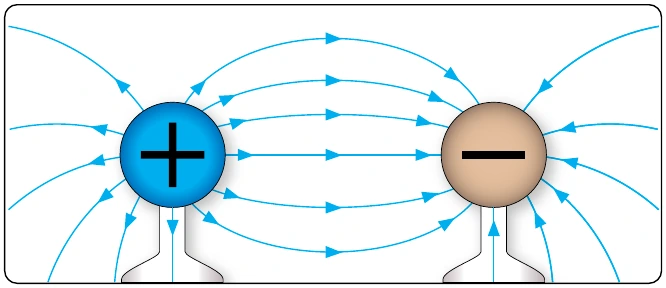
Either a positive or negative test charge can be used, but it has been arbitrarily agreed that a small positive charge is always used in determining the direction of the field. Thus, the direction of the field around a positive charge is always away from the charge because a positive test charge would be repelled. [Figure 12-9] On the other hand, the direction of the lines about a negative charge is toward the charge, since a positive test charge is attracted toward it.
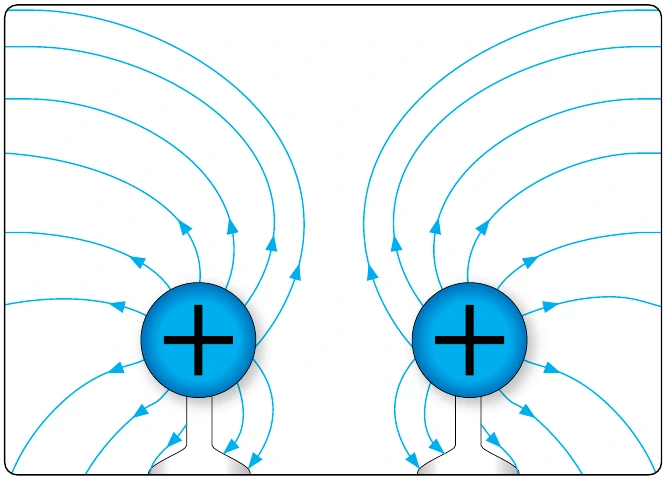
Figure 12-10 illustrates the field around bodies having like charges. Positive charges are shown, but regardless of the type of charge, the lines of force would repel each other if the charges were alike. The lines terminate on material objects and always extend from a positive charge to a negative charge. These are imaginary lines used to show the direction a real force takes.
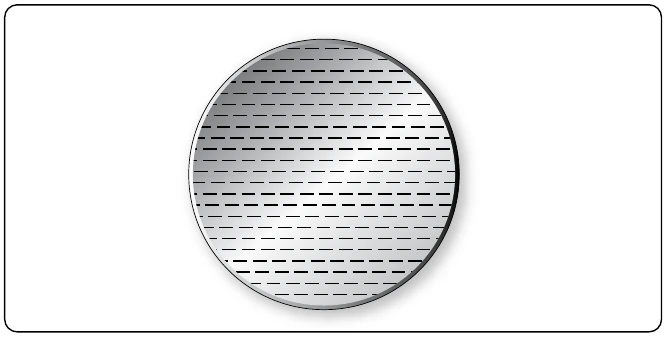
It is important to know how a charge is distributed on an object. Figure 12-11 shows a small metal disk on which a concentrated negative charge has been placed. By using an electrostatic detector, it can be shown that the charge is spread evenly over the entire surface of the disk. Since the metal disk provides uniform resistance everywhere on its surface, the mutual repulsion of electrons results in an even distribution over the entire surface.
Another example, shown in Figure 12-12, is the charge on a hollow sphere. Although the sphere is made of conducting material, the charge is evenly distributed over the outside surface. The inner surface is completely neutral. This phenomenon is used to safeguard operating personnel of the large Van de Graaff static generators used for atom smashing. The safest area for the operators is inside the large sphere, where millions of volts are being generated.
The distribution of the charge on an irregularly-shaped object differs from that on a regularly-shaped object. Figure 12-13 shows that the charge on such objects is not evenly distributed. The greatest charge is at the points, or areas of sharpest curvature, of the objects.
Electrostatic Discharge (ESD) Considerations
One of the most frequent causes of damage to a solid-state component or integrated circuits is the electrostatic discharge (ESD) from the human body when one of these devices is handled. Careless handling of line replaceable units (LRUs), circuit cards, and discrete components can cause unnecessarily time consuming and expensive repairs. This damage can occur if a technician touches the mating pins for a card or box. Other sources for ESD can be the top of a toolbox that is covered with a carpet. Damage can be avoided by discharging the static electricity from your body by touching the chassis of the removed box, by wearing a grounding wrist strap, and exercising good professional handling of the components in the aircraft. This can include placing protective caps over open connectors and not placing an ESD-sensitive component in an environment that causes damage. Parts that are ESD sensitive are typically shipped in bags specially designed to protect components from electrostatic damage.
Other precautions that should be taken with working with electronic components are:
- Always connect a ground between test equipment and circuit before attempting to inject or monitor a signal.
- Ensure test voltages do not exceed maximum allowable voltage for the circuit components and transistors.
- Ohmmeter ranges that require a current of more than one milliampere in the test circuit should not be used for testing transistors.
- Do not pry components of a circuit board.
- Power must be removed from a circuit before replacing a component.
- When using test probes on equipment and the space between the test points is very close, keep the exposed portion of the leads as small as possible to prevent shorting.
Magnetism
Magnetism is defined as the property of an object to attract certain metallic substances. In general, these substances are ferrous materials; that is, materials composed of iron or iron are magnetic to a limited degree. All other substances are considered nonmagnetic. A few of these non-magnetic substances can be classified as diamagnetic since they are repelled by both poles of a magnet.
Magnetism is an invisible force, the ultimate nature of which has not been fully determined. It can best be described by the effects it produces. Examination of a simple bar magnet similar to that illustrated in Figure 12-14 discloses some basic characteristics of all magnets. If the magnet is suspended to is referred to as North seeking rather than North, there is no conflict in referring to the pole it seeks, which is the North magnetic pole. The opposite end of the magnet, marked “S” is the South seeking end and points to the South magnetic pole. Since the earth is a giant magnet, its poles attract the ends of the magnet. These poles are not located at the geographic poles.