
Chapter 14
Human Factors
What are Human Factors?
The term “human factors” has grown increasingly popular as the commercial aviation industry realizes that human error, rather than mechanical failure, underlies most aviation accidents and incidents. Human factors science or technologies are multidisciplinary fields incorporating contributions from psychology, engineering, industrial design, statistics, operations research, and anthropometry. It is a term that covers the science of understanding the properties of human capability, the application of this understanding to the design, development, and deployment of systems and services, and the art of ensuring successful application of human factor principles into the maintenance working environment.
The spectrum of human factors that can affect aviation maintenance and work performance is broad. They encompass a wide range of challenges that influence people very differently as humans do not all have the same capabilities, strengths, weaknesses, or limitations. Unfortunately, aviation maintenance tasks that do not take into account the vast amount of human limitations can result in technical error and injuries. Figure 14-5 shows some of the human factors that affect AMTs. Some are more serious than others but, in most cases, when you combine three or four of the factors, they create a problem that contributes to an accident or incident.
Elements of Human Factors
Human factors are comprised of many disciplines. This section discusses ten of those disciplines: Clinical Psychology, Experimental Psychology, Anthropometrics, Computer Science, Cognitive Science, Safety Engineering, Medical Science, Organizational Psychology, Educational Psychology, and Industrial Engineering. [Figure 14-6]
The study and application of human factors is complex because there is not just one simple answer to fix or change how people are affected by certain conditions or situations. The overall goal of aviation maintenance human factors research is to identify and optimize the factors that affect human performance in maintenance and inspection.
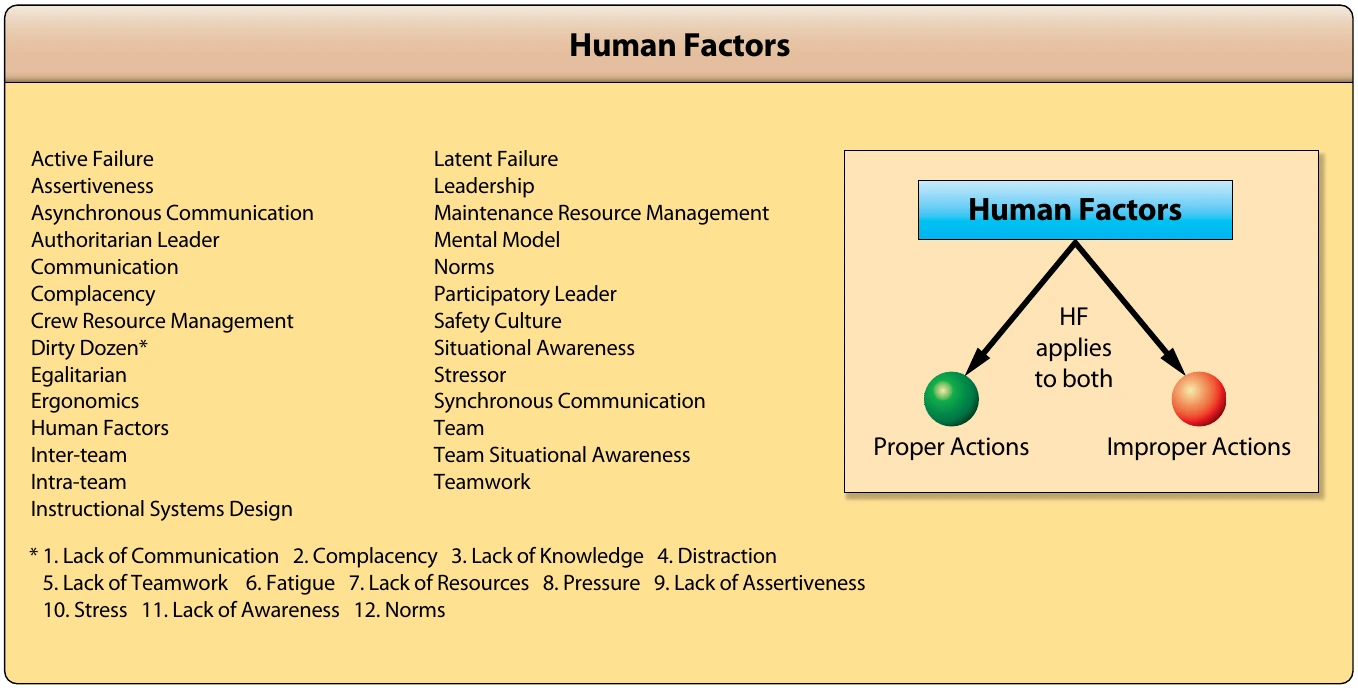
ns.
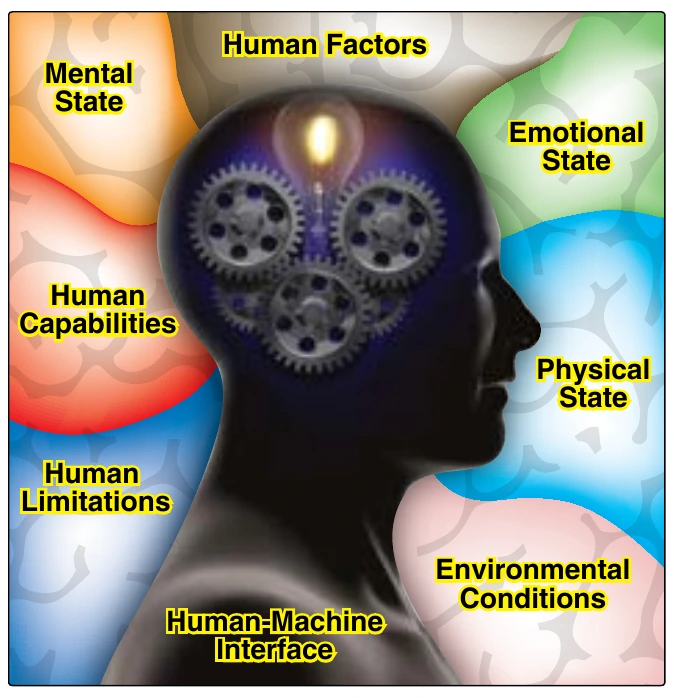
optimized by incorporating the many disciplines that affect human factors in an effort to understand how people can work more efficiently and maintain work performance.
By understanding each of the disciplines and applying them to different situations or human behaviors, we can correctly recognize potential human factors and address them before they develop into a problem or create a chain of problems that result in an accident or incident.
Clinical Psychology
Clinical psychology includes the study and application of psychology for the purpose of understanding, preventing, and relieving psychologically-based distress or dysfunction and to promote subjective well-being and personal development. It focuses on the mental well-being of the individual. Clinical psychology can help individuals deal with stress, coping mechanisms for adverse situations, poor self-image, and accepting criticism from coworkers.
Experimental Psychology
Experimental psychology includes the study of a variety of basic behavioral processes, often in a laboratory environment. These processes may include learning, sensation, perception, human performance, motivation, memory, language, d with many human factors due to their work environments.
policies and procedures, experimental studies help measure performance, productivity, and deficiencies.
Anthropometry
Anthropometry is the study of the dimensions and abilities of the human body. This is essential to aviation maintenance due to the environment and spaces that AMTs have to work with. For example, a man who is 6 feet 3 inches and weighs 230 pounds may be required to fit into a small crawl space of an aircraft to conduct a repair. Another example is the size and weight of equipment and tools. Men and women are generally on two different spectrums of height and weight. Although both are equally capable of completing the same task with a high level of proficiency, someone who is smaller may be able to perform more efficiently with tools and equipment tailored to their size. In other words, one size does not fit all and the term “average person” does not apply when employing such a diverse group of people.