
Chapter 2
Regulations, Maintenance Forms, Records, & Publications
Overview — Title 14 of the Code of Federal Regulations (14 CFR)
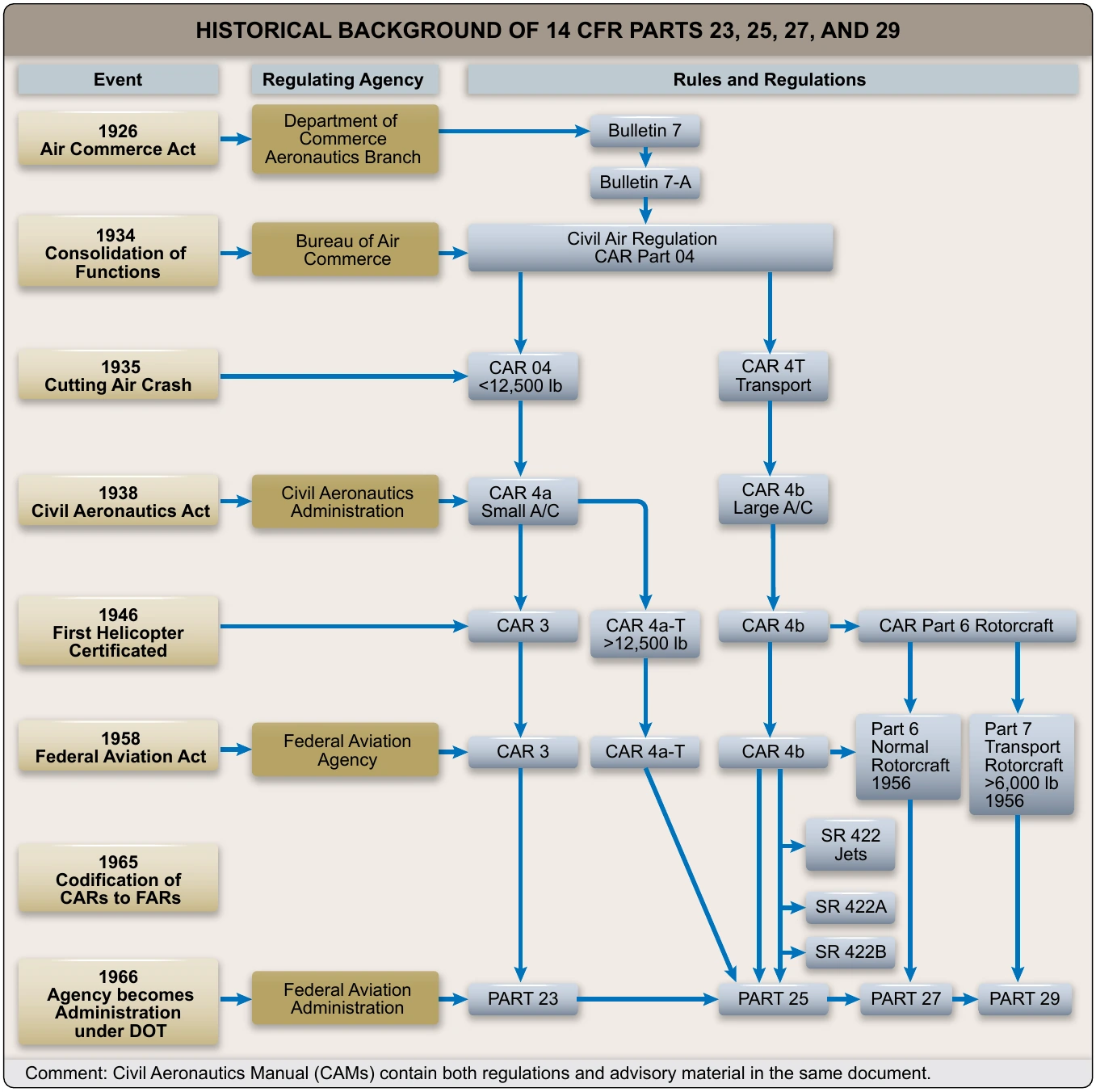
Aviation-related regulations that have occurred from 1926– 1966 are reflected in Figure 2-1. Just as aircraft continue to evolve with ever improving technology, so do the regulations, publications, forms, and records required to design, build, and maintain them.
The Federal Aviation Administration (FAA) regulations that govern today’s aircraft are found in Title 14 of the Code of Federal Regulations (14 CFR). [Figure 2-2] There are five volumes under Title 14, Aeronautics and Space. The first three volumes containing 75 active regulations address the Federal Aviation Administration. The fourth volume deals with the Office of the Secretary of the Department of Transportation (Aviation Proceedings) and Commercial Space Transportation, while the fifth volume addresses the National Aeronautics and Space Administration (NASA) and Air Transportation System Stabilization.
These regulations can be separated into the following three categories:
- Administrative
- Airworthiness Certification
- Airworthiness Operation
Since 1958, these rules have typically been referred to as “FARs,” short for Federal Aviation Regulations. However, another set of regulations, Title 48, is titled “Federal Acquisitions Regulations,” and this has led to confusion with the use of the acronym “FAR.” Therefore, the FAA began to refer to specific regulations by the term “14 CFR part XX.” Most regulations and the sections within are odd numbered, because the FAA realized in 1958 when the Civil Aeronautics Regulations were recodified into the Federal Aviation Regulations that it would be necessary to add regulations later.
Over the years, the FAA has sometimes seen the need to issue Special Federal Aviation Regulations (SFAR). [Figure 2-3] These are frequently focused very specifically on a unique situation and are usually given a limited length of time for effectiveness. Note that the SFAR number is purely a sequential number and has no relevance to the regulation it is addressing or attached to.
The remainder of this handbook focuses only on those regulations relative to airworthiness certification. There are 30 of these listed in Figure 2-4, and they are shown graphically in Figure 2-5. A significant benefit of this chart is the visual effect showing the interaction of the regulation with other regulations and the placement of the regulation relative to its impact on airworthiness. It is fundamentally important that the definition of the term “airworthy” be clearly understood.
Only recently did the FAA actually define the term “airworthy” in a regulation. (Refer to the 14 CFR part 3 excerpt following this paragraph.) Prior to this definition in part 3, the term could be implied from reading part 21, section 21.183. The term was defined in other non-regulatory FAA publications, and could also be implied from the text found in block 5 of FAA Form 8100-2, Standard Airworthiness Certificate. This certificate is required to be visibly placed on board each civil aircraft. (Refer to “Forms” presented later in this chapter.)
Title 14 CFR Part 3—General Requirements
Definitions. The following terms have the stated meanings when used in 14 CFR part 3, section 3.5, Statements about products, parts, appliances and materials.
- Airworthy means the aircraft conforms to its type design and is in a condition for safe operation.
- Product means an aircraft, aircraft engine, or aircraft propeller.
- Record means any writing, drawing, map, recording, tape, film, photograph or other documentary material by which information is preserved or conveyed in any format, including, but not limited to, paper, microfilm, identification plates, stamped marks, bar codes or electronic format, and can either be separate from, attached to or inscribed on any product, part, appliance or material.
Airworthiness can be divided into two areas: original airworthiness as depicted in Figure 2-5, and recurrent airworthiness as depicted in Figure 2-6. There are three primary regulations that govern the airworthiness of an aircraft:
- 14 CFR part 43—Maintenance, Preventive Maintenance, Rebuilding, and Alterations
- 14 CFR part 91—General Operating and Flight Rules
Although the history section that opens this chapter lations.
discusses the FAA as if it was a single unit, it is important to understand that there are various subgroups within the FAA, and each have different responsibilities of oversight in the aviation industry. These may vary by organizational chart or geographic location.
The maintenance technician interacts mostly with FAA personnel from the Flight Standards Service (AFS) and the Flight Standards District Office (FSDO) but may also have some interaction with FAA personnel from the Aircraft Certification Service (AIR).