
Chapter 2
Regulations, Maintenance Forms, Records, & Publications
- Good parts with good paperwork.
- Good parts with bad paperwork.
- Bad parts with “good” (bogus) paperwork.
- Bad parts with bad paperwork.
The first of those listed represents properly authorized parts that, when properly installed, are approved parts, and the aircraft can be returned to service. The last of those listed represent unauthorized and unapproved parts. The technician should be alert for these and must never install them on an aircraft.
The center two categories of parts represent suspected unapproved parts. If either the physical part or the paperwork associated with the part is questionable, it is best to contact the shop foreman, shift supervisor, or the assigned quality individual to discuss your concerns. Suspected unapproved parts (SUPs) should be segregated and quarantined until proper disposition can be determined. Contacting the manufacturer of the product is a good way to start gathering the facts concerning the product in question. Refer to the current version of AC 21-29, Detecting and Reporting Suspected Unapproved Parts, for additional information.
Current contact information for submitting a SUP Notification can be found at www.faa.gov.
Other FAA Documents
Advisory Circulars (AC)
AC refers to a type of publication offered by the FAA to provide guidance for compliance with airworthiness regulations. They provide guidance such as methods, procedures, and practices acceptable to the Administrator for complying with regulations. ACs may also contain explanations of regulations, other guidance material, best practices, or information useful to the aviation community. They do not create or change a regulatory requirement. The AC system became effective in 1962. It provides a single, uniform, agency-wide system that the FAA uses to deliver advisory material to FAA customers, industry, the aviation community, and the public.
Unless incorporated into a regulation by reference, the content of ACs are not binding on the public. ACs are issued in a numbered-subject system corresponding to the subject areas of the FARs (14 CFR, Chapter 1, Federal Aviation Administration) and Chapter 3, Commercial Space Transportation, Federal Aviation Administration, Department of Transportation, Parts 400–450. An AC is issued to provide guidance and information in a designated subject area or to show a method acceptable to the Administrator for complying with a related federal aviation regulation.
Because of their close relationship to the regulations, ACs are arranged in a numbered system that corresponds to the subject areas of the CFRs. In some series, consecutive numbers may ations (14 CFR).
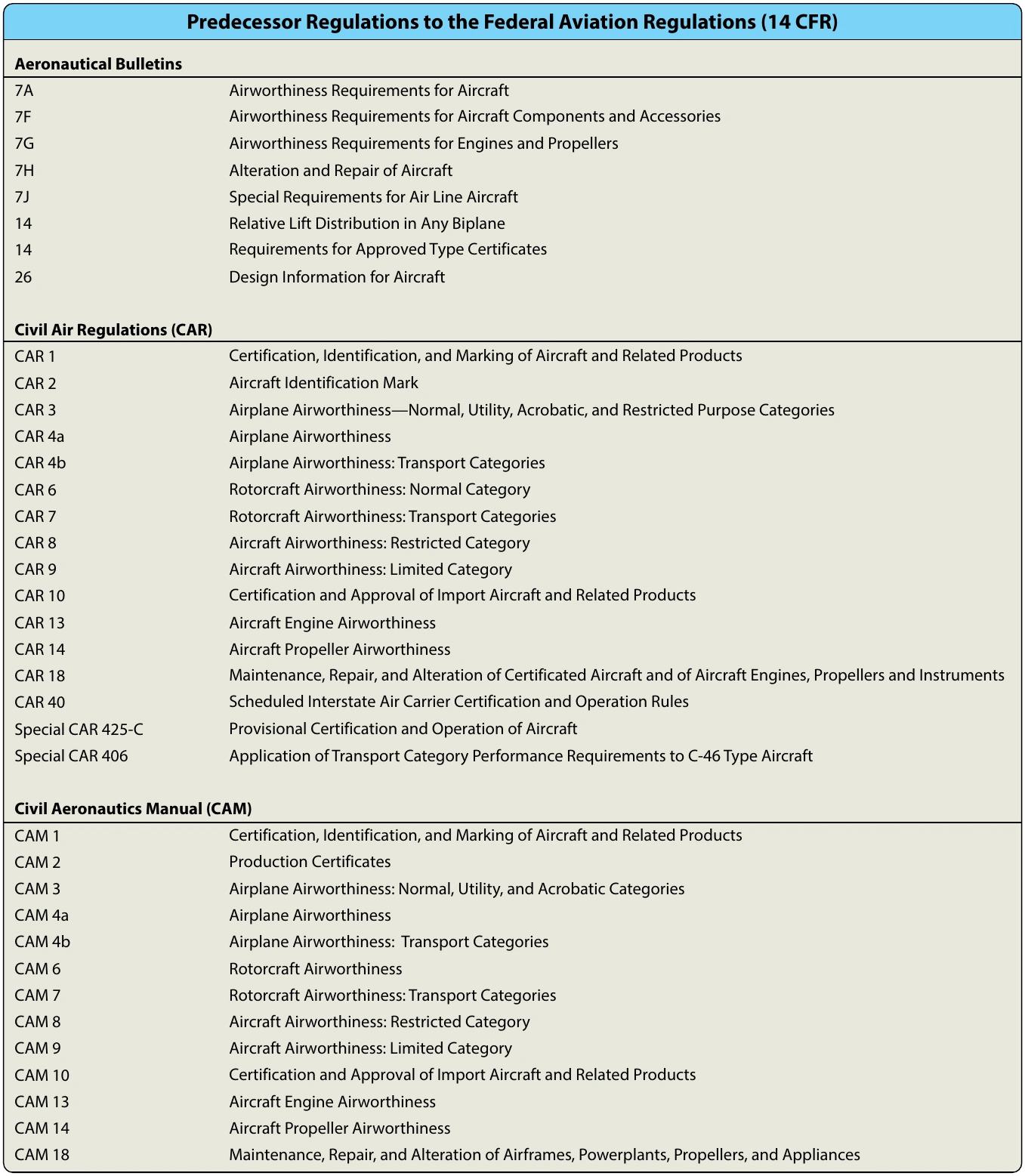
be missing. These numbers were either assigned to ACs still in preparation that will be issued at a later date or were assigned to ACs that have been canceled.
The AC Numbering System
There are three parts to an AC number, as in 25-42-C.
- The first part of the number identifies the subject matter area of the AC. This corresponds to the part of the FAA’s regulations. In the above example, this would be part 25.
- The second part of the number, beginning with the dash, is a sequential number within each subject area. In the above example, this would be the 42nd AC relating to part 25.
- The third part of the number is a letter assigned by the originating office showing the revision sequence if an AC is revised. The first version of an AC does not have a revision letter. In the above example, this is third revision, as designated by the “C.” [Figure 2-12]
Airworthiness Directives (AD)
In accordance with 14 CFR part 39, the FAA issues ADs in response to deficiencies and/or unsafe conditions found in aircraft, engines, propellers, or other aircraft parts. ADs require that the relevant problem must be corrected on all aircraft or aircraft parts using the same design. ADs are initiated as either proposed, corrective, or final (telegraphic) via the Federal Register. The Federal Register is the official daily publication of the United States Government. It is the printed method of informing the public of laws that are enacted or will be enacted. Electronic versions of ADs are available from the Federal Register and from the Regulatory and Guidance Library. You can search by manufacturer, model, or AD number. All ADs are “incorporated by reference” into part 39 and are considered final. ADs must be followed to remain in compliance with the FAA. Once an AD has been issued, a person/company is authorized to use the affected aircraft or part only if it has been corrected in accordance with the AD.
Types of Airworthiness Directives (AD)
Three types of ADs are issued:
- Notice of Proposed Rulemaking (NPRM), followed by a Final Rule
- Final Rule; Request for Comments
- Emergency ADs