
Chapter 2
Regulations, Maintenance Forms, Records, & Publications
- Information in item 1 comes directly from the aircraft dataplate, except for the tail number. That is to be compared to the aircraft registration form.
- Information in item 2 reflects the name and address listed on AC Form 8050-3, Certificate of Registration.
- Item 3 is used when there is no existing approved data for the intended repair or alteration. In that case, the technician can request that the local FSDO Principal Maintenance Inspector (PMI) review the data and then grant a field approval, shown by completing and signing this area. In many cases, this block is blank because the technician has found, used, and made reference to data already approved by the FAA.
- Item 4—If the repair or alteration is being done to the aircraft airframe, no entry is required since the data is identical to that in item 1. However, if the repair or alteration is being done to an engine, a propeller, or other appliance, entries must include the appropriate make, model, and serial number information.
- Item 5 should have “X” marked in either the “Repair” or the “Alteration” column.
- Item 6—Enter appropriate data as specified and check the proper box in B. The technician is encouraged to carefully read the preprinted statement in subparagraph D prior to signing this section.
- Item 7 must be completed by the IA or authorized individual from the repair station.
- Item 8 (on the reverse side) is for the description of the work accomplished. It must include a reference to the approved data used to conduct the required maintenance.
The form must be completed at least in duplicate, with the original provided to the owner/operator and a copy to the local FSDO within 48 hours of completing the maintenance and RTS. If the FAA Form 337 is used to document additional fuel tanks in the cabin or cargo, then an additional copy must be signed and in the aircraft at all times. Maintenance facilities and mechanics are encouraged to make a copy for their own records.
Records
Making Maintenance Record Entries
Title 14 of the CFR part 43, sections 43.9 and 43.11 require the technician to make appropriate entries of maintenance actions or inspection results in the aircraft maintenance record. How long those records must be kept is defined in 14 CFR part 91, section 91.417.
Whenever maintenance, preventive maintenance, rebuilding, or alteration work occurs on an aircraft, airframe, aircraft engine, propeller, appliance, or component part, a maintenance record entry must be created. The importance of compliance with this requirement cannot be overemphasized. Complete and organized maintenance logs for an aircraft can have significant (and usually positive) effect during the buy/sell negotiations of an aircraft. On the other hand, poorly organized and incomplete logs can have a detrimental effect upon the selling price of an aircraft.
Temporary Records—14 CFR Part 91 Section 91.417(a)(1) and (b)(1)
These are records that must be kept by the owner until the work is repeated, superseded, or 1 year has transpired since the work was performed. These are typically records referring to maintenance, preventive maintenance, alteration, and all inspections. They include a description of the work performed (or reference to the FAA-accepted data); the date of completion; and the name, signature and certificate number of the person doing the RTS.
Permanent Records—14 CFR Part 91, Section 91.417(a)(2) and (b)(2)
These records must be retained by the owner during the time they operate the aircraft. They are transferred with the aircraft at the time of sale. Typically, these are documents relating to total time in service, current status of life-limited parts, time since last overhaul, current inspection status, current status of applicable AD notes, and major alteration forms as required by 14 CFR part 43, section 43.9.
Electronic Records
During the last 25 years, the field of aviation maintenance has seen a significant change in the documentation requirements for aircraft and related parts. Nowhere is that change seen as revolutionary as the introduction of electronic data and record retention. Just as the arrival of the personal computer placed the possibility of the power and versatility of a computer in the hands of the average person, it made it available to the maintenance technician. Initially some technicians developed their own programs for listing data (TCDS, AD notes, and so forth), but soon commercially available programs were developed. Basically, these were developed by either one of the following two groups:
- Computer literate persons who felt the aviation industry could benefit from the computer
- Aviation professionals who felt the aviation industry must benefit from the computer
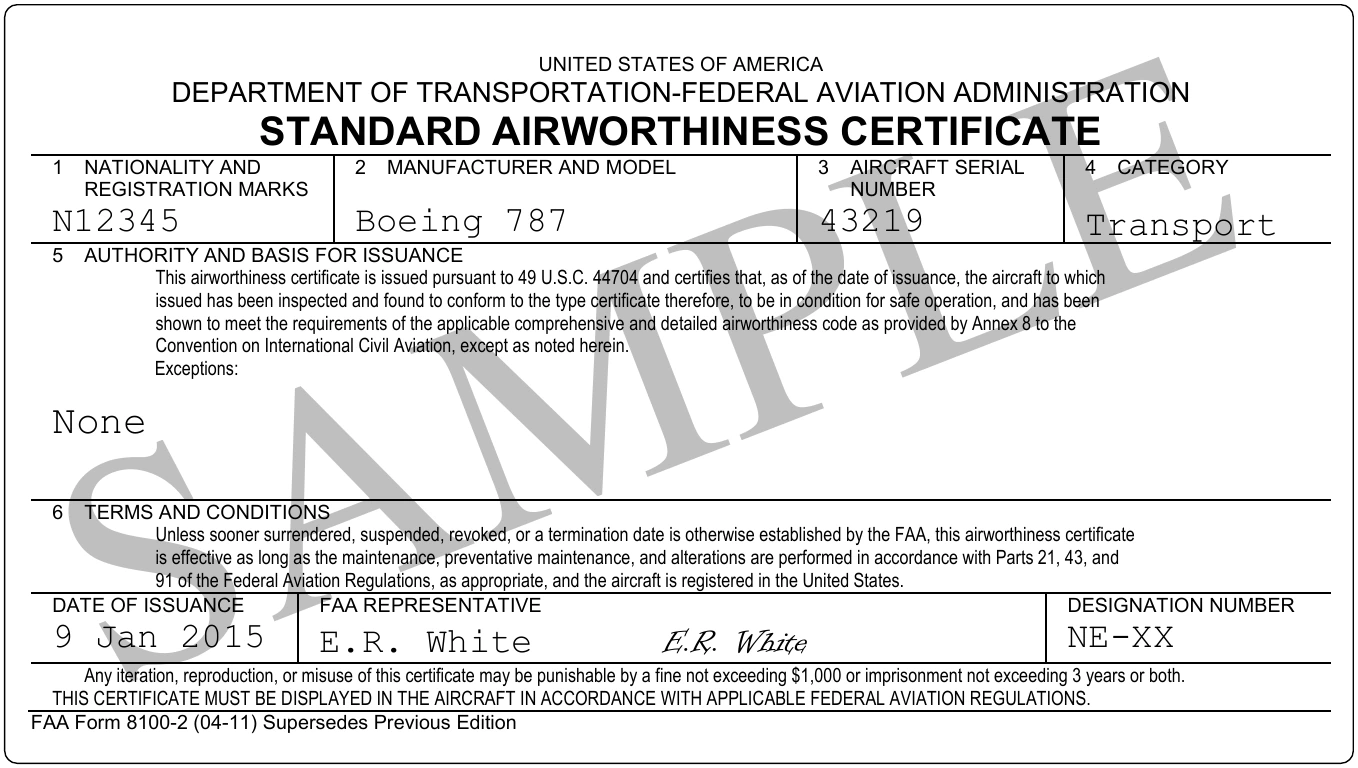
Some of those initial programs were either not very user friendly (if developed by computer wizards) or not “very sophisticated” (if developed by the maintenance technician). Today, there is a mixture of these various database programs. A review of the advertisement section in any current aviation maintenance magazine offers required to conduct proper maintenance, inspections, and data recording (logbook entries, AD compliance history, length of component time in service, and so forth) desired to improve the efficiency of the technician. UNITED STAT DEPARTMENT OF TRANSPORTATION Although some large shSopTs aAndN ceDrtAifieRd rDep aAir IsRtatWionsO mRayT have1 a sNeApTaIrOaNteA LgITroYu ApN oDf people r2espMoAnNsUiFbAleC TfoUrR “ErRe cAoNrDd Ms aOnDdE researcRhE,” G ItShTeR ApTrIoOfNe sMsAioRnKaSl maintenance technician must be awNa5re4 o3f 2th1e benefits of thesJe asycstkemsso. nSo m4e7 faGc-to4rs to 5 AUTHORITY AND BASIS FOR ISSUANCE consider whenT hrise aviriweowrthiinnegss ace rstiyficsattee ims is saureed: p ursuant to 49 U.S.C. 44704 and issued has been inspected and found to conform to the type certificate
- What iss htohwen ttoy mpeiceta thl es riezqeu iroemf ethntes oaf ithrec raappfltic tahblae tc ommparienhetensnivaen acnde d is beingC odnovennteio no onn? In (teir.nea.t,io lneals Csi vtihl Aavniat i1on2,,e5xc0e0pt paso nuotnedd hse,r emin.o re Exceptions: than 12,000? Mixed?)
- NoDonees the program have built-in templates for the aircraft being worked on?
- 6 WTEhRaMt SF AANAD f CoOrmNDs I(TiIfO aNnSy ) are available in the program? Unless sooner surrendered, suspended, revoked, or a termination date
- Does iti sh eaffvecetiv ae auss loenrg- afsr itheen mdaliynt etneamncep, lparetvee nttoat ieven mteairn ttehnaen cdea, atnad 91 of the Federal Aviation Regulations, as appropriate, and the aircraft DAfToEr O thF eIS fSoUrAmN CoEr must dFaAtaA bReE PdRirEeScEtlNyT eAnTItVeEre d onto the 9 foFrme?b 2015 E.J. Smith
- CAnayn it eirta ticoan,l rceuprloadutect iown, eoir gmhistu sae nofd th bis acelartinficcaete mdaayt abe? punishable by a fi THIS CERTIFICATE MUST BE DISPLAYED IN THE AIRCRAFT IN ACCORDANCE W •F AA FDorome s8 1i0t 0h-2a v(0e4 -a1d1)eSquupaetres ewdeosr dPr esveiaourcs hE dciatiopna bilities?
- Is it networkable?
- Are the updates sent via U.S. mail or downloaded from
tandthae Irndter nAet?irworthiness Certific
- What is the maximum number of aircraft that the
us Products and Articles (Face system can handle?