
Chapter 2
Regulations, Maintenance Forms, Records, & Publications
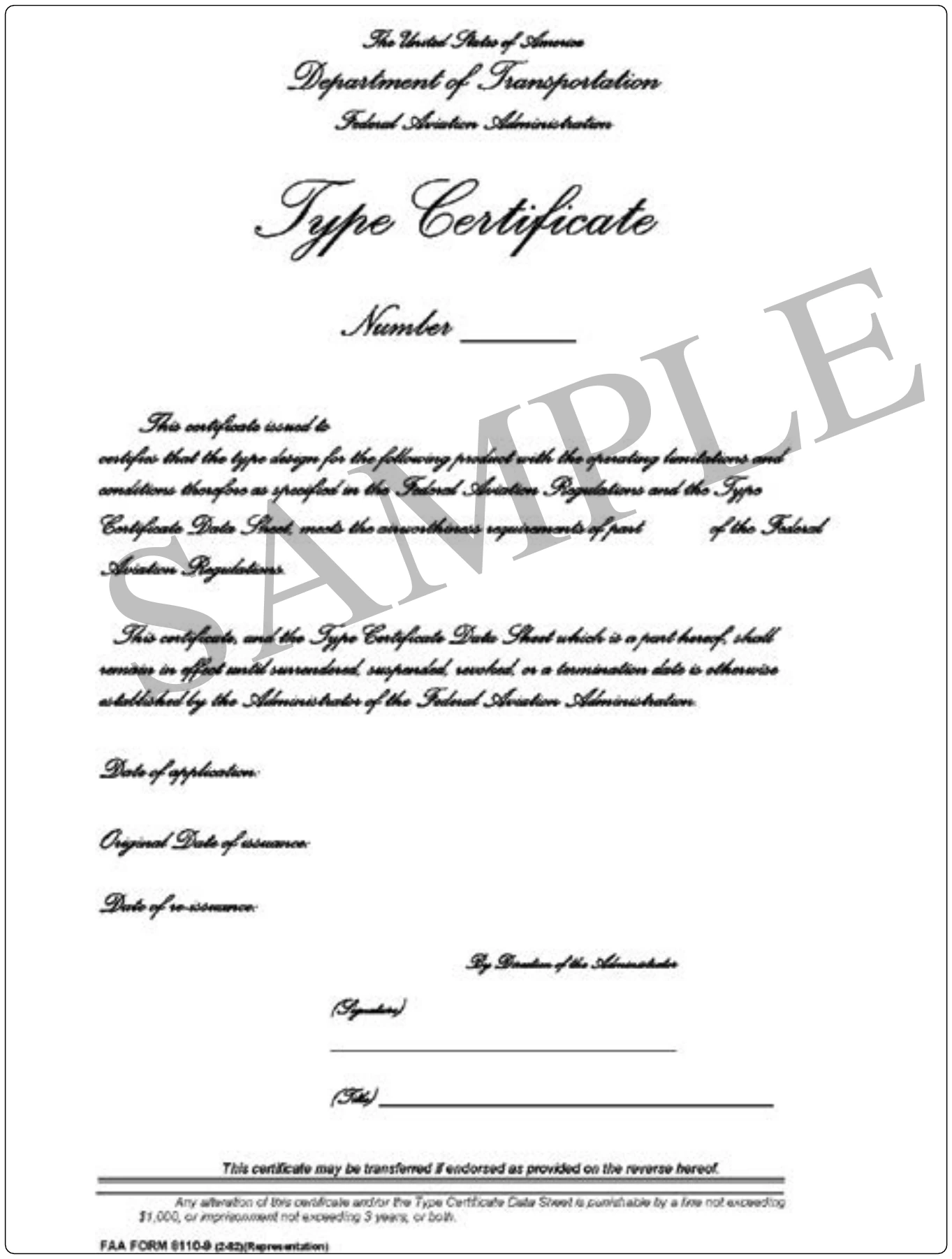
FAA Form 8130-7, Special Airworthiness Certificate, may be issued to authorize the operation of an aircraft in the following categories: [Figure 2-21]
- Primary
- Restricted
- Multiple
- Limited
- Light-sport
- Provisional
Airworthiness certificates may be issued by either FAA personnel or FAA designees. Refer to 14 CFR part 183, sections 183.31 and 183.33. The certificate must not only be on board the aircraft (14 CFR part 91, section 91.203(a) (1)), but must also be “displayed at the cabin or flight deck entrance so that it is legible to the passengers or crew” 14 CFR part 91, (section 91.203(b)). Since the ability to obtain this certificate is based upon the requirement to inspect the aircraft to determine that it conforms to type design and is in condition for safe operation, it can also be revoked by the FAA if either of those two requirements ceases to exist.
Aircraft Registration
Aircraft must be registered in the United States if the aircraft is not registered under the laws of a foreign country and is owned by either a citizen of the United States, a foreign citizen lawfully admitted to the United States, or a corporation organized in and doing business under U.S. laws and primarily based in the United States. This registration is accomplished by using FAA Form 8050-1, Aircraft Registration Application. The aircraft registration form is available online at www.faa.gov. The aircraft owner can mail in completed copy, and keep a copy of the form as temporary authority to operate the aircraft after the fee and evidence of ownership have been mailed or delivered to the Registry. When carried in the aircraft with an appropriate current airworthiness certificate or a special flight permit, a copy of this completed application provides authority to operate the aircraft in the United States for up to 90 days.
and a registration fee. A successful review of the application results in the issuance of AC Form 8050-3, Certificate of Aircraft Registration. (Note the AC prefix.)
14 CFR section 91.203(a)(2) requires that either the pink copy of the application or the actual certificate of registration be on board the aircraft during its operation.
If the registration is ever lost or damaged, it may be replaced by contacting the FAA Aircraft Registration Branch and providing them with the aircraft specific data, including make, model, N-number, and serial number. A replacement certificate fee and an explanation of the reason for the replacement certificate are also required.
Radio Station License
A radio station license is required if the aircraft is equipped with radios, and the aircraft is planned to be flown outside the boundaries of the United States. A radio station license is not required for aircraft that are operated domestically. (A major change occurred on February 8, 1996, when the telecommunications Act of 1996 was signed into law.)
The Federal Communications Commission (FCC) formerly required that any communication transmitter installed in aircraft be licensed. These FCC licenses were valid for 5 years. This is not an FAA requirement. FAA inspectors who conducted ramp inspections and detected an expired radio station license were not required to notify the FCC, nor could they issue a violation to the owner/operator. Simply informing the operator of the expired radio station license was their only responsibility.
FSGA 96-06, a Flight Standards Information Bulletin (FSIB) for General Aviation (FSGA) titled “Elimination of Aircraft Radio Station Licenses” became effective on July 8, 1996. Although that FSIB had an effectivity of only 1 year, the elimination of the requirement for aircraft used only in domestic operations continues.
FAA Form 337—Major Repair and Alteration
Refer to the current issue of AC 43.9-1, Instructions for Completion of FAA Form 337 for help completing FAA Form 337, Major Repair and Alteration (Airframe, Powerplant, Propeller, or Appliance). [Figure 2-22]
As the name clearly states, this form is to be used whenever major repairs or alterations are accomplished on an aircraft. The only exception would be that 14 CFR part 43, Appendix B, allows for a certificated repair station to RTS an aircraft after a major repair by using a signed and dated work order and a signed maintenance release.