
Aviation Training Experts™

handbook

Aviation Maintenance Technician Handbook–General

FAA-H-8083-30B Version 2023

Chapter 3

Mathematics in Aviation Maintenance

the radius is equal to one-half of the diameter.

Example: A flight deck instrument gauge has a round
Formula: face that is 3 inches in diameter. What is the area of ; the face of the gauge? From Figure 3-10 for N = 3, the ; answer is 7.0686 square inches. This is calculated by: ; If the diameter of the gauge is 3 inches, then the ; radius = D/2 = 3/2 = 1.5 inches.
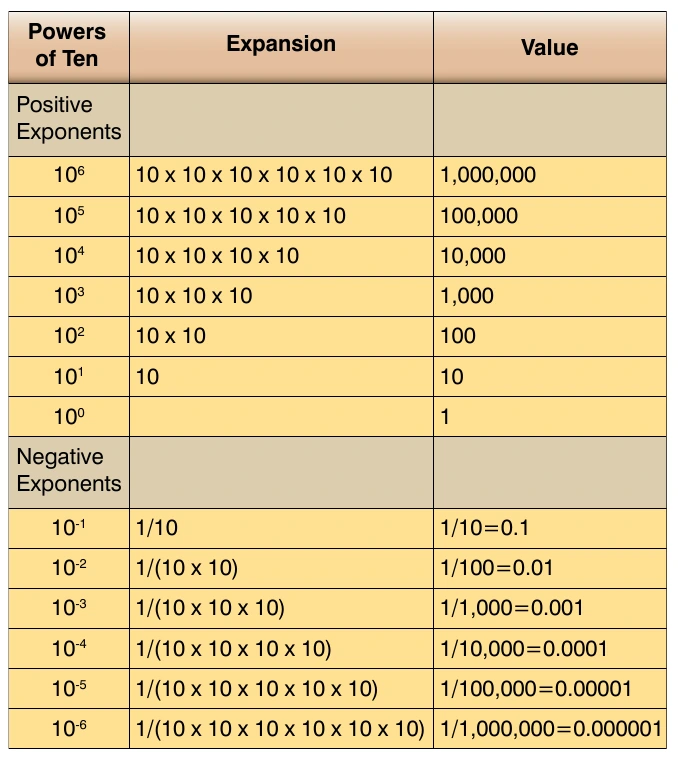
Figure 3-9. Powers of ten.

Scientific Notation

Scientific notation is used as a type of shorthand to express very large or very small numbers. It is a way to write numbers so that they do not take up as much space on the page. The format of a number written in scientific notation has two parts. The

Formula: first part is a number greater than or equal to 1 and less than ; 10 (for example, 2.35). The second part is a power of 10 (for ; example, 106). The number 2,350,000 is expressed in scientific ; notation as 2.35 × 10⁶. It is important that the decimal point

is always placed to the right of the first digit. Notice that very large numbers always have a positive power of 10 and very small numbers always have a negative power of 10.

Formula: Example: The velocity of the speed of light is over 186,000 ; miles per second (mps). This can be expressed as 1.86 × 10⁵ mps

in scientific notation. The mass of an electron is approximately

Formula: 0.000,000,000,000,000,000,000,000,000,911 grams. This can ; be expressed in scientific notation as 9.11 × 10⁻²⁸ grams.

Converting Numbers from Standard Notation to Scientific Notation

Example: Convert 1,244,000,000,000 to scientific notation as follows. First, note that the decimal point is to the right of the last zero. (Even though it is not usually written, it is assumed to be there.)
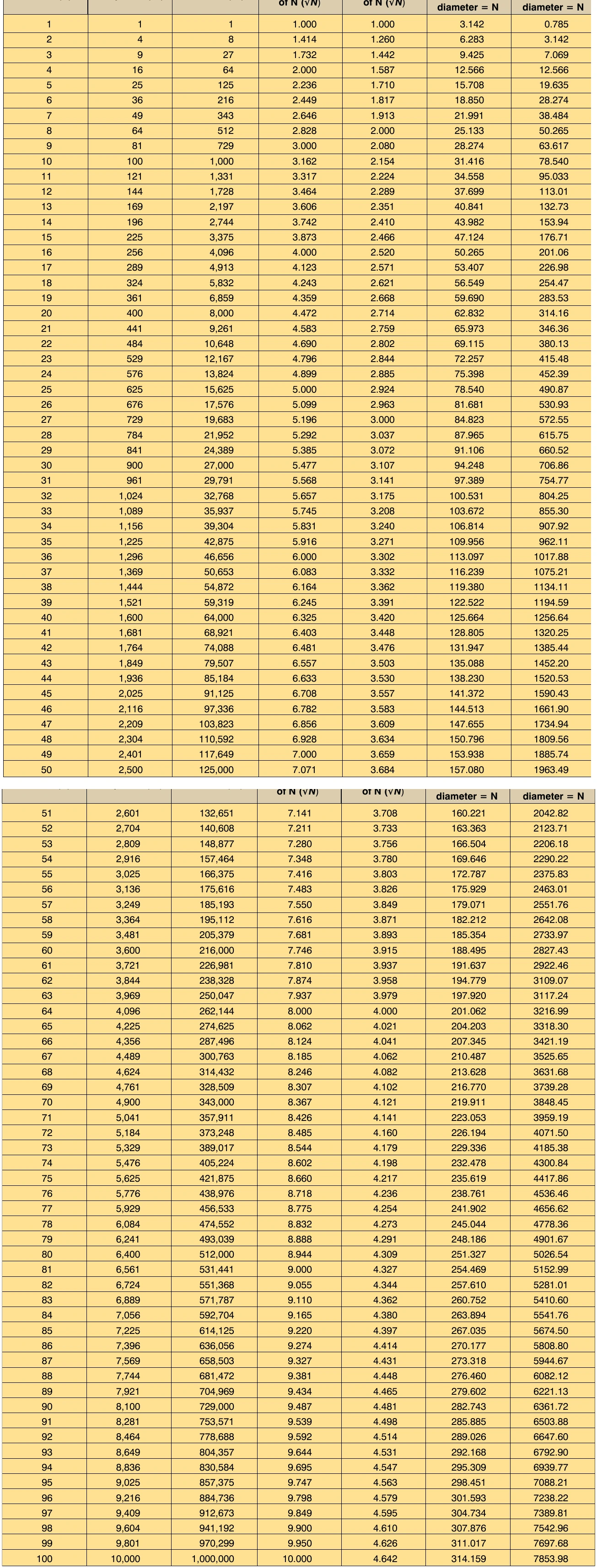
Figure 3-10. Functions of numbers.
Formula: 1,244,000,000,000 = 1,244,000,000,000.0

To change to the format of scientific notation, the decimal point must be moved to the position between the first and

Formula: second digits. In this case, it is between the 1 and the 2. Since ; the decimal point must be moved 12 places to the left to get ; there, the power of 10 is 12. Remember that large numbers ; always have a positive exponent. Therefore, 1,244,000,000,000 ; = 1.244 × 10¹² when written in scientific notation.

Example: Convert 0.000000457 from standard notation to scientific notation. To change to the format of scientific notation, the decimal point must be moved to the position between the first and second numbers, which in this

Formula: case is between the 4 and the 5. Since the decimal point ; must be moved 7 places to the right to get there, the ; power of 10 is −7. Remember that small numbers (those ; less than one) have a negative exponent. Therefore, ; 0.000000457 = 4.57 × 10⁻⁷ when written in scientific notation.

Converting Numbers from Scientific Notation to Standard Notation