Aviation Training Experts™

handbook

Aviation Maintenance Technician Handbook–General

FAA-H-8083-30B Version 2023

Chapter 3

Mathematics in Aviation Maintenance

Example: Convert the decimal number 233 to a binary number.

Formula: Start by subtracting 128 (the largest place value from the ; 8-bit binary number) from 233. ; 233 – 128 = 105 A “1” is placed in the first binary ; digit space: 1XXXXXXX.

Continue the process of subtracting the binary number place values:
Formula: 105 – 64 = 41 A “1” is placed in the second binary ; digit space: 11XXXXXX. ; 41 – 32 = 9 A “1” is placed in the third binary ; digit space: 111XXXXX.
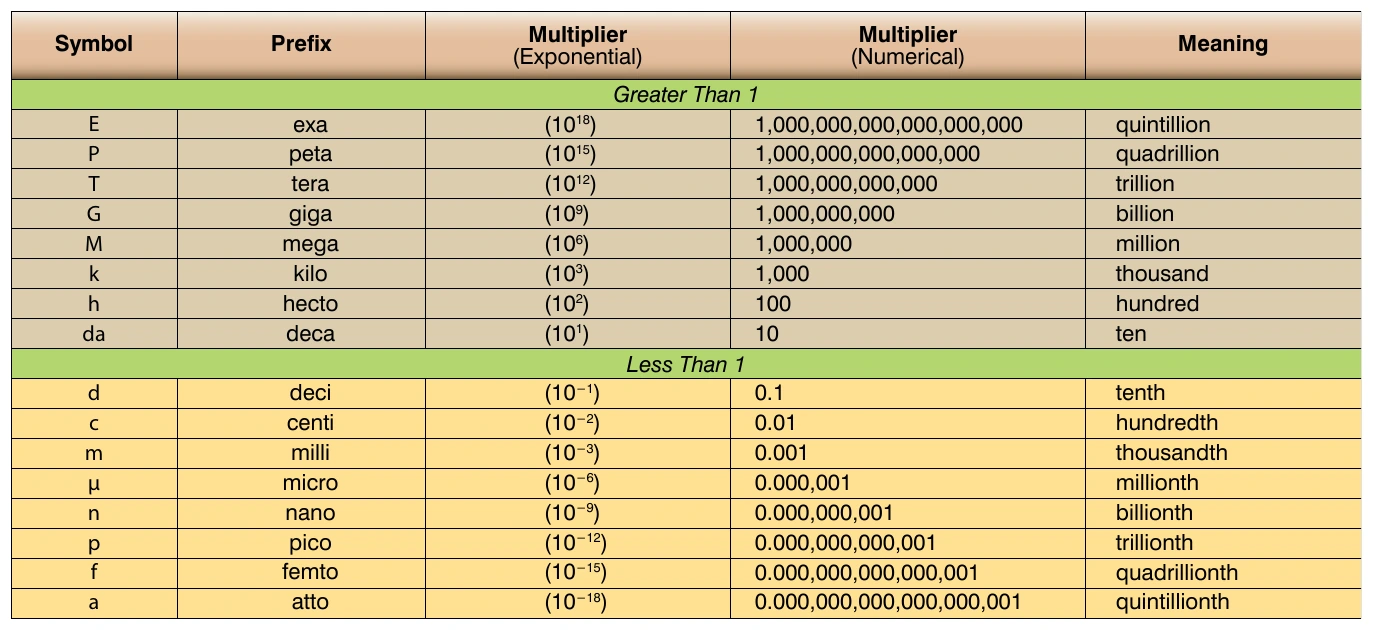
Figure 3-33. Names and definitions of metric prefixes.

Since 9 is less than 16 (the next binary place value), a “0” is placed in the fourth binary digit space, 1110XXXX.

Formula: 9 – 8 = 1 A “1” is placed in the fifth binary ; digit space: 11101XXX ; Since 1 is less than 4 (the next binary place value), a 0 is

placed in the sixth binary digit space: 111010XX.

Since 1 is less than 2 (the next binary place value), a 0 is placed in the seventh binary digit space: 1110100X.

Formula: 1 – 1 = 0 A “1” is placed in the eighth binary ; digit space: 11101001.

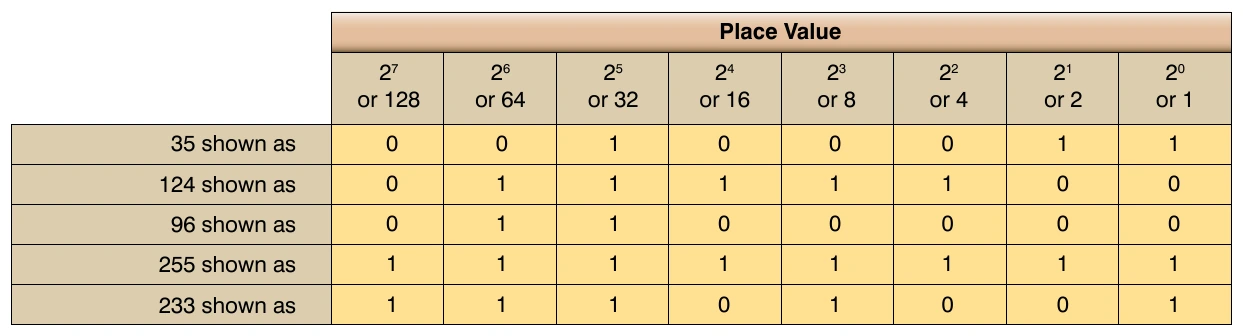
The decimal number 233 is equivalent to the binary number 11101001, as shown in Figure 3-36.

Three additional decimal number to binary number conversions are shown in Figure 3-36.

Figure 3-34. Binary system.
Figure 3-35. Place value chart.
Figure 3-36. Conversion from decimal number to binary number.